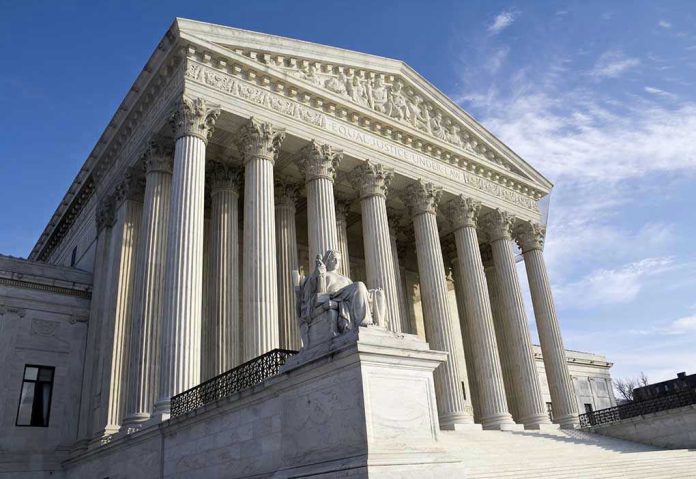
Gunfire outside a Supreme Court justice’s home turned out to be something far more mundane—and far more revealing about how fast our narratives outrun the facts.
Story Snapshot
- Police and federal marshals responded to gunfire outside Justice Sonia Sotomayor’s residence after an apparent late-night carjacking attempt, not a confirmed assassination bid.
- Washington, D.C., police and the United States Marshals Service say there is no indication the suspect even knew whose home he was near.[1][2]
- Media and commentators quickly framed the scare as another chapter in “political violence against justices,” despite a thin evidentiary record.
- At the same time, the Supreme Court is rewriting the rules for when police can burst into your home in the name of “emergency aid,” raising real stakes for ordinary citizens.[1][5]
Gunfire, a Supreme Court Justice, and a Very Different Threat
Police logs for the incident outside Justice Sonia Sotomayor’s Washington, D.C., residence tell a blunt story: two deputy United States Marshals sitting in parked vehicles shortly after 1 a.m., an eighteen-year-old suspect approaching with a handgun, and an apparent attempt to carjack one of the vehicles.[1][2] Both marshals opened fire, striking the suspect, who survived and was arrested on charges including armed carjacking and carrying a pistol without a license, according to the Metropolitan Police Department.[1][2]
Officials described the suspect’s approach from a nearby minivan, gun in hand, tapping on the marshal’s window before the shooting.[2] The United States Marshals Service confirmed the deputies were part of the dedicated unit assigned to protect Supreme Court justices’ residences, and public records place the gunfire outside the apartment where Justice Sotomayor lives.[1][2] Investigators so far say the carjacking “appears to be random” and that there is no evidence the suspect targeted the justice or even knew she lived there.[1][2]
Why the “Assassination Attempt” Frame Outran the Facts
News consumers heard the sequence in a very different order: “gunfire,” “Supreme Court justice,” “home,” “security detail.” Once those words stack together, the mind writes its own script. Early reporting often leans into worst-case framings, while crucial details—like the suspect’s actual charges and motive evidence—lag behind. Here, the available public record contains no warrant affidavit, no investigation memo, and no trajectory map showing shots aimed at the residence itself.[1][2]
That evidentiary gap matters. Real assassination plots against justices do exist: the Brett Kavanaugh case involved a heavily armed suspect who traveled cross-country, admitted on a 911 call that he came “to kill a specific United States Supreme Court justice,” and carried tools clearly suited for a break-in and abduction.[3][4] By contrast, the Sotomayor episode currently looks like D.C.’s grimly ordinary reality: young offenders, popular SUV targets, and armed carjacking in the early-morning hours.[1][2] Conflating the two inflates fear without adding clarity.
Police Power, Emergencies, and Your Front Door
The irony is that while attention fixes on a half-understood street shooting, the Supreme Court itself is quietly deciding what police may do at your front door whenever they invoke “emergency.” In Case v. Montana, officers entered a man’s home without a warrant or probable cause, claiming they needed to render aid after a suspected self-inflicted gunshot.[1][5] The encounter ended with police shooting the occupant inside his own house, turning the “welfare check” into the very danger they claimed to prevent.[1][5]
Arguments in that case revolve around whether the Fourth Amendment’s protection of the home yields whenever an officer asserts a concern about injury, or whether there must be an objectively reasonable basis—essentially probable cause—to believe someone inside truly faces immediate harm.[1][5] Conservative instincts about limited government and the sanctity of the home point in one direction: emergency aid should be narrowly defined, not a blank check for intrusive entry. If police can bypass warrants on thin pretexts, every loud noise or anonymous tip becomes a potential gateway into your living room.
How High-Profile Fear Distorts Everyday Risk
Stories that link Supreme Court justices, gunfire, and “our democracy under threat” tend to dominate headlines, but they often obscure two more grounded realities. First, urban residents face daily exposure to crime patterns—carjackings, robberies, stray gunfire—that rarely draw national outrage unless they brush against elite institutions.[1][2] Second, the legal doctrines quietly crafted around those emergencies will not just govern future threats to justices; they will govern how law enforcement treats your home, car, and family.
Common sense, and traditional American skepticism of government overreach, suggest a middle path. Treat genuine, evidenced plots against public officials with the seriousness they deserve, but demand concrete proof before labeling every nearby shot as political terror. At the same time, insist that courts require real, articulable facts before officers kick in doors under the banner of “emergency.” Misplaced fear makes us accept power grabs we would otherwise reject. Fear aimed at the wrong target is not just wasted—it is dangerous.
Sources:
[1] Web – Report: Police Rush to Supreme Court Justice’s Home After Gunfire …
[2] Web – CASE v. MONTANA | Supreme Court – Law.Cornell.Edu
[3] Web – Shooting prompts Supreme Court to tighten emergency warrantless …
[4] Web – Shooting prompts Supreme Court to tighten emergency warrantless …
[5] Web – Justices Reject “Moment of Threat” Rule in Police Shooting Case