

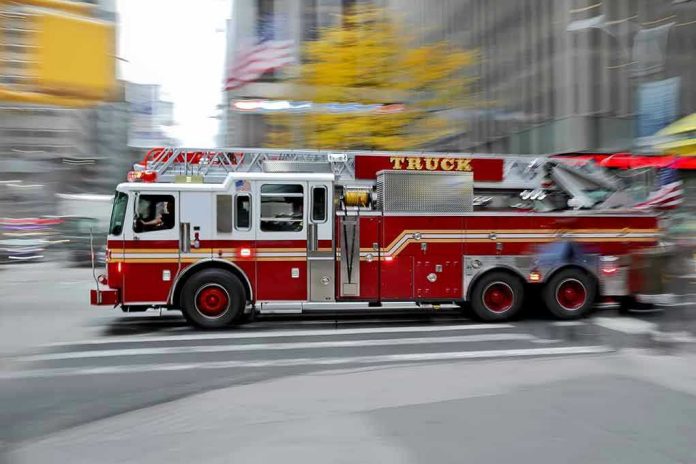
One woman’s death beneath a New York City Fire Department truck on a Bronx street has reopened the oldest emergency-response riddle: how fast is too fast when seconds save lives but mistakes take them.
Story Snapshot
- Officials report a woman was killed in a collision involving an emergency vehicle in the Bronx; parallel cases show how fast facts can fracture into competing narratives [6][8][9].
- Police reconstructions in similar New York crashes often shift early blame as video, data, and witness accounts clarify events [8][12].
- Emergency drivers must balance lawful exemptions with a continuous duty to drive with due regard; lawsuits follow when the line is crossed [7][10].
- Families demand accountability, while responders warn that second-guessing split-second choices can chill lifesaving speed [8][11].
What is known right now and what remains murky
Initial reports describe a deadly encounter between a New York City Fire Department truck, said to be rushing to an emergency, and a female pedestrian in the Bronx. Early frames in similar incidents have pinned fault before police reconstruction work caught up, as seen in the Gravesend chain-reaction crash that killed one and injured many; investigators later emphasized timeline, signals, and driver actions under response conditions [8][12]. Early narratives can lean on sirens and sympathy; final findings rely on hard evidence and law [9].
News 12 | Bronx | Woman Dies After Being Struck By Fdny Truck In Morrisania https://t.co/CyvbB1296f
— Bill Davies (@nycmaven44637) June 6, 2026
Comparable New York cases show the danger of snap judgments. In Brooklyn, coverage first highlighted an emergency run and mass injuries; subsequent detail focused on intersection dynamics, a van collision, and a fatal bus impact, tightening the lens on speed, right-of-way, and visibility under lights-and-sirens operation [10]. Even televised updates warned viewers that key conclusions had to wait for police collision squads to analyze video, telemetry, and braking marks before assigning responsibility [12]. The pattern repeats because emergency exemptions never erase due care.
How the rules actually read for emergency vehicles
New York law grants emergency drivers exemptions to speed limits and signals when using audible and visual warnings, but the duty of “due regard” still governs every move. That duty asks whether a reasonably careful responder, with the same information in the same moment, would have chosen the same gaps, speeds, and paths. Civil lawsuits have tested that line repeatedly; families cite preventable risk, while departments argue mission urgency and training sufficiency. Prior Bronx litigation has named drivers and supervising officers when alleged protocol lapses surfaced [7].
Departments teach a hierarchy: arrive, then act. Policy emphasizes complete stop-and-clear procedures at red lights, controlled lane changes, and speed that matches sight distance. In courtroom reality, the question narrows: were lights and sirens active; did the operator clear cross traffic; did bystanders yield; and did the operator adjust for weather, darkness, or pedestrian density. Those are fact questions, not impressions. When investigators release their reconstruction, the answers likely hinge on seconds of approach and a few feet of visibility, not headlines [12].
Where accountability meets common sense
Calls to criminalize responders after any fatality risk punishing service, not negligence. Conservative common sense favors a sharper tool: transparent reconstruction, rapid release of video where privacy allows, and automatic referral to independent review when a death occurs. That approach respects victims while safeguarding the public’s interest in fast, confident emergency response. In Brooklyn’s chain-reaction case, families called for accountability and legal action while newsrooms reminded viewers that investigators were still processing critical evidence [8][11][12]. That balance should guide the Bronx case as well.
🇺🇲 ACCIDENT: A woman was struck and killed by an FDNY fire truck responding to an emergency in the Bronx Friday night, officials said. The collision happened near Intervale Avenue and Chisholm Street. The victim was transported to St. Barnabas Hospital, where she was pronounced… pic.twitter.com/pyap3J12RO
— Belaaz News (@TheBelaaz) June 7, 2026
Policy fixes should track the facts, not fears. If reconstruction shows the operator followed protocol and the tragedy resulted from a sudden, unforeseeable movement by a pedestrian or motorist, the remedy is public education on yielding and urban visibility. If the record shows corners cut—blown control points, excessive speed beyond sight lines, or missed clear-and-confirm checks—then discipline, retraining, and route or signal engineering changes follow. Either way, publish the findings promptly and in plain English to rebuild trust and improve the next response [8][12].
Sources:
[6] YouTube – Bronx firehouse honors off-duty FDNY firefighter killed in hit-and-run
[7] Web – 1 dead, at least 10 injured in chain-reaction crash involving FDNY …
[8] Web – LAWSUIT IN FIRETRUCK DEATH | Firefighter Close Calls
[9] Web – Chain-reaction crash involving FDNY truck in Brooklyn leaves 1 …
[10] Web – Chain-reaction crash involving FDNY firetruck leaves 1 dead, 11 …
[11] Web – Man Killed, 11 Hurt in Crash Involving FDNY Tower Ladder
[12] YouTube – 1 dead, at least 10 injured in chain-reaction crash involving FDNY …