
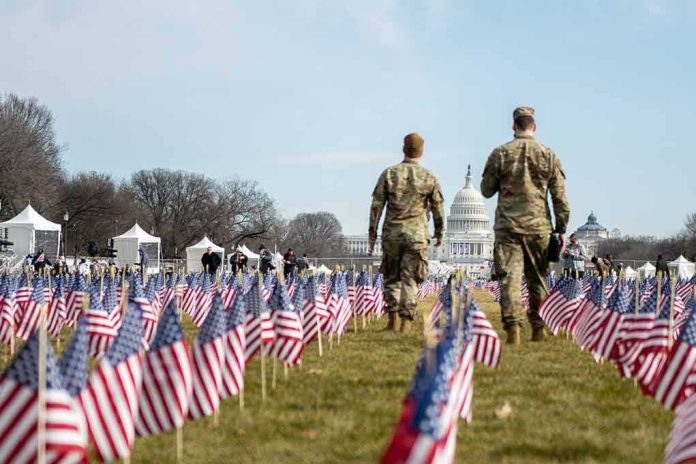
On America’s 250th birthday, tens of thousands of people were marched off the National Mall by loudspeakers warning of deadly storms, then herded into tax and bureaucracy buildings for safety while the party waited on the weather’s verdict.
Story Snapshot
- Organizers and federal agencies ordered a full evacuation of the National Mall as severe thunderstorms closed in.
- Security checkpoints shut down and guests were told to shelter in nearby federal buildings and museums, including the Internal Revenue Service.
- Storms and lightning, not “extreme heat,” drove the official evacuation call, even as heat made the day punishing.
- The episode shows how weather, politics, and public trust collide when Washington cancels a once-in-a-generation celebration.
How a historic celebration turned into a mass evacuation
Freedom 250’s “Salute to America” was sold as a huge, once-in-a-lifetime Fourth of July show on the National Mall, with President Donald Trump set to speak and fireworks ready to roar over the monuments. As crowds packed the grass and security lines stretched long, organizers were watching radar screens as much as stage cues. By around 7 p.m., that backstage tension broke into public orders.
Freedom 250 and its federal partners told everyone on site to evacuate immediately due to approaching severe thunderstorms, lightning, hail, and possible flash flooding. The announcement came over giant screens and speakers, and it was not tentative. Secret Service agents, Park Police officers, and event staff moved quickly, directing people away from the Mall and toward shelter. Security screenings were stopped, checkpoints closed, and the area shifted from party space to potential hazard zone.
Where thousands were told to hide from the storm
The evacuation did not simply tell people to “go home.” Washington’s Homeland Security and Emergency Management office pushed out a specific list of shelters. Federal buildings including the Ronald Reagan Building, the Department of Commerce, the Department of Agriculture, the Department of Education, and the Internal Revenue Service were opened as safe havens. Major museums along Constitution Avenue also took in crowds, turning tourist halls into storm bunkers for soaked and frustrated holiday guests.
One detail cut through the bureaucracy: the Internal Revenue Service shelter hit capacity. On a day meant to celebrate freedom, thousands ended up waiting out the weather inside the nation’s tax agency. That overcrowding forced organizers to redirect people to other locations in real time. It showed how hard it is to move tens of thousands of people in minutes, even with detailed plans. It also underscored a basic truth of emergency management: paper protocols meet human behavior, and they often clash.
Storms, heat, and the fight over what really shut the Mall
National and local coverage agree on the core trigger: a severe thunderstorm threat with strong winds, heavy rain, and frequent lightning strikes pushed the evacuation. The National Weather Service had a severe thunderstorm watch up into the night, and forecast data showed a high chance of more rain and storms lasting into the next day. That kind of setup is exactly what safety rules target for large, open-air crowds surrounded by metal structures and limited exits.
Heat, however, hung over the entire day. Reports described the hottest Fourth of July on record in Washington, with temperatures over 100 degrees and heat index values above 110. Social media posts talked about “severe heat” alongside the storms, and many people clearly suffered through brutal conditions while waiting for the show. But when you look at the official statements, the evacuation order itself cites thunderstorms, lightning, hail, and flash flooding, not heat, as the immediate reason to clear the Mall.
Public doubt, politics, and the missing paperwork
Not everyone accepted the order. Local video showed some groups arguing with Secret Service agents and refusing to leave, even as most of the crowd streamed toward shelter. Online, commenters joked, complained, or hinted that “God works his power” to disrupt the event. That mix of skepticism and sarcasm fits a wider pattern: when Washington calls off a big political celebration, some people, especially conservatives, wonder if the weather is the whole story or just the easiest one to tell.
On America's 250th birthday, the National Mall was evacuated mid-celebration. DC hit 102°F. Heat index topped 110. 150 million under NWS heat alerts. DC and Philadelphia parades canceled.
Then thunderstorms hit — Freedom 250, Secret Service, and DC Homeland Security ordered an… pic.twitter.com/XtvQidOhkC
— karmactive (@karmactivealive) July 5, 2026
From a common-sense, rule-of-law viewpoint, the facts we can see line up with a straightforward safety call: storms were real, lightning was close, and multiple independent outlets documented severe conditions across the region. At the same time, there is an information gap that feeds doubt. No detailed post-event safety audit has been released by the National Park Service or the Federal Emergency Management Agency. No public incident report spells out the exact wind speeds, lightning distance, or crowd thresholds that triggered the lockdown.
Why this evacuation matters beyond one stormy night
That silence matters because weather is increasingly used as the deciding factor in major public events, especially in an era of rising concern about climate and extreme conditions. Climate studies show more frequent severe storms and dangerous heat waves across American cities. Washington’s own climate plans warn that its public buildings and open spaces face growing risk from flooding, extreme weather, and heat. When officials pull the plug on a huge patriotic gathering, they are acting inside that larger trend.
For many older Americans who still see the Fourth of July as a simple day of flags, fireworks, and family, the America 250 evacuation became a symbol of something more complex. It spotlighted how fragile large civic rituals are when safety, politics, and media narratives collide. It showed that even on a day meant to honor independence, citizens are asked to trust unseen data and unshared reports. The storm passed, the Mall reopened, and the fireworks finally flew. But the questions about who decides, based on what, still hang in the humid Washington air.
Sources:
youtube.com, wjla.com, facebook.com, nbcnews.com, instagram.com, 250.dc.gov, freedom250.org