

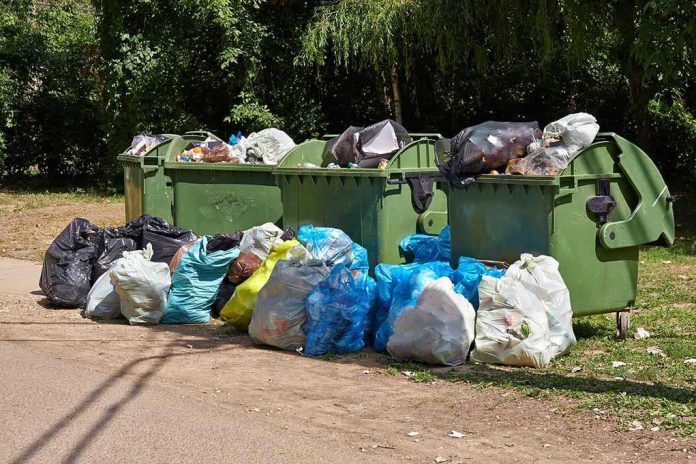
The state told Sacramento to police your banana peels, and now the city is lifting your trash can lids to prove it.
Story Snapshot
- California Senate Bill 1383 forces cities to check how you sort trash and food waste
- Sacramento crews now visually inspect about 5,000 garbage cans, leaving coaching tags instead of fines
- Media brands these workers “climate cops” and “trash spies,” stoking privacy and overreach fears
- Future enforcement can include real fines, even as the city claims an “education first” approach
Trash can inspections born from a state climate mandate
California lawmakers did not build Sacramento’s trash inspections out of thin air; they hardwired them into state law. Senate Bill 1383 requires every city to cut organic waste going to landfills by seventy-five percent by 2025, mainly to reduce methane emissions from rotting food and yard trimmings. To hit that target, the state orders jurisdictions to run route reviews or waste evaluations and educate residents when contamination shows up in the bins. Sacramento’s program is the city’s answer to that mandate, not a random crusade by bureaucrats. Law now says city staff must look at what residents toss out, and the city either complies or risks state penalties later on.
Sacramento’s Container Reviews page spells out how this plays out on your block. Staff conduct random visual audits of garbage, recycling, and organics containers placed at the curb on collection day, as required by Senate Bill 1383. They open lids, look at what is visible, and record how well households separate trash, recyclables, and food waste. The stated goal is to reduce contamination and to educate, not punish, with the city stressing that no fines will be issued during these reviews and that this phase is focused on coaching residents. That distinction matters, but for many homeowners, a stranger peeking under the lid at dawn still feels like government walking onto their driveway.
How the lid lifting actually works on your street
The Sacramento Bee reports the city plans to inspect about 5,000 residential garbage containers from July through September, choosing routes and households at random. Crews “briefly lift the lid” on curbside cans to check whether residents have mixed recyclables, organic waste, and garbage, usually in the early morning on a couple of days each week. When containers are inspected, workers leave one of two tags: “Great Job” if sorting looks right, or “Let’s Sort This Out” when contamination is found. That feedback is designed as a quick nudge, not a citation. Still, crews also take photographs during inspections, creating a visual record of household waste that happens without any explicit consent from the resident. For many privacy-minded citizens, photography shifts this from simple coaching into real surveillance.
State guidance confirms that this kind of up-close look is not an accident; it is built into how California expects cities to enforce the law. CalRecycle, the state agency, defines route reviews as annual visual inspections of randomly selected containers on all collection routes, with jurisdictions required to notify generators and provide education on proper material separation when contamination is found. Those same rules authorize penalties between fifty and five hundred dollars per violation when enforcement begins, depending on how often and how seriously an entity breaks the rules. In other words, today’s friendly tag on your trash can is backed by a tougher enforcement hammer hanging just offstage.
From “education first” to real fines and suspects of interest
City officials keep repeating that Sacramento is taking an education-first approach. The Recycling and Solid Waste division says its goal is coaching residents to comply whenever out-of-compliance customers come to their attention, and stresses that during current container reviews no fines will be imposed. That matches a pattern seen in other cities: start with nudges and information, and only later move to penalties when people prove they will not follow the rules. Yet buried in local reporting is a clearer picture of where this road leads. Waste Compliance Manager Erin Treadwell explained that homes not putting an organic can at the curb will be “suspects of interest,” and that households can eventually face fines starting around two hundred fifty dollars, escalating over time. Sacramento’s city code even allows for fines up to five thousand dollars, showing that when patience runs out, punishment is a real option. From a common-sense conservative view, this mix of “we’re just educating” talk alongside heavy fine authority looks like classic government soft sell at the front door while the collection notice waits out back.
The city is already building the machinery needed for stricter enforcement. Sacramento’s Department of Public Works has solicited vendors to conduct residential route reviews to identify contamination and to provide education on proper sorting, fulfilling Senate Bill 1383 requirements. Critics see a potential money trail here: outside contractors, paid with public funds, combing through neighborhoods under a green banner with little public detail on how they are chosen, how much they are paid, or how closely they are overseen. That lack of transparency around vendor contracts and data practices leaves room for suspicion, especially for residents who already distrust state climate policy and worry that every new program is more about revenue and control than cleaner air.
Climate cops, trash spies, and the battle over your curb
National conservative media did not let Sacramento’s bin checks roll out quietly. The New York Post blasted the city for deploying “trash spies” to snoop on homeowners so they comply with Governor Gavin Newsom’s vision, highlighting that workers will lift lids, take photos, and leave unsolicited feedback tags on residents’ cans. RedState’s framing of “climate cops rifling through your garbage cans like common thieves” taps into deep American instincts about property rights and privacy, even though there is no evidence inspectors are digging into bags or removing items from bins; reports say they perform quick visual checks and do not remove material. That mismatch between the actual scope of inspections and how they are described shows how outrage can outpace facts.
Residents are split, and that division will shape what happens next. Some homeowners tell reporters they appreciate the guidance and like knowing they are following the law. Others call the program “excessive” and say “It’s not working. That’s just a lot,” arguing that early-morning lid lifting and coaching tags feel more like nagging than help. From a conservative, common-sense angle, the core question is simple: does a climate law justified by broad environmental goals really need government agents peering into every family’s trash to work? If lawmakers force cities into that model, citizens are right to demand strict limits, honest data on results, and clear proof that the intrusion is both necessary and effective, not just another habit of a government that has forgotten where personal space begins.
Sources:
redstate.com, nypost.com, cityofsacramento.gov, sacbee.com, cityofwestsacramento.org, calrecycle.ca.gov