

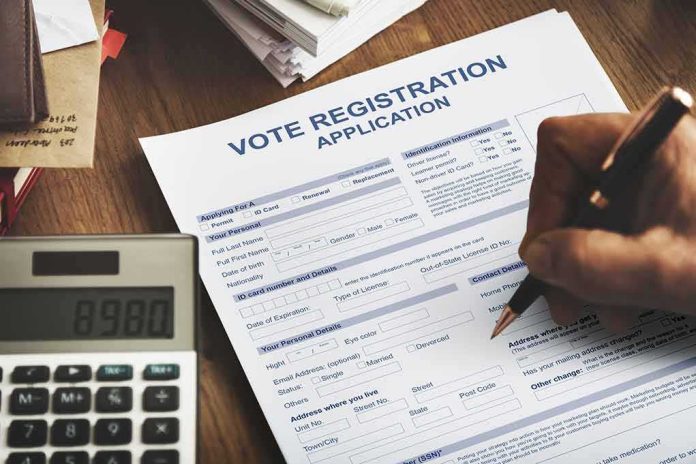
A federal judge said indict the cases you can prove, and federal prosecutors in California did exactly that.
Story Snapshot
- Justice Department charged 28 named lawful permanent residents with election crimes
- Judge denied a blanket ballot freeze but said prosecutions could continue
- Government flagged over 20,000 “likely” noncitizen registrations for review
- Critics say the big list risks false matches and needs disclosure
What prosecutors actually filed, not what they implied
The Justice Department charged 28 people by name in California, instead of waving at a giant estimate. Prosecutors allege sworn lies on voter registration forms, approved registrations, and, in many cases, illegal votes. These are specific counts under federal law, not a social media thread. Each felony carries up to five years in prison if convicted. The department says all defendants are lawful permanent residents, not citizens, and thus not allowed to vote in federal elections.
The focus on named defendants matters. Arguments about databases often fade when a case file holds an application, a signature, a checkbox, and a voting record. That is why prosecutors led with individual complaints. It narrows the dispute to facts a jury can weigh. It also answers the judge’s challenge to handle provable cases first, rather than disrupt statewide counting on an emergency basis.
The big list that set off a legal knife fight
Four days before the criminal charges, the government sued the state after flagging more than 20,000 “likely” noncitizen registrations. The filing asked California to hold back mail ballots linked to those names until citizenship could be confirmed. The word “likely” does heavy lifting here. The requested remedy was verification, not instant disqualification. That request triggered immediate pushback from state officials and advocates.
A federal judge refused to halt ballot processing tied to the 20,000 names. The court signaled that mass relief, days before an election, failed the test for an emergency order. Yet the judge also pointed to a cleaner path: charge individual cases that appear solid. That is the lane prosecutors took with the 28. Denying the temporary order did not bless the rolls; it only rejected a late-stage, broad remedy.
Disclosure fights and false-positive fears
Questions about the 20,000-name list center on matching errors and transparency. Reporters found that some listed people looked to be U.S.-born, a red flag for false matches. The University of California, Los Angeles Voting Rights Project said the method could sweep up naturalized citizens. A court ordered the government to share the list with certain lawyers; the department said it would appeal. Until the data are released, the mass claim will face skepticism.
Some critics highlight the delivery and timing. The state reportedly got a password-protected thumb drive and 48 hours to respond, just before ballots were counted. That makes process the story, not proof. Fair concern, but process quibbles do not erase a signed form with a checked “U.S. citizen” box by someone who is not a citizen. That is why the charged cases, not the aggregate list, will anchor the public’s judgment of the government’s effort.
What common sense says to watch next
Three tests will decide whether this push looks careful or careless. First, evidence: Do the complaints show the registration oath, the status record, and, where claimed, a vote that counted? Second, citizenship timing: Did any defendant naturalize before the date in question? Third, consistency: Did prosecutors apply the same standard across the larger pool? If the answers line up on paper, the charges will look earned, not political.
Conservatives should separate two ideas. Individual fraud must be charged and punished to protect equal votes and secure elections. Broad, last-minute list sweeps should be verified before they touch ballots. The court drew that line. Prosecutors followed it with 28 named cases. If more files clear the same bar, bring them. If the mass list crumbles under sunlight, fix the method. Confidence grows when the system proves it can do both.
Sources:
redstate.com, justice.gov, news.bloomberglaw.com, democracydocket.com