

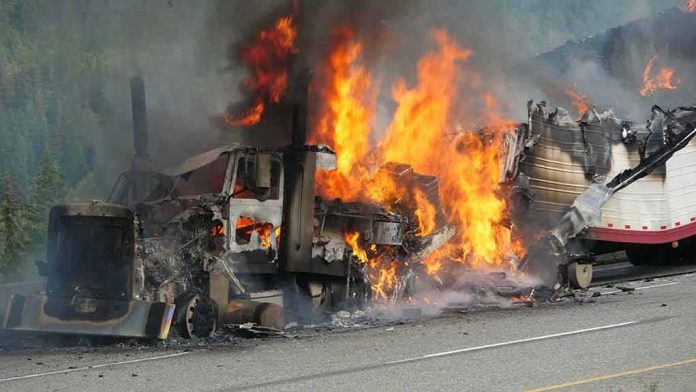
A fuel tanker exploded on Cairo’s Ring Road, and at least 31 people died in minutes.
Story Snapshot
- A privately operated fuel tanker crashed and ignited a massive fire above Tunnel 10 near Warraq.
- The Health Ministry reported at least 31 dead and dozens injured; ambulances rushed victims to hospitals.
- Flames spread to nearby traffic, burning cars and motorcycles on the busy highway.
- Authorities described a tanker that veered off the road before exploding, turning a lane into an inferno.
What Happened On The Ring Road
Egyptian authorities said a privately operated tanker carrying petroleum products veered off the Ring Road near the Warraq district of Giza, above Tunnel 10, and exploded on Wednesday, November 25, 2026. The blast and fire killed at least 31 people, according to the Health Ministry. Ambulances moved the injured to several hospitals as firefighters attacked flames that raced along the roadway. The tanker’s cargo fed the blaze. Commuters had little time to escape once the fire jumped to nearby vehicles.
Reports described a scene of black smoke, twisted frames of cars, and scorched concrete. The Health Ministry said dozens of ambulances deployed, signaling how fast officials recognized the scale of the disaster. The Egyptian Petroleum Ministry said the vehicle was privately run and transporting petroleum products when it left the roadway, crashed, and exploded. That sequence tracks with fuel-tanker physics: a heavy load, high center of gravity, and flammable cargo magnify small errors into deadly events.
Why The Fire Spread So Fast
Heat from ignited fuel transfers to any nearby car in seconds. Fuel runs downhill and along seams in the pavement. On a ring road with steady traffic, that means many targets. Egyptian Public Prosecution reporting cited by independent coverage said flames burned 27 cars and motorcycles, showing how chain-reaction fires can grow on a busy corridor. Ring roads also have barriers and narrow shoulders. That traps drivers when a fire breaks out, leaving little escape room or airflow to clear smoke.
Crash scenes with hazardous fuel also strain first responders. Teams must both fight fire and screen for reignition. Hospitals take burn victims whose conditions can change fast. That is one reason early injury counts often vary. Outlets reported 15, 21, or 25 injured as agencies updated figures through the day. Newsrooms repeated the Health Ministry’s death toll of at least 31, which matched the scale of the fire and later reports from several major outlets.
The Road-Safety Backdrop In Egypt
Egypt faces long-running road-safety pressures that make large casualty events more likely. The World Health Organization has described high road-death burdens in the country over past reporting cycles, reflecting fast traffic growth, mixed vehicle safety, and enforcement gaps. Those national patterns do not cause any single crash, but they raise the odds that when a crash occurs, it is severe. A fuel tanker on a crowded ring road adds risk on top of risk, with weight, speed, and flame all in one package.
Policy answers are not mysterious. Lower speed limits for hazardous cargo, strict route planning around dense zones, tougher inspection of tankers, and better barrier design save lives. So does driver vetting and rest rules. The petroleum and transport sectors know these tools well. Enforcement is the hinge. When regulators set clear rules and courts back them, companies adapt. When rules sit on paper, families bury loved ones after fires that never needed to happen. Common sense and public safety align here.
What Officials Have Said So Far
The Petroleum Ministry said the tanker was privately operated and carrying petroleum products when it veered off the road and exploded. The Health Ministry announced at least 31 dead and said ambulances moved the injured to multiple hospitals. Major international outlets reported the location near Warraq above Tunnel 10 and matched the official death toll, giving a consistent account across channels. Coverage also described the Ring Road closure as emergency crews cleared wreckage and cooled hot spots.
Egypt detains driver suspected of causing Cairo fuel tanker crash and inferno that left 31 dead https://t.co/J6dt1V4Moy #FoxNews
— Greg Gibbons (@GregGibbon53629) November 26, 2026
This kind of catastrophe leaves many asking who is accountable. Facts reported to date do not name the driver or the operating company, and officials have not published a complete causal chain. That happens often in mass-fire events, where heat erases clues. The central points remain solid: a privately run tanker crashed, ignited a fast-spreading fire on a major Cairo artery, and at least 31 people died as a result. Any final report should lock in the details and drive reform that keeps tankers safe and the public safer.
Sources:
afp.com, upi.com, us.cnn.com, en.wikipedia.org, nytimes.com, applications.emro.who.int