One offhand joke at Syracuse University exposed how fast a familiar political weakness turns into a viral character trial.
Quick Take
- Joe Biden compared Syracuse trustee chair Jeffrey Scruggs to Barack Obama during an April 14, 2026 speech, then brought Scruggs onstage.
- The moment spread quickly after a Fox News clip circulated, reigniting the long-running “Biden gaffe” storyline.
- Critics read the remark as racial stereotyping; defenders framed it as a clumsy visual joke about baldness and vibe.
- The bigger issue wasn’t one line, but how modern politics turns split-second humor into permanent evidence.
The Syracuse moment that lit the fuse
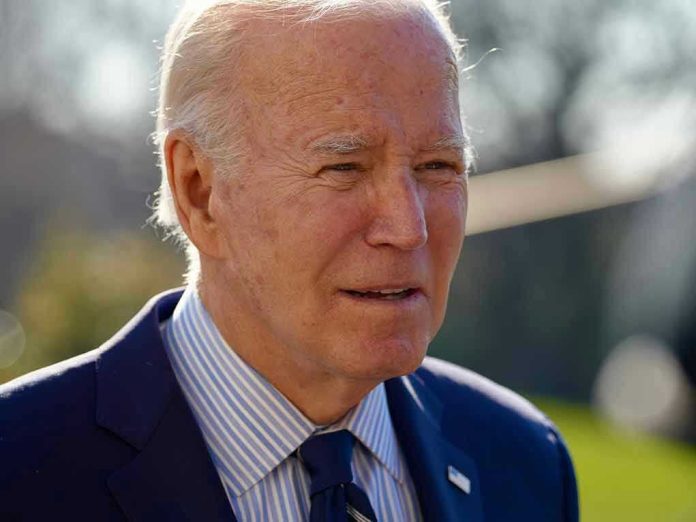
Joe Biden spoke at Syracuse University on April 14, 2026, in a celebratory setting tied to his presidential legacy and his connection to the school. Mid-speech, he pointed out Jeffrey Scruggs, the university’s Board of Trustees chairman, and joked that he wanted to turn and call him “Barack,” implying Scruggs looked like Barack Obama. Biden then invited Scruggs onstage and even suggested where each should stand, leaning into the bit.
The room laughter mattered, because it explains why these moments happen: politicians chase warmth, not footnotes. A crowd laughs, the speaker keeps going, and the staff hopes the tape dies quietly. That is not the world we live in. A short clip travels better than the full event, and the punchline becomes the headline. By evening, the comment had turned into a Rorschach test for anyone already convinced Biden routinely crosses lines.
Why this joke lands differently in 2026 than it would have in 1996
Comparing one person to a famous person sounds harmless until it touches a loaded American nerve: the old stereotype that “they all look alike.” Critics argued the Obama comparison wasn’t just awkward but revealing, especially because Scruggs and Obama share only broad traits described by commentators as superficial. The conservative critique wasn’t subtle: if a former president can’t distinguish individuals in the moment, that reads as either tone-deafness or something worse.
Defenders took the opposite route, saying people make celebrity comparisons constantly, and baldness plus general profile can spark an easy, lazy joke. That defense has a problem: politics is not your backyard cookout. A national figure’s words carry institutional weight, and race-related humor has almost no margin for error. Common sense says a leader who has spent decades in public life should know the “look like Obama” line invites the ugliest interpretation.
The gaffe machine: how a single clip becomes a dossier
This viral moment didn’t appear out of nowhere; it snapped neatly into a pre-existing binder labeled “Biden says the quiet part out loud.” Commentators immediately stacked it beside earlier quotes that drew backlash, including the “poor kids” line and the “you ain’t Black” remark. That pattern is why the clip traveled: people weren’t reacting only to Syracuse, they were reacting to their memory of years of verbal stumbles that opponents argue reveal worldview and deterioration.
Critics also folded in long-running disputes about Biden’s personal narratives, including how he described his academic performance at Syracuse Law. That’s a savvy political move: combine a fresh viral clip with older credibility fights, and the audience feels like it’s watching a repeat offender, not a one-time slip. Whether fair or not, it’s effective. Voters over 40 have seen this movie: one gaffe doesn’t end careers; accumulation does.
What conservative readers should focus on: standards, not gotchas
Conservatives tend to prize personal responsibility, clear speech, and a sober respect for institutions. Those values clash with a political culture that excuses careless language as “just a joke” when it comes from the right people, then demands firings when it comes from the wrong ones. The Syracuse line deserves criticism because it was avoidable and predictably divisive. The strongest critique sticks to facts: the quote happened, the clip spread, and the joke carried racial baggage.
The weaker critique is the reflexive leap to mind-reading—declaring certainty about motive rather than judging conduct. Americans can hold two ideas at once: Biden may have attempted humor, and the humor still may have been racially insensitive. That is where common sense and fairness meet. The practical question isn’t whether the internet can label someone forever; it’s whether leaders can discipline themselves to stop feeding the label-making machine.
The real collateral damage: the person onstage and the public offstage
Jeffrey Scruggs became an unwilling prop in a national argument he didn’t start. Even if he laughed in the moment, the viral afterlife can feel different, because it strips context and turns a living person into a screenshot. Meanwhile, the public gets another round of race discourse reduced to memes and dunking. That cheapens legitimate concerns about stereotyping and also encourages cynicism: people stop believing anyone is acting in good faith.
'All Black Guys Look Like Obama?' Biden's Awkward Gaffe Goes Viralhttps://t.co/MR9puRBNSy
He is a racist. Always was. He just got a pass from the media and his fellow racist Democrats.
— gtslade (@gtslade) April 15, 2026
The episode also underlines a hard truth about modern media incentives. A short clip with a racial angle beats a long speech about policy every time, because outrage is faster than analysis. If Biden’s team wanted to protect his legacy, they would treat every microphone like a courtroom transcript: no improv, no ad-libbed comparisons, no joking about identity. The country has moved beyond granting grace for “awkward” when the topic is race.
Sources:
‘All Black Guys Look Like Obama?’ Biden’s Awkward Gaffe Goes Viral
Joe Biden Did Something Racist Again