
Two bombs turned Emmanuel Macron’s “historic” Syria visit into a live-fire lesson in how modern politics treats risk, spin, and human lives very differently.
Story Snapshot
- Macron was already at the Syrian Presidential Palace when two bombs exploded near his Damascus hotel.
- Eighteen people were hurt, including four police officers, but Macron’s security perimeter held.
- No group claimed responsibility, leaving media free to sell “assassination attempt” without hard proof.
- The gap between official calm and media drama shows how conflict is now as much narrative as bullets.
Blasts On The Boulevard, President In The Palace
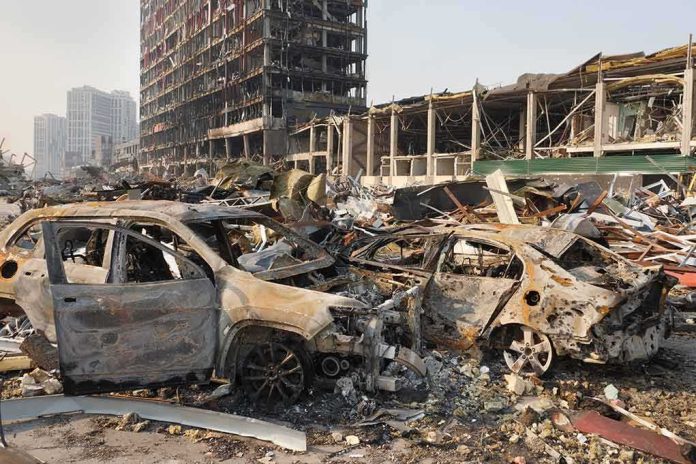
The explosions hit central Damascus on a busy stretch between the tourism ministry and the national museum, across from the Four Seasons Hotel where Macron had spent the night. Syrian officials say two devices blew up near the hotel, one inside a parked car and another hidden in a trash container. At roughly the same time, Macron’s motorcade had already left and he was en route to, or inside, the Syrian Presidential Palace to meet Ahmed al-Sharaa. His staff say he did not hear the blasts, and his day’s schedule did not change.
Video and photo clips from local outlets and international networks show flame and thick smoke rising from a vehicle, then a second blast near an ambulance that had rushed to the scene. The Syrian Interior Ministry says security forces had already discovered the devices and were preparing to defuse them when they detonated, which explains why police officers are among the wounded. BBC analysts used blast footage to place the site about 125 meters from the Four Seasons, close enough for headlines, far enough to matter for security.
What We Know For Sure, And What We Honestly Do Not
On the hard-fact list, three points stand out. First, eighteen people were injured, including four police officers, and at the time of reporting there were no confirmed deaths. Second, Macron was physically unharmed, his convoy did not come under direct attack, and the French presidency insists his visit continued as planned. Third, no group has publicly claimed responsibility, and Syrian authorities have not named suspects. That last point matters most, because it keeps motive in the realm of guesswork instead of evidence.
This is where responsible judgment parts ways with cable-news drama. Some outlets rushed to describe the blasts as a “possible assassination attempt,” mostly because “bombs near president’s hotel” makes a strong hook. Syrian officials pushed the opposite angle, stressing that the site sat outside Macron’s designated security zone, and that the visit faced “no direct threat.” For a reader who cares about basic common sense and conservative values like personal responsibility, the honest answer is simple: until investigators show who planted these bombs and why, calling it an assassination attempt is at best speculation dressed up as certainty.
Risk, Optics, And A President Who Kept Moving
The most telling detail may be that Macron never changed his schedule. The Élysée Palace said his agenda stayed “unchanged,” and Syrian President Ahmed al-Sharaa publicly praised him for continuing the visit. That choice fits a pattern researchers have seen for years: leaders who press ahead during crises often gain stature, while those seen as retreating pay a political price. For the Syrian government, keeping everything “normal” helps project control in a capital still scarred by recent bombings, including a cafe attack near the Justice Palace that killed ten just days earlier.
For Macron, the optics cut two ways. At home, his team can frame him as steady under fire, willing to walk into unstable territory and not flinch when things blow up nearby. Abroad, especially in a region where trust in Western leaders is thin, the choice may look more like calculated theater. As long as the bombs hit locals and police, not the motorcade, both governments can claim resolve without paying the ultimate price themselves. That asymmetry is now a common pattern in political violence: civilians absorb the shock so leaders can pose as unshaken.
Assassination Attempt Or Background Violence?
The big question that keeps getting asked is simple: were these bombs aimed at Macron, or was he just a high-profile bystander to Syria’s ongoing instability? Here, the facts hit a hard limit. The devices exploded near a hotel that housed the French president, on the same day he met Syria’s leader, in a city that has seen several recent attacks. That cluster of details invites suspicion. Yet without a claim of responsibility, a recovered message, or clear intelligence, it does not prove intent.
#Breaking 🌏 World 🌐 🇸🇾
"Dual bombs rock central Damascus wounding 18 during historic visit by French President Macron"
➡️ 2 improvised explosive devices detonated in the heart of Damascus on Tuesday morning, wounding at least 18 people, including 4 police officers, in a… pic.twitter.com/JWOA5498zj— BreakinNewz (@BreakinNewz01) July 7, 2026
Studies of modern conflict show this kind of ambiguity is common. A United Nations review notes that most deadly attacks now occur in conflict-heavy states and involve non-state armed groups, but many strikes never come with a public “we did it” statement. That silence lets each side craft its own story. Syrian officials can say this was a general security incident, not a breach of VIP protection. Western media can lean toward “targeted attack” to underline how dangerous the region is and justify more caution or pressure.
Why Ordinary People Always Pay For The Story
Political violence research is blunt about who suffers long after the smoke clears. Civilians exposed to bombing and chaos face higher rates of post-traumatic stress, depression, and anxiety, along with deep distrust and social withdrawal. In Damascus, that means shop owners, hotel workers, and families near the blast site now live with the memory and the fear, while the world argues about whether this was “about Macron.” No matter which narrative wins, the wounded still have hospital bills and trauma, and their neighborhoods bear the mark of yet another explosion.
If you care about order, accountability, and the idea that leaders should answer for the environments their visits create, one takeaway is clear. High-risk diplomacy in places like Syria is not just about motorcades and palace photo ops. It is about whether powerful people accept the costs that locals carry when those visits turn into gunpowder theater. Until investigators show who planted the bombs and why, the only honest headline is the simplest one: eighteen Syrians were hurt, and Emmanuel Macron walked away untouched while the story spun around him.
Sources:
townhall.com, cbsnews.com, cnn.com, aljazeera.com, nbcnews.com, facebook.com, youtube.com, ktvz.com, ucdavis.edu