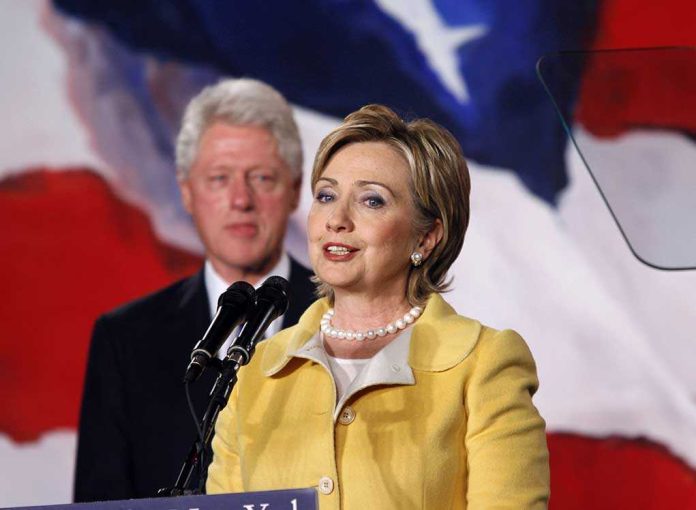
Two of the most powerful Democrats of the last half‑century now face a stark choice that ordinary Americans know well: show up and answer hard questions, or face the consequences.
Story Snapshot
- Bill and Hillary Clinton have been subpoenaed to give closed‑door depositions in Congress’ Jeffrey Epstein investigation.
- House Oversight has set specific January dates and warned the Clintons they could face contempt of Congress if they do not appear.
- The subpoenas target their interactions with Jeffrey Epstein and Ghislaine Maxwell, including flights on Epstein’s plane.
- The clash tests whether Washington holds powerful political families to the same standard as everyone else.
Congress Targets the Clintons’ Epstein Ties Head-On
The Republican‑led House Oversight and Accountability Committee has moved past rumors and innuendo and into formal power: it subpoenaed former President Bill Clinton and former Secretary of State Hillary Clinton in August 2025 to testify in its Jeffrey Epstein investigation. The committee wants details on their interactions with Epstein and Ghislaine Maxwell, from social contact to flights on Epstein’s private jet. The goal is not tabloid fodder; it is to map who knew what, when, and whether law enforcement failed.
The subpoenas sit inside a broader Federal Law Enforcement Subcommittee probe into how the Department of Justice, FBI, and other agencies handled Epstein and Maxwell across multiple administrations. That same vote authorized subpoenas for former attorneys general and FBI directors from both parties, signaling the inquiry is not formally limited to the Clintons. Yet committee communications underscore that, so far, the Clintons appear to be the only witnesses signaling they may simply not show up.
From Bipartisan Subpoenas to a Contempt Showdown
The current standoff did not appear overnight. On July 23, 2025, the Federal Law Enforcement Subcommittee approved, by bipartisan voice vote, subpoenas for ten individuals, including the Clintons. Chairman James Comer followed on August 5 with formal subpoenas compelling their depositions. Staff then spent months trying to lock in dates, ultimately setting Bill Clinton for December 17 and Hillary Clinton for December 18, 2025. Those December dates came and went after their attorney cited a funeral and proposed written responses instead.
Comer rejected the idea that written answers could substitute for in‑person questioning and publicly accused the Clintons of delaying, obstructing, and largely ignoring the committee’s efforts over four months. After the December no‑shows, the committee rescheduled Bill Clinton for January 13 and Hillary Clinton for January 14. As of this week’s reporting, a committee spokeswoman says neither has confirmed attendance and warns that the panel will initiate contempt of Congress proceedings if they fail to appear. The line has been drawn: no more calendar games, show up or face a formal contempt fight in the full House.
What Contempt of Congress Would Really Mean
Contempt of Congress sounds theatrical, but the power carries real teeth when Washington chooses to use it. Recent years saw Trump allies Steve Bannon and Peter Navarro prosecuted and sentenced to prison for defying January 6 committee subpoenas, while Attorney General Merrick Garland was held in contempt in 2024 yet faced no prosecution when DOJ declined to act. Those two outcomes frame today’s stakes: Congress can flex, but the Justice Department ultimately decides whether defiance of a subpoena results in jail time or just headlines.
For many Americans, the question is simple: if Bannon and Navarro went to trial, what happens when the names on the subpoena are Clinton and Clinton? A conservative, common‑sense view says the standard should not change just because the witnesses are a former president and a former secretary of state. If Congress’ oversight authority means anything, it has to apply to Democrats and Republicans alike. If DOJ treats defiance by prominent Democrats differently than it treated defiance by Trump advisers, it will only deepen the belief that there is one system for the well‑connected and another for everyone else.
Epstein’s Shadow and the Question of Equal Accountability
Jeffrey Epstein’s crimes involved the exploitation of vulnerable girls and young women, a world away from the comfortable circles of donors, celebrities, and politicians who once flew on his jet or visited his properties. Bill Clinton’s spokesperson has previously acknowledged that the former president flew on Epstein’s plane but denied any knowledge of criminal activity and said Clinton had not spoken with Epstein for years before the 2019 scandal reignited. The current congressional probe aims less at relitigating those personal denials and more at whether federal agencies soft‑pedaled investigations because of Epstein’s powerful friends.
From an American conservative perspective, this is precisely where Congress should lean in hardest. Sex‑trafficking networks thrive when elites assume immunity and institutions flinch at the thought of embarrassing them. A bipartisan subcommittee already agreed there is enough concern to subpoena former attorneys general, FBI leadership, and the Clintons themselves. If the Clintons now refuse to sit for questions that others have agreed to answer, lawmakers who talk about “no one being above the law” will face a test of whether they mean it when the last name on the witness list is not Trump.
Sources:
POLITICO – House Oversight GOP threatens to hold Clintons in contempt