
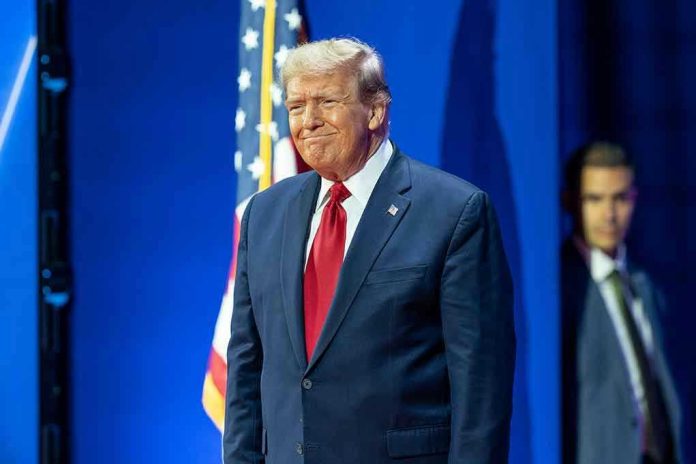
Could a constitutional loophole give Donald Trump a third term in office?
Story Overview
- Alan Dershowitz proposes theoretical scenarios for a Trump third term.
- A recent meeting between Trump and Dershowitz sparks constitutional debate.
- Trump teases the idea with a “Trump 2028” hat but downplays serious intent.
- The discussion highlights loopholes like Electoral College abstention or Speaker of the House succession.
The Meeting That Sparked Debate
A recent meeting in the White House has reignited the debate over a potential third term for Donald Trump. The meeting involved Trump and renowned constitutional lawyer Alan Dershowitz, who presented a draft book exploring theoretical constitutional loopholes that could allow Trump to serve a third term. The book suggests methods such as Electoral College abstention or Speaker of the House succession as potential pathways. This meeting has stirred both intrigue and skepticism among political circles and the public.
While Trump has publicly stated that he recognizes the current constitutional limitations, his display of a “Trump 2028” hat adds fuel to the speculative fire. This act, coupled with the meeting, has captured the public’s imagination and reignited discussions that many thought had been settled with the ratification of the 22nd Amendment. The Amendment, ratified in 1951 in response to Franklin D. Roosevelt’s four terms, clearly limits presidents to two elected terms. Yet, the theoretical scenarios proposed by Dershowitz have opened a new chapter in this ongoing saga.
Understanding the Constitutional Loopholes
The theoretical loopholes presented by Dershowitz hinge on creative interpretations of the Constitution. One scenario involves Electoral College abstention, where enough electors abstain from voting, potentially throwing the election to the House of Representatives. Another scenario considers the possibility of Trump becoming the Speaker of the House and then ascending to the presidency. These ideas, while intriguing, face significant legal and practical challenges. Legal experts, including Hofstra Law professor James Sample, have critiqued these scenarios as highly unlikely, given the historical and legal precedents.
The discussion around these scenarios reflects broader debates within constitutional law academia. While some view these ideas as clever textual interpretations, others dismiss them as politically unfeasible. The discussion underscores a tension between academic exploration and practical governance, highlighting the need for clear constitutional norms and the dangers of eroding established precedents.
The Political and Social Implications
The speculation around a third Trump term has implications beyond legal debates. Politically, it energizes Trump’s base while simultaneously outraging his opponents. The discussion could distract from more pressing policy matters, especially as the 2028 election cycle looms. Socially, it adds to the already polarized discourse, with both sides using the debate to reinforce their narratives. For Trump supporters, the idea represents a bold challenge to the status quo, while for opponents, it epitomizes a threat to democratic norms.
The media and publishing industries also stand to gain from this ongoing debate. Dershowitz’s forthcoming book is poised to attract attention from both supporters and critics, with its provocative ideas likely to spark further discussion and analysis. In the realm of constitutional law, the debate offers a rich field for scholarly scrutiny and public debate, contributing to the broader discourse on presidential powers and limitations.