

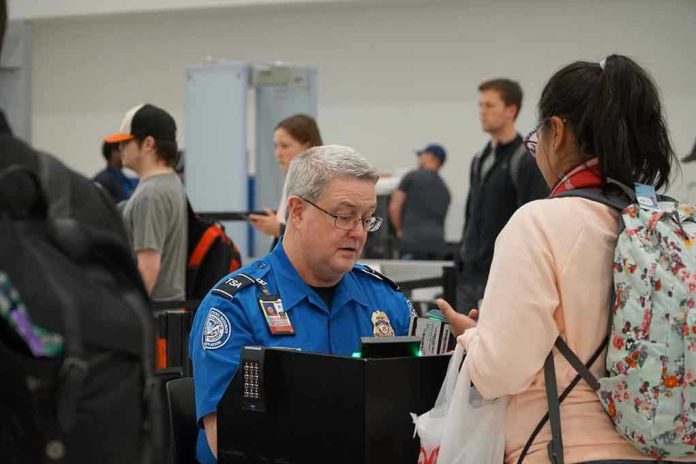
What happens when a security measure meant to protect air travel becomes a tool for immigration enforcement?
Story Snapshot
- TSA has been sharing domestic airline passenger data with ICE.
- ICE uses this data to screen travelers against deportation databases.
- Targeted airport arrests and deportations have been carried out.
- The program was secret until a New York Times investigation exposed it.
TSA’s Data Sharing with ICE
Since March of this year, TSA has been forwarding passenger lists, including names and sometimes photos and flight details, to ICE. This data sharing occurs on a near-daily basis. ICE cross-references these lists with its deportation and immigration enforcement databases to identify individuals subject to deportation. ICE agents have been deployed to airports to arrest targeted travelers, preventing them from challenging their removal legally.
The program was unknown to the public until a New York Times investigation unveiled it, raising concerns about the unprecedented use of domestic travel data for immigration enforcement. Critics argue that this represents a significant overreach of the original purpose of the TSA’s Secure Flight program, which was intended to match passengers against terrorism watchlists.
Historical Context and Background
The TSA’s Secure Flight program collects passenger identity data to enhance aviation security by checking against terrorism watchlists. Previously, data sharing with other agencies was limited to law enforcement and public health tracking. The current data-sharing arrangement with ICE marks a shift towards using domestic travel data for immigration enforcement. Historically, ICE focused on border areas and specific interior operations, not routine domestic air travel.
The decision to share bulk passenger data instead of targeting specific individuals for scrutiny is a significant change. This program was not publicly disclosed until reported by the New York Times, making it a covert operation that contradicts the intended purpose of aviation security.
Key Stakeholders and Responses
Primary stakeholders include TSA, ICE, and the Department of Homeland Security (DHS). TSA collects and shares passenger data with ICE, which uses the information to detain and deport flagged individuals. The DHS defends the program as a necessary measure to prevent illegal aliens from flying unless it is to leave the country.
Civil liberties groups, such as the ACLU, have criticized the program for turning airports into chokepoints for immigration enforcement. They argue that this practice infringes on the rights of individuals to travel domestically without fear of detention. The federal courts have been involved, as ICE actions have sometimes undermined judicial authority, as seen in the case of Any Lucía López Belloza, who was deported despite court orders.
Long-term Implications
This program could normalize the screening of all domestic travelers against various government databases, extending beyond immigration to other areas such as criminal warrants or tax compliance. Such a shift would transform air travel into a general surveillance checkpoint, raising significant privacy and civil liberties concerns.
The expansion of data architecture and biometric identifiers is likely as name-based matching is prone to errors. This could lead to increased pressure to collect more personal data, further eroding privacy. The ongoing public and political discourse will shape the future of such programs, balancing security needs with individual rights.