

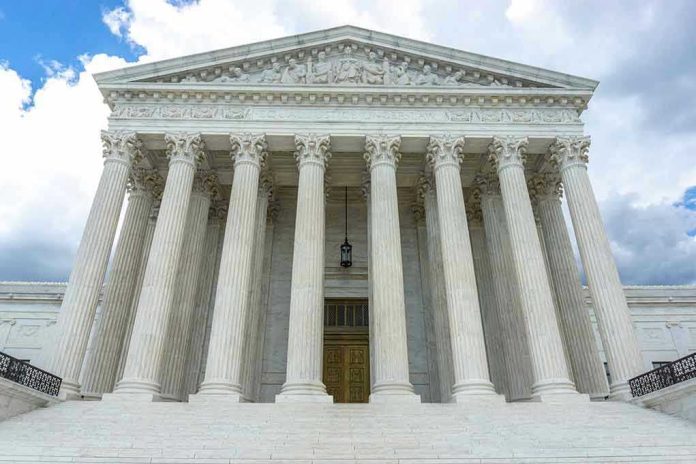
The Supreme Court just handed Republicans a game-changing redistricting victory in Texas, but what hidden racial maneuvers lurk behind the partisan triumph?
Story Snapshot
- Supreme Court stays lower court block, allowing Texas’s pro-Republican 2025 congressional map for 2026 midterms.
- District court found “clearcut” racial gerrymandering evidence, yet high court prioritizes election stability.
- Map boosts GOP control from 25 to 30 of 38 seats, targeting Democratic districts.
- Shadow docket decision draws dissent for overriding thorough lower court findings.
- Texas legislature drew map amid Justice Department pressures, blending race and partisanship.
Texas Legislature Enacts Pro-Republican Map
Texas lawmakers approved the new congressional map in late August 2024. Governor Greg Abbott signed it into law. The redistricting responded to Justice Department directives on certain districts. Lawmakers aimed to secure Republican advantages in 30 of 38 seats. This mid-decade shift followed post-2020 census battles and perceived federal overreach. Partisan goals drove the process, but critics alleged race predominated.
District Court Uncovers Racial Gerrymandering Evidence
A three-judge federal panel ruled on November 18, 2025. Judge Jeffrey Brown, a Trump appointee, authored the 160-page opinion. The court identified clearcut evidence of racial predominance violating the 14th and 15th Amendments. Direct proof included racial triggers, governor involvement, and manipulation of demographics. The panel blocked the map, finding race overrode traditional partisan intent. Judge Jerry Smith dissented, calling it pure partisanship beyond judicial reach.
Supreme Court Intervenes on Shadow Docket
The Fifth Circuit issued a temporary stay pending trial. Texas appealed to the Supreme Court. On December 4, 2025, the high court stayed the district ruling via shadow docket. No oral arguments occurred; briefing stayed limited. Justice Samuel Alito noted indisputable partisan motivation, permissible under precedent. The order restored the map for 2026 midterms, citing Purcell principle against eve-of-election changes. Conservative majority prevailed.
Justice Elena Kagan dissented, joined by Sonia Sotomayor and Ketanji Brown Jackson. She praised the district court’s thorough fact-finding. The dissent argued the order disserved Texans sorted by race. It aligned with precedents like Alexander, demanding strict scrutiny when race predominates. Critics like Brennan Center decried shadow docket abuse favoring partisanship over evidence.
🚨 BREAKING: Supreme Court hands Republicans a redistricting win by striking down lower court block on Texas map pic.twitter.com/0V9MXFzRCv
— Fox News (@FoxNews) April 27, 2026
Stakeholders Clash Over Motivations
Texas officials defended the map as compliance with federal guidance, not gerrymandering. LULAC and Latino voters challenged it as unconstitutional racial sorting. The Justice Department allegedly set racial targets, prompting the redraw. Supreme Court favored state legislatures over federal judges. Power tilted toward election stability, overriding detailed lower findings. Common sense aligns with deferring to states on partisan maps, absent proven racial abuse.
Political and Social Ripples Emerge
Short-term, Republicans campaign under favorable lines before December 8 filing deadlines. Nate Cohn analysis predicts 6-12 Democratic seat losses, bolstering GOP House control. Long-term, it may spark nationwide mid-decade redistricting. Latino communities face diluted representation in coalition districts. Social divisions deepen from racial line-drawing. Judicial checks weaken, incentivizing bold maps. Brennan Center warns of democratic distortion, but facts support partisan prerogative over exaggerated claims.
Sources:
Supreme Court opinion (25A608, Abbott v. LULAC)
Brennan Center analysis on Supreme Court shadow docket use
Oyez precedents on redistricting cases
NCSL on Supreme Court redistricting cases