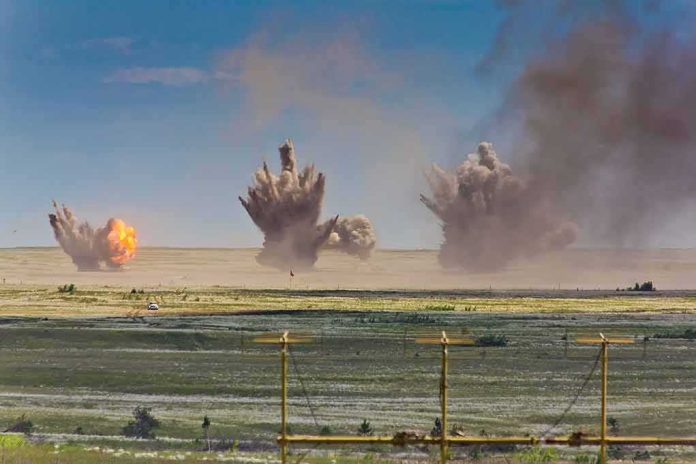
The United States set off a non-nuclear blast deep inside a Nevada tunnel to sharpen its eyes for hidden nuclear tests.
At a Glance
- Energy Department team conducted a subsurface chemical explosion at the Nevada National Security Site.
- Goal: improve detection of low-yield and concealed underground nuclear blasts.
- Test used high explosives and radiotracers in the P-Tunnel, Area 12.
- Officials say results will feed new models and sensors used worldwide.
What Actually Happened In The Nevada Desert
The National Nuclear Security Administration led a controlled chemical explosion underground at the Nevada National Security Site. Officials described it as a subsurface, non-nuclear high-explosive experiment. The Energy Department said the mission focused on finding and sizing very small, buried nuclear blasts that are hard to spot. The work took place mid-week and followed a series of similar research shots in recent years. This was not a nuclear test. It was a science drill with real stakes.
Engineers placed sensors to capture ground shake, air pressure waves, and trace gases. They also used radiotracers, which are harmless markers that help track how gases move through rock and soil. The site was the P-Tunnel in Area 12, a historic warren of test galleries. The data set will train the algorithms that sift daily noise from true warning signs. That includes signals from distant faults, mining blasts, and the rare event a nation tries to hide a nuclear shot.
Why This Matters Now
Rivals study ways to mask an underground test by firing inside a large cavity. That trick, called decoupling, can make a nuclear blast look much smaller on seismic networks. The United States proved decades ago that decoupling can muffle a small yield by tens of times. Today’s race is not about bigger bombs. It is about better ears, cleaner math, and faster calls that let the world know if a line was crossed. This experiment fits that race.
Officials framed the Nevada shot as a step to detect low-yield and even decoupled tests in real time. The data will ground-check new models and improve sensor placement strategy. It also supports allied monitoring work under the test ban regime. The point is deterrence through verification. If a country believes it cannot hide a blast, it thinks twice before trying. That is common sense defense, and it saves far more than it costs.
How The Science Improves Detection
Small, buried explosions send out weak, messy signals. Rock layers bend and bounce waves. Wind and storms add acoustic clutter. Underground gas can seep in odd ways through cracks. Scientists need field data to tune their tools. That is why they run chemical blasts in known geology. The Nevada tunnels offer controlled shots and dense instruments. Researchers then compare predictions to what actually happened and tighten every model knob by a click.
Teams across the national labs feed these results into broader test beds. Work at Sandia’s large centrifuge linked scaled experiments to field-like yields and depths, closing gaps between lab and desert. Other projects blend seismic, infrasound, and electromagnetic data so one sensor’s weakness is another’s strength. The outcome is a fused picture that flags the rare signal and tags it as explosion, quake, or something else, with confidence and speed.
What The Government Says The Test Proves
The National Nuclear Security Administration said the experiment will validate new predictive models and detection algorithms. The agency listed specific instruments used and noted the role of radiotracers to understand gas movement after a blast. Officials emphasized the non-nuclear nature of the event. They linked the work to improving the nation’s ability to detect low-yield nuclear explosions anywhere in the world, even those designed to be hard to find.
🚨🇺🇸 BREAKING: US Tests Nuclear Blast Detection
The U.S. conducted a non-nuclear underground explosive experiment in Nevada to improve its ability to detect low-yield nuclear explosions.
⚠️ The test focused on detecting hard-to-identify underground blasts.@Brinkwire1
— BrinkWire. (@BrinkWire1) October 1, 2026
That stated aim aligns with the mission of the Nevada National Security Site. The site supports stockpile stewardship without nuclear testing and advances nonproliferation monitoring. Congress has also been briefed on related underground infrastructure, including upgrades that support diagnostics and advanced sources. The steady drumbeat is clear: keep the deterrent safe, and keep the world honest by making cheating too hard, too fast to hide.
The Bottom Line For Readers Who Prefer Results
The United States did not restart nuclear testing. It ran a tightly controlled chemical blast to get better at catching the cheaters. The blast happened underground, in a tunnel built for this kind of work, with instruments packed wall to wall. The test feeds the algorithms and the hardware that watch the planet day and night. That is how you keep the peace in an era of clever concealment and bold propaganda: see more, sooner, and with proof that stands up.
Sources:
reuters.com, indiatoday.in, ktnv.com, nature.com, sandia.gov, news3lv.com