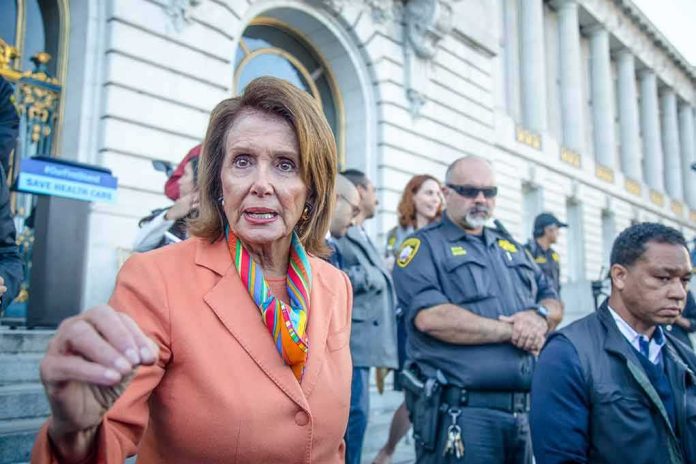
When Donald Trump branded Nancy Pelosi an “evil woman” the very day she announced her retirement, he didn’t just end an era—he reignited the core battle lines that have defined American politics for nearly two decades.
Story Snapshot
- Nancy Pelosi’s retirement marks the close of a historic congressional career and signals a seismic shift in Democratic leadership.
- Trump’s reaction was immediate and intensely personal, publicly labeling Pelosi “evil” and highlighting their bitter rivalry.
- The exchange underscores the deep polarization and personal animosity driving America’s political discourse.
- Pelosi’s departure sets the stage for generational change and fresh power struggles in Washington.
The Collision of Titans: Pelosi’s Farewell, Trump’s Attack
Nancy Pelosi’s announcement on November 6, 2025, that she will step down at the end of her current term, marked more than the retirement of a congresswoman; it closed the book on a singular era in American governance. As the first female Speaker of the House, Pelosi’s legacy is intertwined with legislative milestones, bruising battles, and unyielding opposition, especially against Donald Trump. That same day, Trump seized the moment, labeling her “evil,” a term that echoed years of venomous exchanges and exposed the raw animus between two political icons.
Pelosi’s retirement announcement was delivered in a video message to her San Francisco constituents, reflecting on nearly four decades of service. She highlighted achievements including the passage of the Affordable Care Act and recent infrastructure bills, while also acknowledging the toll of years spent navigating an increasingly divided Congress. Trump, never one to let a high-profile exit pass quietly, responded within hours by dismissing Pelosi’s record and declaring relief at her departure, claiming she had “cost the country a lot in damages and in reputation.” The timing and tone of his remarks reignited headlines, fueling speculation about the future of House leadership and the next phase of partisan warfare.
Historic Rivalry and Bitter Confrontations
Few relationships in Washington have been as fraught as the one between Pelosi and Trump. Their public clashes have shaped the national narrative, from Pelosi’s role in Trump’s impeachment trials to her dramatic shredding of his State of the Union speech. Both leaders have wielded language as weapons, with Trump frequently resorting to personal insults—“crazy Nancy” being a favorite—and Pelosi countering with accusations that Trump had undermined constitutional norms. These exchanges have not merely entertained; they have crystallized the ideological divide for millions of Americans.
The legacy of Pelosi’s tenure, spanning two non-consecutive terms as Speaker, is inseparable from her combative leadership style. Her ability to marshal Democratic votes, pass sweeping legislation, and stand firm against opposition made her both a revered and reviled figure. Trump’s consistent antagonism, meanwhile, has mirrored the broader Republican critique of Pelosi as the embodiment of liberal excess. Their rivalry has often transcended policy, evolving into symbolic theater that reflects—and inflames—America’s culture wars.
Leadership Transition and Political Fallout
With Pelosi’s departure looming in January 2027, attention turns to the scramble for succession within the Democratic caucus. Speculation abounds over who will inherit her mantle—and whether the next generation of leaders will maintain her confrontational style or seek common ground. For Republicans, Pelosi’s exit is seen as a strategic opportunity to reshape the narrative and potentially retake her long-held district. The ripple effects are already being felt, as operatives and consultants recalibrate strategies and media outlets pivot to cover the unfolding transition.
The short-term impacts are clear: wall-to-wall media coverage, renewed debates over Pelosi’s legacy, and a fresh round of partisan sniping. In the long term, her retirement could mean profound changes in legislative priorities, party dynamics, and the tone of congressional discourse. The generational shift underway in Democratic leadership may bring new voices to the fore, but the underlying polarization—and the appetite for personal attacks—shows little sign of waning. The American public, meanwhile, is left to ponder what comes next in a political theater defined by outsized personalities and relentless conflict.
Expert Perspectives: Legacy, Division, and What’s Next
Political analysts have long viewed Pelosi as both a master legislator and a lightning rod for controversy. Her reputation for discipline and strategic acumen is matched by her role in deepening partisan divides. Trump’s response to her retirement—immediate, caustic, and deeply personal—serves as a microcosm of the era’s political rhetoric. Scholars caution that such incivility, while effective in rallying bases, may do lasting harm to the norms of public debate.
Democrats will remember Pelosi as a trailblazer whose legislative victories shaped the country’s trajectory. Republicans will continue to cite her as proof of the dangers of runaway liberalism. Independent observers, however, note the broader significance: Pelosi’s exit marks a generational turning point, one that will test the resilience of American institutions and the capacity for renewal amid division. As the dust settles, her legacy will be debated for years, but one fact remains—the battle lines she drew, and Trump’s final insult, will linger long after her office is cleared.
Sources:
AOL: Pelosi hits back at Trump
DotDotNews: Trump calls Pelosi ‘evil woman’
Le Monde: Pelosi announces retirement