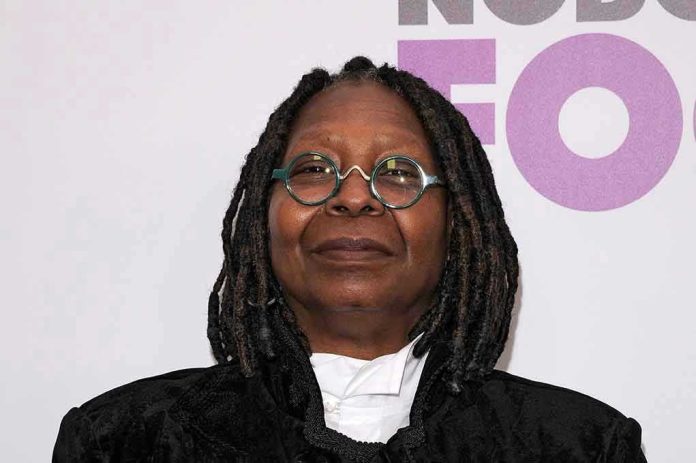
Whoopi Goldberg’s recent on-air apology uncovers a layered narrative of media bias, celebrity influence, and political rhetoric that keeps audiences on edge.
Story Highlights
- Whoopi Goldberg apologized for misrepresenting Trump’s comments on The View.
- Trump’s controversial remarks about Rob Reiner’s death sparked widespread criticism.
- The incident highlights media accountability in a highly partisan landscape.
- Unclear factual details about a “Brown” shooting case complicate the narrative.
Goldberg’s Controversial Segment
Whoopi Goldberg found herself in the crosshairs after mischaracterizing Donald Trump’s comments regarding Rob Reiner’s death and an unclear “Brown” shooting case. During a segment on The View, Goldberg accused Trump of contributing to a toxic environment with his remarks about Reiner, which she later admitted were overstated. The segment quickly drew ire from conservative media outlets, who framed Goldberg’s comments as “lies” and pressured her to issue a public apology.
Goldberg’s apology came amid this mounting pressure, acknowledging inaccuracies in her statements about Trump’s involvement or comments related to the Brown case. Her clarification did little to quell the storm, as it was primarily circulated in conservative circles, further fueling debates on media integrity and bias.
Trump’s Reaction to Rob Reiner’s Death
Donald Trump’s reaction to Rob Reiner’s death was as controversial as expected. Instead of offering condolences, Trump took to social media to blame Reiner’s death on his alleged “Trump Derangement Syndrome” and the anger he supposedly incited in others. This statement, while documented, was criticized as indecent and unpresidential, serving as a catalyst for Goldberg’s initial remarks on *The View*.
The backlash from Hollywood figures and liberal commentators was swift, decrying Trump’s lack of empathy and divisive rhetoric. This response set the stage for Goldberg’s comments, which were ultimately scrutinized for factual inaccuracies, leading to her on-air apology.
The Mysterious “Brown” Shooting Case
The narrative surrounding the “Brown” shooting case remains murky. Multiple shooting incidents involving individuals with the surname Brown have occurred over the past decade, but the specific case Goldberg referenced during her segment remains unidentified in public reports. This ambiguity complicates the narrative, as Goldberg’s comments about Trump’s alleged involvement or responsibility in a Brown-related shooting could not be substantiated, prompting her apology.
In the context of Trump’s law-and-order stance and controversial comments about various shootings, Goldberg’s conflation of details from multiple cases might have led to her misstatements. The lack of clarity about the specific Brown case involved highlights the challenges of navigating complex narratives in partisan media environments.
Media Accountability and Partisan Narratives
The incident with Goldberg’s apology underscores the ongoing battle for media accountability in a highly polarized landscape. Conservative outlets seized on her misstatements as proof of systemic bias in mainstream media, while liberal audiences viewed it as a minor correction in the broader context of Trump’s history of extreme rhetoric. This dynamic illustrates the challenges of maintaining journalistic integrity and trust in an era where partisan narratives often overshadow factual accuracy.
Daytime talk shows and opinion news programs, like The View, may face increased pressure to enhance behind-the-scenes fact-checking processes for sensitive segments. Brief, low-visibility corrections are often the norm, balancing transparency with reputational risk. This incident adds to existing evidence in studies of infotainment and the effectiveness of media corrections in shaping public perceptions.
Sources:
AOL Article on Whoopi Goldberg’s Apology