

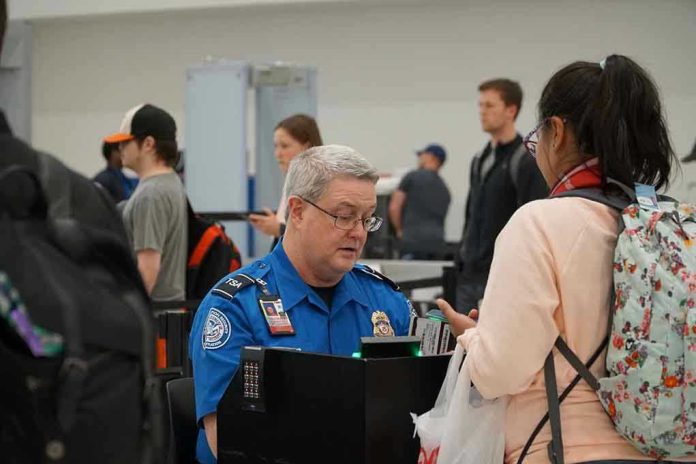
The federal government just turned “forgot your REAL ID?” from an inconvenience into a $45 decision you have to make before you leave for the airport.
Story Snapshot
- TSA began charging a mandatory $45 “ConfirmID” fee on Feb. 1, 2026 for domestic travelers who lack a REAL ID-compliant license or another accepted ID.
- ConfirmID requires online identity verification through TSA.gov and produces a receipt valid for 10 days.
- REAL ID enforcement started May 7, 2025, but TSA allowed flexible enforcement until May 5, 2027.
- TSA still can deny checkpoint access if it cannot confirm identity, even after online verification and payment.
The $45 Surprise Waiting in Your Travel Day Timeline
The ConfirmID fee hits at the worst possible moment: the final 24 hours before a flight, when people discover their license doesn’t meet REAL ID standards or they left a passport in a drawer. Starting Feb. 1, 2026, TSA expects those travelers to complete an online identity verification on TSA.gov, pay $45, and bring the confirmation to the checkpoint. The price covers a 10-day window, not a single boarding pass.
https://twitter.com/WPLGLocal10/status/2017634230503715121
TSA designed this as a modernized alternative to getting turned away outright, but it moves the friction earlier in the process. The traveler must handle the problem before arriving at the airport, which sounds efficient until you picture a family juggling bags, rental car returns, and an unfamiliar online workflow. ConfirmID takes about 10–15 minutes online, while in-person verification can take 30 minutes or longer if anything stalls.
REAL ID Was a 2005 Security Law; ConfirmID Is the 2026 Price Tag
REAL ID did not appear out of thin air. Congress passed the REAL ID Act in 2005 after 9/11, pushing states to tighten how they issue driver’s licenses and ID cards. The law’s minimum standards require document verification and stronger anti-fraud controls, and implementation deadlines slipped for years due to state pushback and practical hurdles. After more delays, federal enforcement based on identification documents began May 7, 2025.
TSA also promised “flexible enforcement” rather than an instant nationwide travel lockout. That flexibility matters because it acknowledges messy reality: people move, names change, records get lost, and some DMVs make the process feel like a part-time job. ConfirmID fits inside that flexibility window through May 5, 2027, but it signals a clear shift: the government now treats noncompliance as something you can pay to patch, temporarily.
How ConfirmID Changes the Airport Bargain You Thought You Had
For years, many travelers assumed airport security worked like this: show a state license, answer a few questions if something goes wrong, get extra screening, and move along. ConfirmID rewrites that script by formalizing a paid identity-verification path. TSA says travelers must complete biometric or biographic verification online, pay a non-refundable fee, and present the receipt at the checkpoint. The receipt’s 10-day validity is generous for multi-flight weeks but punishing for repeated forgetfulness.
TSA leadership has also been blunt about limits. Security officers must still verify identity at the checkpoint regardless of prior online confirmation, and TSA cannot guarantee clearance if verification fails. That is an important detail for travelers who assume a receipt equals a boarding guarantee. From a common-sense standpoint, the policy draws a sharp line between “permission to try” and “permission to pass,” and it keeps final authority with the officer on site.
Who Pays, Who Avoids It, and Why the System Nudges You Toward a REAL ID
ConfirmID is easiest to avoid if you already carry an accepted alternative such as a U.S. passport or military ID. For everyone else, the recurring cost can add up fast: $45 covers 10 days, so frequent travelers who stay noncompliant could pay repeatedly across the year. That pricing structure looks less like a friendly backup plan and more like a nudge toward getting a REAL ID once and stopping the bleeding.
Equity arguments will swirl around this, and some will be fair. People with limited DMV access, tight work schedules, or missing paperwork can get squeezed. Conservative instincts should still recognize the tradeoff: secure identification standards serve a legitimate national-security purpose, but government should avoid turning basic mobility into a soft toll for the disorganized and the busy. The clean solution remains straightforward: make REAL ID acquisition less burdensome, not just noncompliance more expensive.
What to Watch Next Before the May 2027 Cliff
The bigger story sits on the calendar: May 5, 2027, when flexible enforcement ends. ConfirmID may feel like the “new normal” for procrastinators, but the enforcement schedule points toward a harder edge later. Airlines and airports also have incentives to push compliance because longer identity-resolution times create checkpoint backups that ripple into missed flights and ugly rebooking lines. Operational pain always finds the customer first.
https://twitter.com/BostonGlobe/status/2017644421848748250
REAL ID compliance already exists nationwide in the sense that every state issues REAL IDs, yet millions still carry older licenses or never upgraded. ConfirmID may catch those travelers once, maybe twice, but the fee and the uncertainty at the checkpoint send the same message every time: the era of “good enough ID” is closing. The traveler who prepares now buys peace later, and peace is the real product TSA just started selling.
Sources:
REAL ID – Airlines for America
REAL ID Required for U.S. Travelers Beginning May 7, 2025 – Department of Defense Travel
REAL ID – Pennsylvania Department of Transportation