A seven-year-old boy with half a skull, a shattered highway, and a fight over who let danger onto the road.
Story Snapshot
- Police charged the big-rig driver with intoxication-based felonies tied to the crash [1].
- Federal officials said the driver entered the country illegally in 2022 and remained unlawful [1].
- Investigators said the truck never braked and toxicology confirmed impairment [2].
- Homeland Security said the case fits a wider risk pattern involving unlawful drivers of commercial trucks [4].
The crash that turned a highway into a policy battlefield
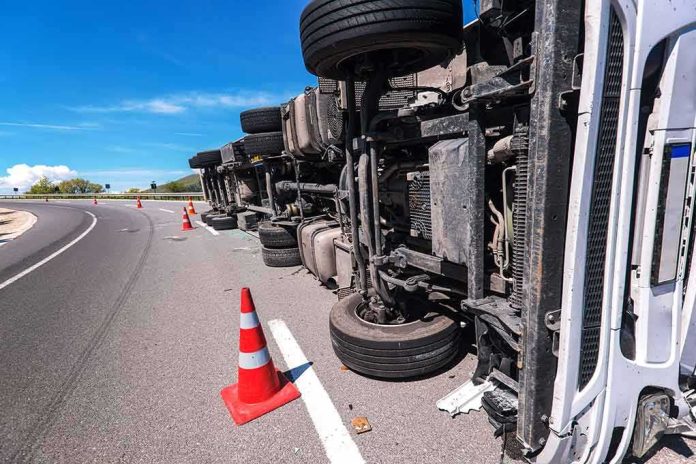
California Highway Patrol reported an eight-vehicle pileup near Ontario that left three people dead and four injured. Police arrested 21-year-old Jashanpreet Singh, the semi-truck driver. Prosecutors filed charges that include driving under the influence of drugs causing bodily injury and gross vehicular manslaughter while intoxicated [1]. Federal sources said the truck never braked before impact and that toxicology confirmed impairment [2]. These facts place the legal focus on conduct behind the wheel. They also opened the door to a larger immigration fight.
Federal immigration officials told reporters Singh is an Indian national who crossed the southern border in 2022 and was in the United States illegally at the time of the crash [1]. Media accounts citing federal sources said Border Patrol first encountered him in El Centro in March 2022 and released him pending a hearing [2]. Those claims, if proven in court records, link the tragedy to a known policy risk: release into the interior without fast resolution. That connection is political dynamite, but the criminal case still centers on intoxication.
What the charges say versus what the politics shout
Police and prosecutors pointed to impairment, speed, and failure to brake as the crash causes [1][2]. That is the core of the criminal theory. Some officials and commentators, however, now frame the case as proof of a broader enforcement breakdown. The Department of Homeland Security called it part of a concerning trend of criminal unlawful immigrants operating commercial vehicles, which it said poses a direct threat to public safety [4]. That claim speaks to policy choices, not only this crash. It also aligns with a common-sense view that laws must be enforced to prevent avoidable risks.
Counter-arguments stress the difference between cause and context. Reports say the driver had a restricted non-domicile commercial license under then-existing rules, and that a regulatory dispute over later federal rule changes is separate from the crash mechanics [4]. The defense case will likely argue that licensing status and immigration category did not cause intoxication, delay braking, or change vehicle physics. On narrow legal terms, that is true. On public safety terms, voters also weigh whether system choices put danger on the road.
Where the record is solid, and where it is still thin
Several claims rest on agency statements repeated by media, not yet on filed immigration records. No provided source includes the underlying detainer form, the full alien registration file, or the Border Patrol intake record. That lack does not make the claims false; it means the most specific immigration facts still need document-level proof. The strongest published facts right now are the charges, the crash count, and the investigator claims about no braking and toxicology results [1][2]. Those support the conduct-based case beyond politics.
Identity confusion across adjacent coverage adds noise. Some reports reference Jashanpreet Singh in the Ontario crash, while others discuss a separate Sacramento-area case naming Manvir Singh [4][5]. Readers should not collapse two stories into one. The way to cut through confusion is simple: match the California Highway Patrol case number, booking record, and county court docket to each media claim. Until then, treat narration that blends the two as suspect. Facts first, then policy.
What accountability should look like now
Accountability begins with the criminal case: intoxication, speed, braking, and reconstruction. That requires the California Highway Patrol’s full report and the toxicology packet. It continues with document truth on immigration: the detainer, the alien file, and any release paperwork. It includes licensing facts: the Department of Motor Vehicles file, work authorization, and any federal approvals tied to the non-domicile license [4]. If those records show lawful process failures, reform them. If they show willful violations, punish them. Justice demands both clarity and courage.
The principle at stake
America can welcome legal immigrants and still demand strict safety on the roads. Voters should reject the false choice between compassion and common sense. The State should remove drunk and drugged drivers from commercial cabs, enforce immigration law as written, and verify credentials before anyone hauls forty tons at highway speed. The family of a child left with half a skull does not care about spin. They need a system that stops the next truck before it crosses the line [1][2][4].
Sources:
[1] Web – California 7-year-old left with half a skull after crash involving …
[2] Web – Semi-truck driver arrested in deadly crash on Southern California …
[4] YouTube – Illegal truck driver CHARGED: Released by Biden admin
[5] Web – Deadly crash in California renews federal criticism of immigrant truck …