

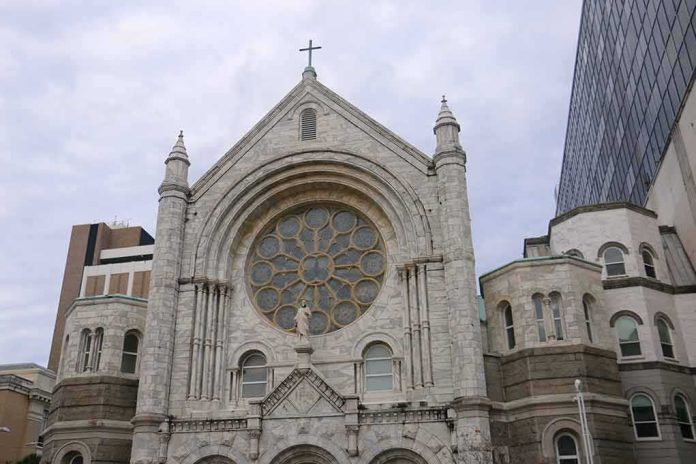
Fire investigators in Buffalo say someone deliberately set the blaze that tore through the former St. Ann’s Church complex on the city’s East Side, the second fire to hit the site in just six months.
Quick Take
- A four-alarm fire gutted the former St. Ann’s school building on Emslie Street in January 2026, followed by another blaze at the same site in July.
- Buffalo officials confirmed the more recent fire was arson, though investigators moved cautiously before making that call.
- Mayor Sean Ryan says the city will not pay an estimated two million dollars to demolish the site.
- Online commenters have tied the fires to talk of turning the property into a mosque, though that link has not been officially confirmed.
A Historic Complex Hit by Fire Twice in Six Months
The trouble started overnight on January 16, 2026, when a fire ripped through the former St. Ann’s school building at 501 Emslie Street. Crews arrived to a two-alarm fire that quickly grew to four alarms, gutting the top floor and roof of the four-story structure. Damage estimates topped six hundred thousand dollars. The building was left a roofless, frozen shell by morning.
Six months later, crews returned to the same address. Firefighters contained a three-alarm fire at the former St. Ann’s Church site on a Friday afternoon in July, marking the second serious blaze there in less than a year. Neighbors and preservation advocates watched a building already weakened by the January fire take another hit, raising questions about how a vacant, historic property kept catching fire.
Officials Move Carefully Before Ruling It Arson
Investigators did not rush to judgment after the first fire. Fire officials told reporters at the time that a human element was involved but stopped short of calling it arson, saying the intentional nature of the blaze had yet to be determined. That caution matched standard fire-investigation practice, which treats vacant and secured-empty buildings as higher risk for human-caused fires without assuming motive right away.
Buffalo officials later determined the more recent fire at the site was arson, four days after crews contained the three-alarm blaze. One local news account went further, reporting that “somebody intentionally started the fire” and that officials ruled arson as the cause. Investigators also noted a makeshift bed near the entrance of the rear structure where the fire started, a detail that speaks to the vacant building’s exposure to trespassers and fire risk.
The City Won’t Pay to Tear It Down
Buffalo Mayor Sean Ryan announced the city has no plans to demolish the former St. Ann’s site despite the repeated fire damage. Ryan said tearing down the structure would cost roughly two million dollars, a bill he argued taxpayers should not have to cover. That decision leaves the scorched complex standing on the East Side for now, its future undecided while investigators continue examining what happened.
Mosque Conversion Talk Adds Fuel to Public Anger
Social media users reacted swiftly to news of the arson, with many pointing to reported plans to convert the property into a mosque and questioning the timing of the fires. Posts online called the sequence of events suspicious, with one user asking rhetorically what would replace the church and answering, a mosque. These claims reflect public speculation rather than confirmed redevelopment plans, and no official city document cited in this reporting confirms a finalized mosque conversion. Still, the suspicion shows how a vacant historic church can become a flashpoint for community tension long before any redevelopment plan is settled.
BREAKING: 140-year-old St. Ann church set on fire in Buffalo, NY
Cause determined to be arson pic.twitter.com/LlA1n5MNsp
— THE GREAT AWAKENING (@Q_1776_United) July 23, 2026
A Pattern That Reaches Beyond Buffalo
Buffalo’s former St. Ann’s Church is not alone in facing suspected arson after sitting vacant. In Toronto, the historic St. Anne’s Anglican Church burned in June 2024, and police only confirmed the fire as suspected arson more than a year later, after murals, stained glass, and irreplaceable art inside were destroyed. In Idaho, federal investigators similarly ruled a blaze that destroyed St. Ann Church as arson. The pattern suggests older, unused church buildings face real fire risk, whatever redevelopment debates surround them.
For Buffalo residents, the practical stakes are simple. A beloved East Side landmark now sits damaged twice over, with no clear plan for repair or demolition. Investigators have confirmed arson, but the full story of who set the fire and why remains open. Until that answer comes, the debate over the building’s next chapter will likely keep drawing attention far beyond Buffalo’s city limits.
Sources:
thegatewaypundit.com, wivb.com, wkbw.com, youtube.com, audacy.com, facebook.com, toronto.anglican.ca, ncronline.org