
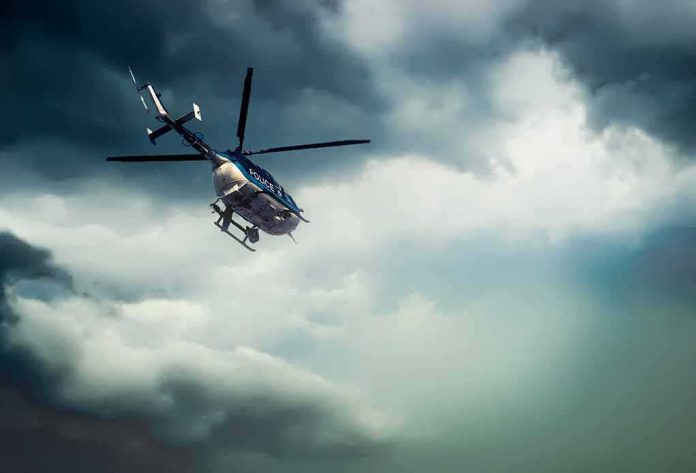
A Pennsylvania State Police helicopter and a Cessna 150 collided near Carlisle Airport around 7:50 p.m., igniting a chaotic, high-stakes scene that now sits squarely with federal investigators to unravel.
Story Snapshot
- Authorities identified the aircraft as a Cessna 150 and a Bell 407 helicopter.
- The helicopter belonged to the Pennsylvania State Police, with two people on board.
- The collision happened near Carlisle Airport in the early evening on August 19, 2026.
- Emergency crews flooded the airport; the coroner was called to the scene.
What Happened In The Air Over Carlisle
Federal Aviation Administration officials reported a midair collision between a Cessna 150 and a Bell 407 helicopter near Carlisle Airport just before 8 p.m. on August 19, 2026. Multiple outlets identified the helicopter as a Pennsylvania State Police aircraft, with two people aboard. The small plane’s occupancy was not immediately known. The crash unfolded near the runway area. Photos and reports from the scene showed the helicopter on its side and smoking next to the pavement.
Dispatchers sent a large response within minutes. Fire units, emergency medical teams, and state and local police converged on the airport. Airspace in the immediate area was closed as crews worked the scene and secured debris fields. The county coroner was requested, a clear signal that officials treated the event as likely fatal from the outset, though a final casualty count was not immediately released. The National Transportation Safety Board took the lead in the investigation, with the Federal Aviation Administration supporting.
Why Airport Patterns Are The Danger Zone
Midair collisions often happen near airports when pilots fly by visual separation. Federal safety studies show most midair collisions occur in or near the airport environment, where traffic is dense and pilots join or leave the pattern at different angles and speeds. The mix of a helicopter and a fixed-wing trainer-type plane raises familiar risks. Sightlines can be tight. Closure rates can surprise even seasoned crews. One missed radio call or a blind spot can erase precious seconds to avoid conflict.
General aviation records point to the pattern and final approach as common pinch points. Many midairs occur at or within a few miles of non-towered fields, below 1,000 feet above ground level, during clear weather when many pilots are active. The Carlisle Airport setting fits that high-risk profile. Investigators will look hard at traffic sequencing, altitude, radio use on the common frequency, and whether standard entry and departure paths were followed.
What Investigators Will Pin Down Next
Investigators will map wreckage, analyze radar or Automatic Dependent Surveillance–Broadcast tracks if available, and review radio audio to lock down timing and positions. They will confirm the helicopter’s mission, crew qualifications, and maintenance status. They will do the same for the Cessna 150’s pilot and aircraft records. Expect a focus on “see-and-avoid” performance, closure geometry, and any workload or distraction factors that cut into scan time. This is standard, methodical work, not guesswork.
Our condolences to the family & loved ones of the Cessna 150 pilot who lost their life in the collision at Carlisle Airport.
We’re also keeping PSP Corporal Corman & Trooper Mills in our thoughts as they recover.
Thank you to all our first responders who responded.
📸 CBS 21 pic.twitter.com/LMmqTIsfUj
— Cumberland County, PA (@CumberlandCoPA) August 20, 2026
Past National Transportation Safety Board findings in other collisions show a pattern: many turn on both pilots’ failure to see and avoid, sometimes compounded by pattern geometry or route design that placed aircraft on converging paths. That does not assign blame here; it sets the lens. The Board will test each link in the chain. If a radio call did not carry, they will ask why. If a flight path was unconventional, they will ask whether it was necessary and announced.
What This Means For Safety And Accountability
Law enforcement aviation must earn public trust every flight. A police helicopter shares the same air with students, hobbyists, and business pilots. That demands crisp procedures, clear radio work, and tight coordination. The same holds for any pilot in a light plane. Conservative common sense puts a premium on discipline: fly the pattern, mind the scan, speak up on the frequency, and break off if something does not look right. Freedom in the air depends on order in the pattern.
Federal investigators will release a preliminary report soon, which should confirm registrations, occupants, and a basic sequence. The full report will take longer. Until then, the facts stand: a Pennsylvania State Police Bell 407 and a Cessna 150 collided near the runway at Carlisle, two troopers were aboard the helicopter, the response was massive, and federal teams are on the case. That is the frame for accountability and for the safety lessons that will follow.
Sources:
nypost.com, local21news.com, facebook.com, faasafety.gov, npr.org, rogersaviationnw.com