

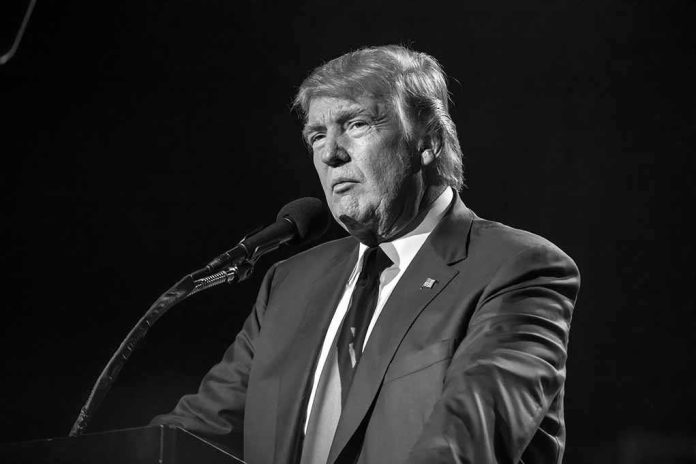
President Trump vowed that “probation is no longer an option” for benefit fraud, and he tied prison time to every stolen dollar.
Story Snapshot
- Trump announced mandatory prison for fraud against federal benefit programs.
- Sentence length would scale with the amount stolen; no probation allowed.
- Second convictions would trigger doubled sentences for repeat fraudsters.
- State and local officials who ignore known fraud could face personal liability.
What Trump Proposed, In Plain Terms
President Trump released a video on October 3, 2026, that set a hard line: if you steal from the American people through programs like Medicare, Medicaid, or Social Security, you go to prison, not probation. He said the sentence should grow with the loss amount. He added a repeat-offender rule that doubles the sentence for a second conviction. He also backed personal liability for state or local politicians who know about fraud, could stop it, and fail to act.
Trump’s framing was direct: “the more you steal, the longer you’ll stay in that prison,” and “probation is no longer an option for the fraudsters”. Coverage soon echoed those points, noting he did not publish a chart of ranges or dollar brackets but made clear he wants stiffer time tied to theft size. Outlets summarized the targets as major federal benefits, where fraud drains taxpayer funds and angers honest participants who follow the rules.
How It Would Work, And What Is Missing
The plan sets outcomes but leaves mechanics to Congress. Reporting states there is no bill text or sentencing table yet. That means no specific loss thresholds, no list of covered statutes, and no instructions on how to apply the doubling rule across different courts. The same gap applies to the official-liability idea. The proposal does not define the legal test for a politician’s knowledge, authority, causation, or immunity limits. Congress would need to write those standards into law first.
On scope, public reports point to fraud that hits Medicare, Medicaid, and Social Security. They do not spell out whether the plan would cover private insurance fraud, state-only programs, conspiracy, or attempts. They also do not specify how disputed loss calculations would be resolved. Those details matter because dollar figures drive the sentence length under Trump’s stated principle. Until Congress fills in those blanks, agencies and courts cannot implement the idea as policy.
Why The Message Hits A Nerve With Taxpayers
Benefit fraud sparks anger because it feels like theft from neighbors, not a distant fund. Trump’s position taps a common-sense view: if you steal public money, you should not walk free. Conservative values stress accountability, restitution, and equal rules for elites and street crooks alike. Many readers will cheer mandatory prison for serial scammers and kickback artists. That reaction tracks with the goal to deter schemes that bleed health care programs and undermine trust in safety nets.
Yet sentencing data show the current system already sends many offenders to prison, but often for shorter terms than Trump wants. Federal figures report average health care fraud sentences around two years, and only a small share of cases carry existing mandatory minimums. Those numbers explain why a tougher stance has political traction: people see big losses and think the time does not match the crime. The proposal answers that gap with a bright-line rule and stiffer time served.
What Past Evidence Suggests About Deterrence
Criminal-justice research has long found that catching offenders swiftly often deters crime more than raising maximum sentences alone. Studies surveying mandatory minimums say longer terms by themselves do not always reduce offenses and can shift power to prosecutors or encourage workarounds in court. That pattern should guide Congress as it drafts details: combine stronger penalties with better audits, targeted investigations, faster charging, and firm restitution systems, so certainty and severity move in step.
$250 million meant for hungry kids. 68 convicted. The congresswoman behind the MEALS Act called it "working exactly as intended." Nobody checked the people writing the checks. Every claim sourced. 🧾 https://t.co/Cln3hUVBqg
— The Digital Daily Ledger · Craig Drelas (@CDreoulas) October 11, 2026
Policy design should also guard against unintended effects. Clear loss brackets, clear mens rea standards, and fair treatment for low-level workers pulled into schemes would protect proportionality. A transparent rule for the repeat-offender doubling would prevent inconsistent results. For officials, a defined test for knowledge, ability to act, and causation would keep the focus on willful neglect, not Monday-morning quarterbacking of tough calls. Tight drafting turns a strong message into a working law that courts can apply.
Sources:
crbcnews.com, newsmax.com, yahoo.com, stl.news, punchng.com, themainewire.com, wltreport.com, pulse.com.gh