Three American soldiers were killed and dozens wounded when a one-way attack drone struck a small U.S. post in northeast Jordan near the Syria border.
Story Snapshot
- U.S. Central Command said a one-way attack drone hit a site in northeastern Jordan, killing three and injuring at least 25.
- The Pentagon described the post as part of the mission to defeat the Islamic State group.
- U.S. leaders blamed Iran-backed militias operating from Syria and Iraq for the strike.
- More than 40 total injuries were later tracked, with eight medical evacuations.
What Hit, Where It Landed, and Who Paid the Price
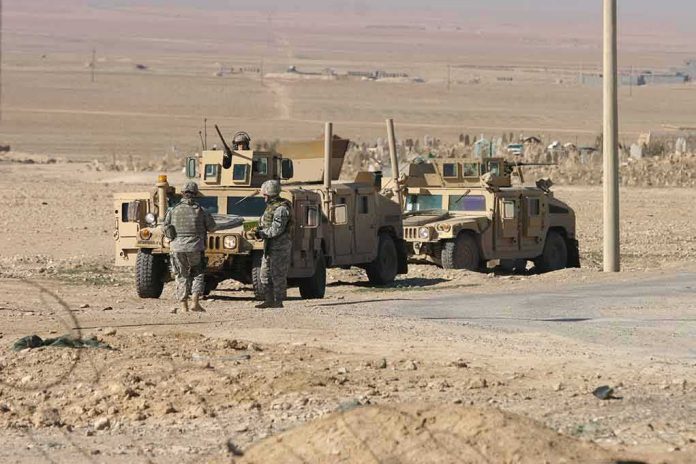
U.S. Central Command reported that a one-way attack drone impacted a base in northeastern Jordan on January 28, 2024, killing three American service members and injuring at least 25 others. The outpost, often called Tower 22, sits near the tri-border area with Syria and Iraq. The Department of Defense said U.S. and partner forces use the site to support the lasting defeat of the Islamic State group, which explains why Americans were stationed at this austere post. Early casualty figures later rose as more troops reported injuries.
President Joe Biden said the strike was carried out by radical groups backed by Iran that operate in Syria and Iraq. That framing matches the pattern of militia attacks that grew after October 2023, where low-cost drones and rockets probed defenses and sought U.S. casualties. The Pentagon said more than 40 U.S. service members were ultimately tracked with injuries, and eight were flown out for further care, which shows the blast’s reach and the risk from even a single small unmanned aircraft.
How A Low-Cost Drone Becomes A High-Cost Threat
Defense officials said they were assessing how a single-use drone pierced defenses and struck housing areas on the Jordanian site. These drones are hard to spot, fly low, and blend into background clutter. A cheap airframe with a simple warhead can still create mass casualties when it hits soft targets. The U.S. military has invested in radar, jamming, and interceptors, yet gaps remain at remote posts. After the attack, Central Command reviewed air-defense needs across the theater to close those gaps.
Common sense says enemies will choose weak seams: small bases, shift changes, and edges of sensor coverage. That is what American troops face from militias that want to bleed U.S. will without triggering a full-scale war. The United States cannot accept a world where terrorists and proxy forces pick off Americans while Washington hesitates. Strength, clarity, and layered defenses save lives. Hesitation or mixed signals invite more of these tests.
Attribution, Mission, and The Stakes
The Pentagon linked the attack to Iran-backed militants who operate from Syria and Iraq, a description echoed by the President and senior officials. The troops at the site were deployed to support the defeat of the Islamic State group, a mission that prevents the terror network from rebuilding safe havens along the border. The United States keeps small footprints in tough places because terror groups exploit vacuums. Pulling back too far, too fast can cost more in the long run by letting enemies rearm and plot beyond our reach.
American conservative values line up with three hard rules here: punish killers who strike our people, deny terrorists safe ground, and back the troops with the armor and tools they need to win. Retaliation must be focused and decisive. Deterrence works when it is seen and felt by those who would test it. That means hitting the responsible networks, their launch teams, and their money streams, without dragging Americans into open-ended occupations.
What Changes Now: Force Protection And Deterrence
Central Command said investigators would determine how the drone got through and how to harden defenses across the region. Expect more counter-drone sensors at small sites, tighter identification of friendly and hostile aircraft, and faster engagement rules at the edge of bases. Expect more dispersion of housing and command nodes to limit blast effects. These steps cost less than a new war and pay off the first time a drone is detected, jammed, or shot down before impact.
TRUMP VOWS RESPONSE AFTER IRAN ATTACKS U.S. FORCES IN JORDAN
The war between the U-S and Iran is heating up again.
NewsNation's Cory Smith has the latest.: “Today President Trump says the US will respond to Iran's attack on US forces in the Middle East, saying, quote, We're…— Worldwide News Network (@WorldwideNNX) August 31, 2026
Policy also needs teeth. Militia leaders should face direct costs when they enable attacks on Americans. The networks that supply parts, training, and intelligence should feel pressure every day. Real deterrence blends defense and offense. It protects the base today and shapes enemy risk tomorrow. The United States owes that balance to the three fallen soldiers, the dozens who were hurt, and every family that waits for a loved one to come home from a hard post on a harsh border.
Sources:
facebook.com, slite.dma.mil, foxnews.com, washingtoninstitute.org