Italy’s leader put schools at the center of a culture fight: faces uncovered in class, fewer foreign-student heavy rooms, and parents learning Italian or risk falling behind the system.
Story Highlights
- Prime Minister Giorgia Meloni said schools will ban burqas and niqabs and cap foreign students per class.
- The plan adds Italian lessons for some parents of students who struggle to integrate.
- Supporters call it a push for language, order, and shared rules; critics call it religious bias.
- The move echoes wider European rules on face coverings in schools and public life.
What Meloni Announced And Why It Matters
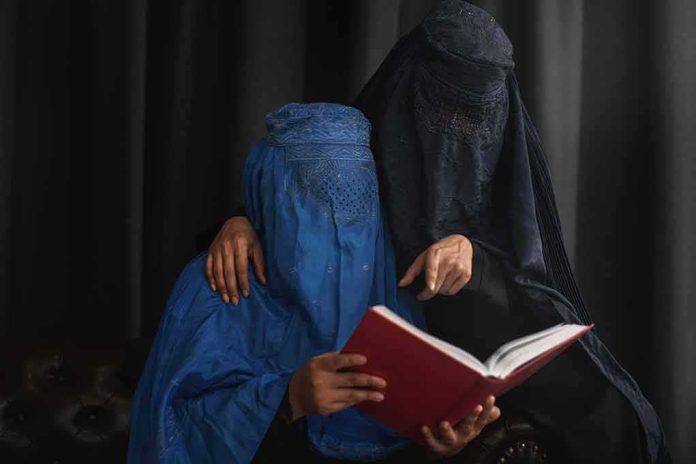
Prime Minister Giorgia Meloni told supporters her cabinet will soon see a measure with three parts. Schools would ban face-covering veils like the burqa and niqab. Classes would face a legal cap on the share of foreign students. Some parents of students with serious integration problems would need to learn Italian. Meloni framed the change as simple school order: children learn best when they can see faces and follow the same language in class.
Meloni also tied the class cap to common sense. If too many students cannot follow Italian, the class slows down for everyone. She said that no longer looks like integration. It looks like neglect of all students, including immigrant kids who most need strong language support. The government has pitched this as a fairness rule. Teachers must teach one class, in one language, with clear standards. Parents also share a duty to help children thrive.
The Pushback And The Fault Lines
Opposition parties and legal experts questioned the ban and the caps, warning about religious freedom and equal treatment claims. The Council on American-Islamic Relations said a veil ban is an authoritarian hit on religious choice and pointed to the odd result that non-religious face coverings could still be allowed for other reasons. Reuters has also tracked the ruling party’s longer push against what it calls cultural separatism linked to Islam, a frame critics reject as unfair.
These critics argue the school is exactly where inclusion should be modeled. They warn a ban could stigmatize a small group of girls and families who already feel on the margins. They also say quotas can misfire. A cap can scatter students who need language help into several classes without adding teachers or tutors. That spreads the problem and leaves every class thin on support. The core dispute is not about goals. It is about which tools actually deliver.
How This Fits Europe’s Pattern Of School Rules
Several European countries already restrict full-face coverings in public spaces, and many schools require open faces for learning and safety. Courts in Europe have often upheld narrow, school-based rules that center on pedagogy, identification, and order, though each case turns on exact scope and reasons offered by the state. Italy has seen local rules before. Meloni’s plan seeks a national line inside schools, not a blanket public ban, at least in this phase.
[Italy burqa ban, Italy niqab ban, Italian school rules, Giorgia Meloni, full-face covering ban, foreign students Italy, Italy education rules, European burqa bans]#Italy #BurqaBan #Niqab #GlobalNews #OutlookIndia pic.twitter.com/cl9D68IDF8
— Outlook India (@Outlookindia) September 21, 2026
The legal test will likely hinge on proportionality. A school can ask for open faces to aid teaching and safety. A school can set language targets to speed up learning. The details decide the case. Narrow school rules with clear help for affected students fare better than symbolic limits with thin support. If the government pairs the ban and caps with more language teachers and parent courses, courts and voters may see a coherent plan, not just a culture signal.
The Policy Bet: Integration With Guardrails
Supporters believe classroom caps and open-face rules set a floor for shared life. They see this as respect for teachers, fellow students, and the nation’s language. That view aligns with a conservative ethic: one schoolhouse, one standard, equal rules, and clear duties for families. Opponents fear a chill on a small faith practice and a slippery slope. They want investment in language help without dress rules they see as aimed at Muslims. Both sides claim to protect social peace.
The next steps will be decisive. Parliament must refine scope, define “foreign student” for caps, and build in support so kids are not shuffled but taught. The government will need to show that language classes for parents are real, reachable, and free or low-cost. Measured that way, success looks simple: faster Italian fluency, fewer discipline fights over face coverings, and rising test scores across mixed classrooms. If those numbers move, the politics follow.
Sources:
redstate.com, euronews.com, youtube.com, aljazeera.com, latimes.com, indiatoday.in