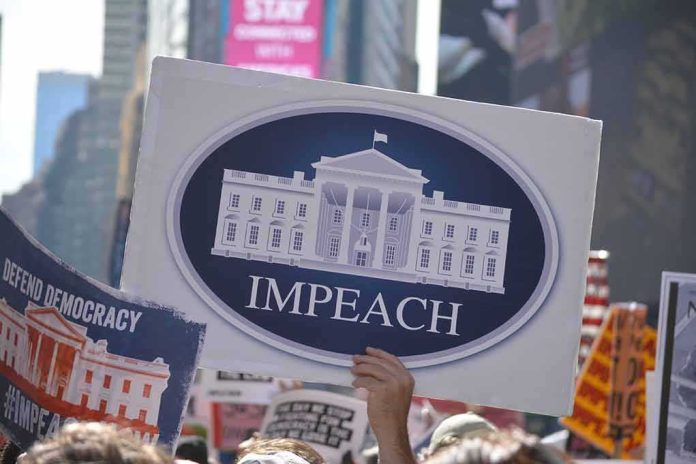
Rep. Steve Cohen just dropped a 26-count impeachment blitz on President Trump, the largest package ever filed against a sitting president.
Story Snapshot
- Cohen, a senior Judiciary member, filed 26 impeachment articles through official House channels.
- The filing alleges abuses of power, oath violations, corrupt pardons, and emoluments violations.
- Counts span elections, war powers, immigration, spending, and media access.
- The move functions as both a constitutional claim and a political marker.
Cohen’s filing: scope, claims, and why it matters
Rep. Steve Cohen of Tennessee introduced 26 articles of impeachment against President Trump on September 24, 2026, through his official House office. His press release says the counts allege multiple abuses of power, violations of the presidential oath, corrupt use of the pardon power, and violations of the Constitution’s emoluments clauses. Cohen identified himself as a senior member of the Judiciary Committee and cast the conduct as “high crimes and misdemeanors,” invoking the Constitution’s impeachment standard to frame the package.
The document reads like a catalog of alleged misconduct across the government. Headings cited in coverage and his release include undermining democracy by sowing doubt in elections, waging war on Iran without Congress, and extrajudicial killings tied to actions near Venezuela’s waters. Other counts claim defiance of court orders on immigration and unlawful withholding of funds while dismantling programs set by Congress. These are concrete institutional claims that aim to test core separation-of-powers lines.
What the 26 articles try to prove
The resolution attempts two things at once. First, it stacks discrete legal theories that a court, a committee, or the public can understand: follow the money, check the orders, read the rulings. Second, it paints a broad pattern of alleged power grabs. Cohen’s office says the package covers misuse of pardons and conflicts tied to private interests. It also lists fights over media access and actions toward inspectors general. The size signals a claim that the issue is not one act, but a governing method.
Legal friction points show up in the headings. War powers claims rest on the Constitution’s grant to Congress to declare war. Spending fights rest on Congress’s power of the purse. Court-order disputes turn on the duty to “take care” that the laws be faithfully executed. If even a fraction of these counts align with the records Cohen cites, the constitutional stakes are high. If not, the package risks looking like a political protest dressed in legal clothes.
How this fits the impeachment playbook
Impeachment is rare and heavy. The Constitution sets “treason, bribery, or other high crimes and misdemeanors” as the bar, and leaves room for Congress to judge what crosses the line. The Senate has never convicted a president. Because of that, House filings often double as a public ledger of alleged abuses and a message to future leaders: guard the guardrails. Cohen’s multi-count reach follows that pattern, expanding to capture a full term’s worth of disputes in one stack.
Scale can help or hurt. A long list can show a pattern across agencies, budgets, and foreign policy. But a long list also invites targets to pick off weaker items and say the whole set fails. The best test for claims like defying court orders or withholding funds is the paper trail: rulings, memos, and statutory text. That is where any impeachment article should live or die. Common sense says Congress must guard its war, purse, and lawmaking powers, or it loses them.
What to watch next
House action will set the pace. Leaders can refer the filing to the Judiciary Committee, hold hearings, or let it sit. Committee staff can demand documents from the White House, the Department of Justice, the Department of Defense, and the Department of Homeland Security, and match them against each count. If hearings open, watch for testimony that pins dates, orders, and statutory hooks to each article. That is how any impeachment case grows from headlines into a record.
Sources:
cohen.house.gov, yahoo.com, truthout.org, narativ.org