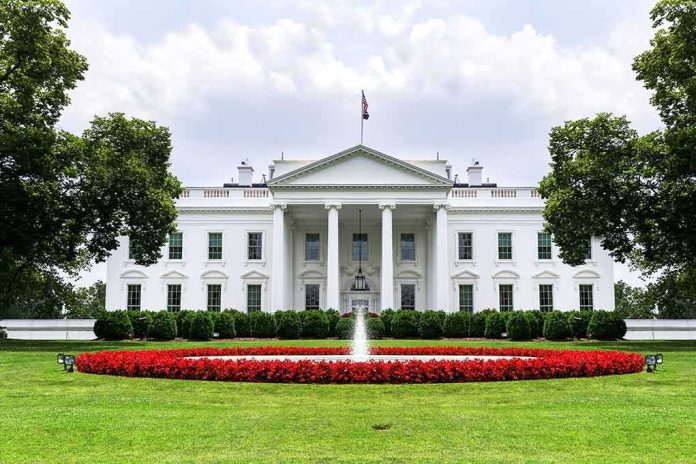
Trump’s late-day post dared the press with a “before and after” swap: briefing room out, FDR’s pool in.
Story Snapshot
- Trump shared a split-image: “Fake News” briefing room vs. “FDR Pool.”
- The image lands amid his bans on several outlets from White House grounds.
- Courts have long rejected arbitrary press exclusions once access is open.
- FDR built the original West Wing pool; the press room later covered it.
What Trump Posted And Why It Struck A Nerve
President Trump posted a side-by-side image on Truth Social. The left showed the White House briefing room labeled “Fake News” and “Before.” The right showed a glossy indoor pool labeled “FDR Pool” and “After.” The post went up on September 27, 2026, at 3:59 p.m. Eastern time, and was archived with those captions and layout. The message mocked the press and teased a throwback to Franklin D. Roosevelt’s pool, which once sat under today’s press room.
The post did more than troll. It came after Trump barred CNN, MS Now, and Politico from the White House grounds, while arguing that access is a privilege, not a right. That action set off legal and political pushback, since the United States has a strong tradition of press access at the White House after facilities open to journalists. The image, then, read like a symbol of his strategy: shrink press proximity and elevate spectacle.
The Long Fight Over Press Access At The White House
United States courts have said for decades that the government cannot deny press access in a political or arbitrary way once it opens facilities to bona fide journalists. The landmark case, Sherrill v. Knight, requires clear standards, notice, and a chance to respond before credentials get denied. That line stands in tension with blanket bans or shifting rules that hinge on coverage tone rather than security or order. Legal experts say such bans face long odds.
The White House argues it can manage space, safety, and decorum. It also claims the First Amendment does not guarantee a seat in the briefing room. That narrow point is true: no one is born with a hard pass. But once the building opens its doors to the press corps, the law kicks in to block selective punishment and viewpoint-based exclusion. Conservative values back rule-of-law clarity here: set neutral rules, apply them evenly, and let the people judge the facts.
FDR’s Pool, The Brady Room, And The Power Of Images
Franklin D. Roosevelt installed an indoor swimming pool at the White House during his presidency. Decades later, renovations built the James S. Brady Press Briefing Room above that space. The West Wing has changed many times across administrations, but the press workspace became central to daily coverage. The White House Historical Association notes the pool-to-press transformation as part of that evolution, which is why the visual swap in Trump’s post hit history and media in one frame.
Trump Floats Tearing Down WH Briefing Room for FDR's Swimming Pool in Late-Night Post https://t.co/T4a3HURbwr
— Mediaite (@Mediaite) September 28, 2026
The image’s punch came from a clean, simple story: erase the “Fake News” room, bring back a glamorous pool with a presidential backstory. It allowed supporters to see swagger and humor. It let critics see a real threat to access. It also blurred the line between joke and plan, which is a feature, not a bug, in modern political messaging. The conservative instinct should be to ask: does the move improve transparency, accountability, and order, or just score a meme?
Policy Signal Or Meme? What To Watch Next
Renovating core West Wing space is not a weekend project. Any real plan to remove the briefing room would require design work, cost estimates, security reviews, and a communications plan. If the White House issues bids, files plans, or closes the room for work, that signals action. If it keeps using the room while posting more images, that signals messaging pressure. Either way, the legal fights over access will hinge on objective standards and even-handed enforcement.
The press will challenge bans in court. Judges will ask whether rules are clear, neutral, and followed. The administration will argue safety and efficiency. Voters will see the results on their screens: either regular briefings with tough questions, or more curated content from the White House. A strong conservative approach favors sunlight and firm rules. Keep order in the room, keep standards public, and keep the people’s house a place where hard questions get asked and answered.
Sources:
mediaite.com, themirror.com, thedailybeast.com, realitytea.com, thegatewaypundit.com