

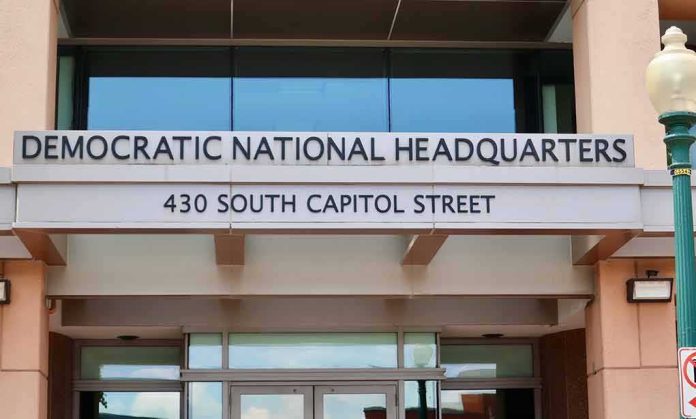
Montana’s top law officer opened a probe after a Democratic Senate nominee said party officials offered her a national post if she quit.
Story Snapshot
- Alani Bankhead alleged a Democratic National Committee job was offered if she withdrew.
- Montana’s attorney general launched an investigation under a state election-law provision.
- The Democratic National Committee said no job was ever offered to Bankhead.
- Reports describe broader pressure on Bankhead to exit and back an independent.
What Bankhead Says Happened And Why It Matters
Alani Bankhead, the Democratic nominee for United States Senate in Montana, said party figures pushed her to step aside after her primary win. She stated on camera that she was offered a role she described as leading female veteran candidates at the Democratic National Committee, and she said that was the only concrete thing put on the table. She also said she faced a wave of calls, emails, and messages from Democratic officials and allies to get out before the drop deadline.
The claim goes beyond routine party pressure. It alleges a specific trade: a national party job in exchange for ending a campaign. That would be a different act under law and ethics than the usual nudges, donor freezes, or endorsement games. Bankhead framed the pressure as coming in a sequence: messages from hundreds of people, a letter from state lawmakers, outreach from elected officials, and a coffee invite from former Governor Steve Bullock. A Montana outlet reported the push included backing independent candidate Seth Bodnar.
How The State Responded Under Montana Law
Montana Attorney General Austin Knudsen said the allegation, if true, appears to violate a state election statute and announced that his office would contact Bankhead, Seth Bodnar, and the Democratic National Committee. He cited Montana Code Annotated 13-35-221 while starting the inquiry. That response signaled the state views the account as specific enough to check rather than a vague grievance. It also sets a paper trail that can later be reviewed for timing, contacts, and any records gathered.
Knudsen’s step keeps the focus on facts that can be tested. Investigators can request emails, texts, call logs, calendar entries, and witness interviews from the days after the primary through the withdrawal deadline. They can also ask whether the described job existed, who could offer it, and whether anyone linked employment to a drop-out or endorsement. That is the practical path to prove or disprove a direct conditional offer under state law.
What The Democratic National Committee And Others Say
The Democratic National Committee told The Hill that Bankhead was never offered a job by the committee. That direct denial draws a hard line between the two accounts. The Helena Independent Record also reported that the Bankhead camp connected the pressure to withdrawing and endorsing Seth Bodnar, while Bodnar’s team said he did not ask Bankhead to drop out and had no knowledge of any offer. These statements frame the dispute while the state inquiry proceeds.
A separate clash with Planned Parenthood Action Fund shows the volume of pressure around Bankhead’s campaign but does not itself prove a job offer. Bankhead’s team said a board member made urgent calls before the August 10 withdrawal deadline that they saw as a request to leave the race. That episode speaks to the common party-world tactics of urging, isolating, and signaling. It does not, on its own, establish a quid pro quo for employment.
The Line Between Hardball Politics And A Quid Pro Quo
Parties try to shape fields every cycle. They recruit preferred candidates, steer money, and stack endorsements. That is normal in American politics. A conditional exchange of employment for withdrawal is not. The difference is bright and matters to voters who expect open primaries to mean something. Montana’s law draws that line on purpose. The reported plan of action—identify the person who made the offer, find the messages, test the timeline—is the right way to confirm what crossed that line.
Two facts can both be true at once: parties push hard, and candidates rarely like it. The question here is narrower. Did anyone with real authority dangle a Democratic National Committee job in return for Bankhead quitting and blessing an alternative? Bankhead says yes and has repeated it on record. The Democratic National Committee says no. The attorney general says the state will find out. That is exactly how a system should work when stakes run this high.
Sources:
thegatewaypundit.com, thehill.com, nbcmontana.com, helenair.com, montanarightnow.com