

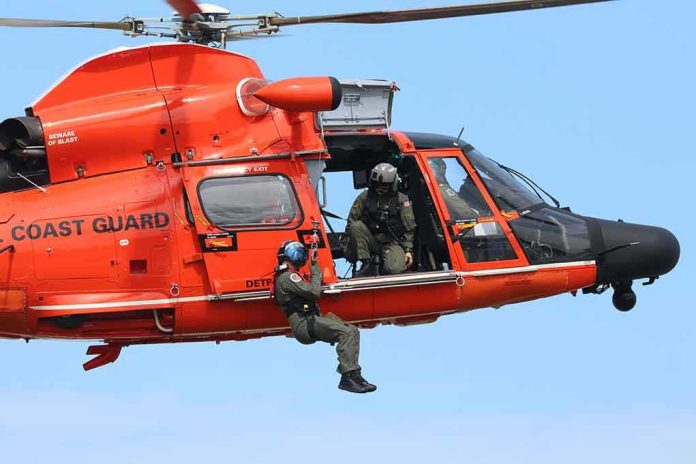
A boat packed with 27 people sank in the dark Pacific waters off Mexico, and when rescuers pulled 16 survivors from the sea, several had wounds that looked like shark bites.
Quick Take
- A mayday call near 1 a.m. reported a sinking boat about 140 miles west of Ensenada, Mexico, on October 16, 2026.
- The U.S. Coast Guard, U.S. Navy, and Mexican Navy rescued 16 people and kept searching for 11 others believed missing.
- The Mexican consulate in San Diego confirmed every rescued survivor was a Mexican national.
- Survivors were treated for injuries consistent with shark bites, though officials have not said sharks caused the capsizing or any disappearance.
A Mayday Call Sets Off A Cross-Border Rescue
The U.S. Coast Guard received a distress call around 1 a.m. local time reporting a boat taking on water in open ocean. Crews scrambled aircraft and vessels to the coordinates, roughly 140 miles west of Ensenada, deep in Pacific waters known for migrant-smuggling traffic headed toward California. What they found was a scene of chaos: people scattered across the dark water, clinging to debris, with hours passing before every survivor could be located and lifted to safety.
Rescue teams pulled 16 people from the water and confirmed all were alive. Eleven others from the same vessel were not accounted for when search efforts continued into the following days. Coast Guard officials described the missing count as an estimate based on how many people the boat was believed to be carrying, not a final, confirmed tally.
The Numbers Behind The Search
Multiple outlets reported the same core figures: a vessel carrying 27 people, 16 pulled out alive, and 11 still unaccounted for. That math lines up consistently across Associated Press coverage and the Coast Guard’s own statements, giving the public a clear baseline even as the search continued. The Mexican consulate in San Diego told reporters every survivor recovered so far was a Mexican national, adding a confirmed government source to the rescue details.
What remains less clear is exactly who the 11 missing passengers were. No names, ages, or family identifications had surfaced in the days after the capsizing. Investigators have not released a verified passenger manifest, leaving the count of 27 as a reported figure rather than a document anyone has shown the public.
Shark Bites Reported Among Survivors
Several survivors needed treatment for injuries that doctors and officials described as consistent with shark bites. That detail understandably grabbed headlines, turning a grim immigration-smuggling story into one with a predator lurking beneath it. But officials have not said sharks caused the boat to capsize, nor have they tied shark activity to why 11 people went missing. The bites happened to people already fighting to survive in open water after their boat went down.
That distinction matters. A shark attacking someone already stranded at sea is a tragic consequence of the vessel failing, not the reason it failed. Readers chasing the most dramatic detail risk losing sight of the real failure here: an overloaded boat, far from shore, with no apparent safety plan for the people aboard it.
A Familiar And Deadly Route
This capsizing did not happen in isolation. The waters off Baja California have seen repeated smuggling-related disasters, including a panga boat that overturned north of the border in May 2025, killing at least three people, and a 2023 wreck near San Diego that left eight dead. A 2022 case even ended in a conviction tied to an overloaded vessel that broke apart, killing three more. The pattern points to a route where unsafe boats and desperate passengers keep colliding with the ocean’s own dangers.
Global tracking backs up how undercounted these tragedies are. The International Organization for Migration recorded at least 2,959 migrant deaths across the Americas between 2014 and 2018, and more than 60 percent happened along the U.S.-Mexico border region. Officials admit the real numbers likely run higher, since bodies lost at sea or in remote terrain often go uncounted entirely.
What Comes Next For The Search
Search crews from three nations’ maritime forces kept working the waters off Baja California following the rescue, hoping to recover the missing or confirm what happened to them. Until a final report, recovery, or manifest surfaces, the count of 11 missing stands as the clearest, most consistent fact investigators have shared publicly.
This incident is a stark reminder of what happens when human smugglers load desperate migrants onto vessels never built to survive open ocean. Families seeking a better life in America deserve policies that stop them from ever boarding these death traps in the first place, rather than headlines written after the fact.
The Coast Guard has not announced a timeline for ending the search, and no additional survivors or bodies had been confirmed as of the latest reports.
Sources:
redstate.com, ibtimes.co.uk, geo.tv, latimes.com, cbc.ca, marinelink.com