
President Trump told the Attorney General to seek the death penalty for anyone who murders a firefighter.
Quick Take
- Trump made the call at a White House Rose Garden luncheon on October 15, 2026, directly addressing Attorney General Todd Blanche.
- He described a firefighter being shot while climbing a ladder and said capital punishment should follow.
- The remarks came months after Trump signed a law expanding benefits for firefighters hurt by job-related cancers.
- Federal law limits when capital charges actually apply, so the proposal’s real reach depends on jurisdiction and statute.
What Trump Said And Who He Said It To
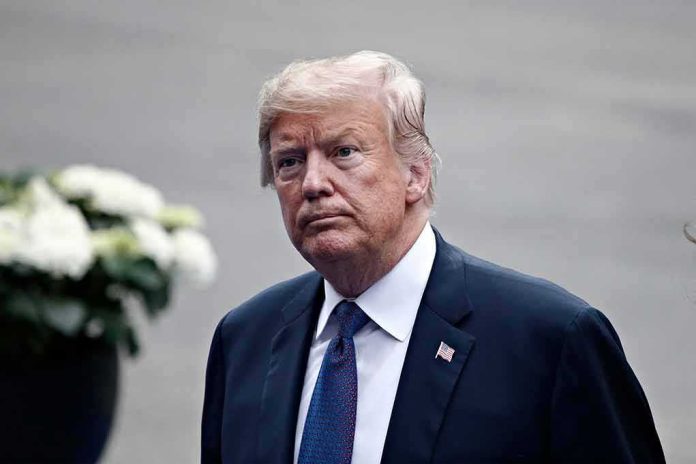
Trump spoke at a Rose Garden luncheon honoring first responders. He turned to Attorney General Todd Blanche and said plainly: “Anybody that murders a firefighter, going up a ladder, and they shoot him… Death penalty, Todd.” The comment was not a passing aside. Reporters covering the event described it as a direct instruction, not just a talking point for a crowd of grateful firefighters and police officers.
Multiple outlets reported that Trump said he had already directed the Department of Justice to pursue capital punishment in firefighter murder cases. The transcript shows him asking Blanche, in front of the room, whether the punishment could actually be applied under existing law. That detail matters. It frames this less as a campaign-style promise and more as a sitting president pushing his own Justice Department toward a specific prosecutorial posture.
The Reasoning Behind The Push
Trump argued the punishment would work fast. According to the event transcript, he said shootings of firefighters would quickly become rare, almost unheard of, if killers knew a death sentence awaited them. It’s a deterrence argument as old as the death penalty debate itself: raise the stakes high enough, and the behavior disappears.
That argument sounds simple. The research behind it is not. A 2012 National Research Council report reviewed more than three decades of deterrence studies and concluded the evidence was too flawed to say whether capital punishment lowers homicide rates at all. No study cited alongside Trump’s remarks offers numbers proving firefighter killings would actually drop. The claim is a prediction, not a proven outcome.
Why This Can’t Simply Become Law By Saying It
Here’s the part that gets lost in the headlines. Federal capital punishment is not something a president can order up for any murder he chooses. The Federal Death Penalty Act requires a specific federal offense, proof of culpability, and legally defined aggravating factors before a death sentence is even on the table. A firefighter’s job alone does not automatically trigger that eligibility.
Most homicides, including attacks on firefighters, get prosecuted under state law, not federal law. States set their own rules on capital punishment, and some don’t allow it at all. So a directive from the White House can shape how federal prosecutors handle federally eligible cases, but it cannot override a state’s own criminal code. The policy’s actual footprint is narrower than the bold language suggests.
A Pattern That Fits The Broader First-Responder Push
This is not the administration’s first move aimed at firefighters this year. In December 2025, Trump signed the Honoring Our Fallen Heroes Act as part of the annual defense bill. That law expanded federal benefits for firefighters who develop certain occupational cancers, treating those illnesses as line-of-duty deaths for benefit purposes. Firefighter advocacy groups praised the bipartisan effort at the time.
President Trump said Thursday he wants the death penalty for anyone who murders a firefighter in the line of duty, expanding his administration's tough-on-crime push to protect first responders and impose the harshest punishment on those who kill police officers.
— Dr Scott Young- END OF FED. (@DrScottyoung747) October 16, 2026
Taken together, the cancer benefits law and the death penalty proposal paint a consistent picture. The administration is positioning itself as aggressively pro-first-responder, both in how it protects firefighters on the job and in how it wants to punish anyone who kills them. Whether the death penalty push survives legal and jurisdictional limits is a separate question from whether the political message lands with the public. On the politics, it’s hard to argue against standing up for the people who run into burning buildings while everyone else runs out.
Sources:
ap7am.com, tommyxtopher.substack.com, iaff.org, usatoday.com, nvfc.org