
One Senate race now hinges on whether voters were steered by a name, a lawsuit, or both.
Story Snapshot
- President Trump said he ordered the Justice Department to condition Alaska’s Senate certification over a same-name candidate dispute.
- Reports say Democratic-aligned operatives sought a second “Dan Sullivan” to siphon votes; Peltola’s campaign denies involvement.
- The Justice Department case asks a court to step in only if results flip on those votes; Alaska officials want it dismissed.
- Alaska’s top court let the second Sullivan stay on the ballot, leaving ethics questions separate from legality.
How a Same-Name Candidate Became a Federal Flashpoint
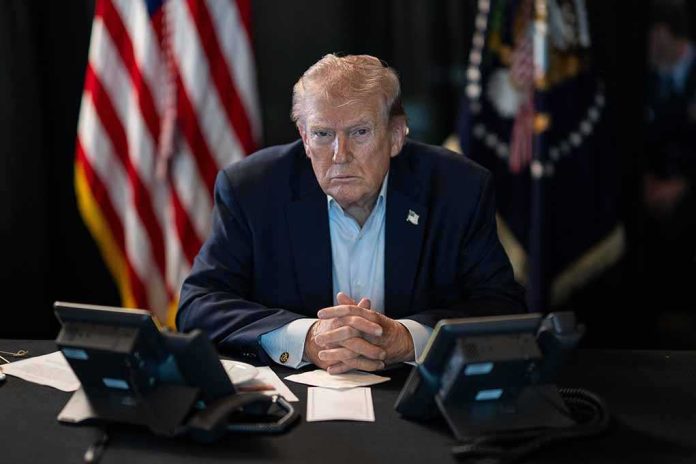
President Trump told reporters he directed the Department of Justice to file a lawsuit that could delay certification of Alaska’s Senate race if incumbent Senator Dan Sullivan loses and votes for Daniel J. Sullivan appear decisive. The complaint centers on voter confusion risk under Alaska’s ranked-choice ballot. The Justice Department asks for court action only if those ballots would change the result, not a blanket stop to certification. State lawyers called the move improper and asked a judge to dismiss it.
Coverage of the lawsuit merged with a separate fight over how Daniel J. Sullivan reached the ballot. Several outlets summarized a New York Times report that said Democratic-aligned operatives, including aides tied to Representative Mary Peltola’s campaign and the Democratic Senatorial Campaign Committee, worked to recruit people named Dan Sullivan and other “spoilers” to pull support from the incumbent. Peltola’s campaign denied any involvement with either Sullivan campaign and rejected claims of coordination.
The Alleged Recruitment Project and the Pushback
Accounts summarized by national and Alaska outlets described an internal “ballot composition” effort that began in 2025 and included outreach to Daniel J. Sullivan of Petersburg. One named figure, former Peltola campaign manager Elisa Rios, was quoted as saying Peltola was aware but not directly involved, then later issued a written retraction of her statements, which deepened disputes over the record. None of these reports are court findings. They remain claims backed by interviews and documents cited by journalists.
Alaska election authorities and several Democratic-aligned groups oppose the Justice Department remedy on certification, arguing that federal courts should not intrude on state-run processes in this way. The lawsuit’s requested relief is conditional. It seeks action only if votes cast for Daniel J. Sullivan would change the outcome. That design lowers the bar for filing but raises stakes in a close race.
What Ballot Law Says, and What It Does Not
The Alaska Supreme Court allowed Daniel J. Sullivan to remain on the ballot in June 2026, which answers the eligibility question for placement but not the ethics of recruitment or the chance of confusion. Ballot eligibility and political hardball are separate tracks. One decides if a candidate meets the rules. The other asks whether operatives tried to tilt voter behavior. The court ruling settled neither the motives nor any civil or criminal liability.
THE EVIDENCE™
WHEN ELECTION INTEGRITY DEPENDS ON WHO BENEFITS
Bob Ferguson Threatened Prosecution Over Two Candidates Sharing His Name. Now Democratic Operatives Are Implicated in Recruiting Another Dan Sullivan in Alaska.By Kim Wojcinski | USA Best Selling Author
The evidence… pic.twitter.com/7qmdGF92Wd— Kim Wojcinski (@KimWojcinski) October 30, 2026
The larger claim from the Justice Department is about voter clarity. The complaint argues a same-name candidate can mislead some voters under ranked-choice voting. Alaska’s ballot identifies the incumbent by name and party and labels him as the incumbent; it lists Daniel J. Sullivan with a different format. Whether those cues prevent confusion is an empirical question that the courtroom may not fully answer on a tight timeline.
Conservative Common Sense on Process and Proof
Election rules must be clear, and enforcement must be even-handed. If operatives tried to plant a decoy, voters deserve to know. If the evidence is thin, voters also deserve restraint. The Justice Department’s conditional remedy tries to split that difference by tying any fix to actual impact. That approach respects results when the second Sullivan does not matter but holds a tool in reserve if he does. Alaska officials argue that is still a federal reach too far.
Peltola frames the lawsuit as “corruption” by Washington allies of Senator Sullivan, which casts the fight as power politics from the nation’s capital. That claim competes with the press accounts that describe a planned recruitment of a namesake to tilt the field. Voters should not have to decode tactical fog to pick a senator. A clean system needs sunlight, clear labels, and accountability anchored to verifiable proof, not rumor or rush.
What to Watch Next
Courts will decide whether the Justice Department’s narrow remedy can stand and under what conditions. Journalists and lawyers may surface more documents, texts, or sworn statements that either corroborate or undercut the recruitment story. Alaska’s ranked-choice system will again face a stress test on whether ballot design and instructions keep voters from mixing up two Sullivans. Results, not spin, should drive any penalties or reforms that come after.
Sources:
twitchy.com, cnbc.com, nbcnews.com, thehill.com, washingtonpost.com, english.elpais.com