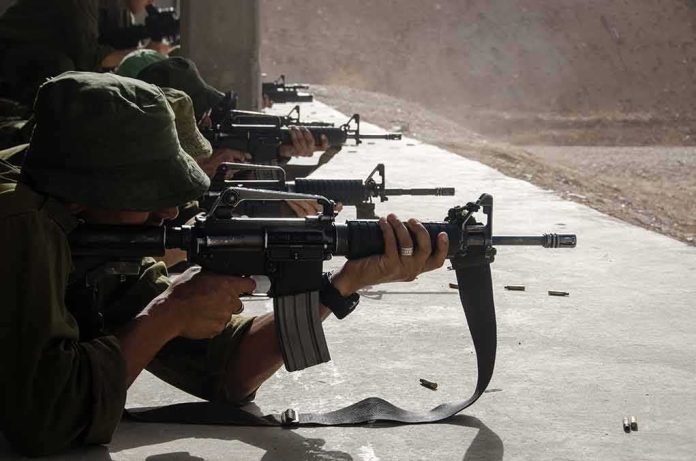
The Army is preparing the first U.S. military firing-squad execution since World War II, and supporters argue it can end life faster and with less suffering than other methods.
At a Glance
- President Trump approved death by U.S. Army firing squad for Nidal Hasan, officials said.
- Army guidance sets time and place authority with the Secretary of the Army.
- Proponents say a direct heart shot causes near-instant loss of consciousness.
- Critics call the method brutal and question its reliability and humanity.
What Was Decided And Who Signed Off
President Trump approved the firing squad for former Army Major Nidal Hasan, according to multiple outlets citing Pentagon and Army officials. Reports describe a Defense Department recommendation chain that ended at the White House. This will mark the first military firing-squad execution since World War II if carried out, a fact repeated across wire services and military press. The decision fixes the method. The separate act of setting time and place falls to Army leadership under established procedures.
Army-focused coverage explains that the Secretary of the Army has authority to set key execution logistics, underscoring that the method and the scheduling are distinct steps. That split matters. It answers a common claim that the date was political theater. The method approval came from the commander in chief after a Defense Department review. The scheduling moves through Army channels. That aligns with a chain-of-command approach that readers expect in a disciplined force, not a stunt.
Why Some Experts Call The Firing Squad “Least Inhumane”
Medical reasoning behind the “least inhumane” label is blunt. A volley targeting the heart can stop blood flow to the brain in a moment, causing rapid loss of consciousness much like a sudden cardiac arrest, according to physician explanations cited in national reporting. Advocates add that rifles fire with consistent force, do not depend on scarce drugs, and do not require complex medical procedures. That removes two common failure points of lethal injection: bad IV access and unreliable drug effects.
Several commentators argue that speed and certainty define mercy in execution. If the heart ruptures and pressure collapses, the brain fades almost at once. That is the claim. It aligns with basic physiology and battlefield trauma patterns most Americans understand. These points do not glorify violence. They frame a hard question with practical terms: If the law demands death, should the state pick the method that causes the shortest path to unconsciousness with the fewest things that can go wrong?
What The Record Shows—and What It Does Not
Reporters note that Army regulations do not publish a method-specific playbook in public view, and details like squad size, target zone, distance, and contingencies have not been released. That gap matters. “Least inhumane” depends on doing it right. Hitting the heart from a fixed distance with trained shooters is not guesswork, but it is also not magic. Without a formal protocol in hand, confidence rests on standard practice and the Army’s training culture rather than on a printed checklist the public can read.
Trump Will Execute Islamic Terrorists by FIRING SQUAD…First Public Military Execution in 60 Years
— Sasha Bellisima (@realSashaBella) October 8, 2026
History provides limited modern data. The United States military has not used a firing squad since 1945, so contemporary, military-run cases are rare in the record. That scarcity weakens any sweeping claim, pro or con. It also explains why the current debate leans on physiology and a few state cases rather than on large studies. Still, the method’s core mechanics are simple compared with lethal injection, which has generated a long trail of supply failures, botched placements, and drawn-out litigation.
The Counterarguments You Will Hear
Civil-liberties groups call firing squads brutal on their face and say the method proves the death penalty is inhumane, full stop. A law review essay argues that a first volley could fail, leaving the inmate conscious and in pain until a second volley, which could take minutes. Those warnings demand serious planning. American conservative values put a premium on clear rules, skilled teams, and accountability. If the state carries the ultimate penalty, it must remove guesswork and delay from the process.
Another pushback focuses on optics. Critics say the method looks violent compared with a clinical room and a needle. That point is true on the surface, but it can mislead policy. A method should be judged on speed to unconsciousness and error risk, not on how tidy it appears. Clean rooms can hide slow suffocation when drugs fail; rifles, done right, do not hide anything. The best standard is a short, certain loss of consciousness, achieved by trained people under strict orders. That is common sense.
Bottom Line For A Serious System
The public record shows a lawful decision on method by President Trump and a clear Army role in scheduling. The humane case rests on simple physiology and the removal of complex medical steps that often fail in lethal injection. The counter-case warns about brutality and the chance of a bad first volley. The path forward is discipline: publish the protocol, train the squad, define the contingencies, and minimize any delay between shots. If the state executes, it must do so swiftly and surely.
Sources:
abcnews.com, washingtonexaminer.com, cbsnews.com, afp.com, reuters.com, yahoo.com