
A governor just rewired how New York cops can work with federal immigration agents, and the loudest charge against her — that she “bribed sheriffs to shield criminal illegals” — collapses the moment you follow the paper trail.
Story Snapshot
- Hochul’s Local Cops, Local Crimes Act bans 287(g) civil immigration deals but keeps criminal cooperation.
- The law redirects local police away from federal civil immigration duties toward local crime fighting.
- Serious accusations of bribery and “shielding criminals” lack hard evidence, case examples, or financial records.
- This fight fits a broader red–blue war over “sanctuary” policies, not a proven corruption scandal.
What Hochul’s Law Actually Does To Police And ICE
Governor Kathy Hochul’s Local Cops, Local Crimes Act does one core thing that matters for taxpayers and sheriffs: it bans New York police and jails from signing 287(g) agreements that turn local officers into civil immigration deputies for Immigration and Customs Enforcement. Those agreements let sheriffs hold people for civil immigration reasons or perform ICE-style checks. Hochul’s bill shuts that lane down, but it leaves the criminal lane open. ICE can still work with locals on criminal cases, warrants, and serious charges.
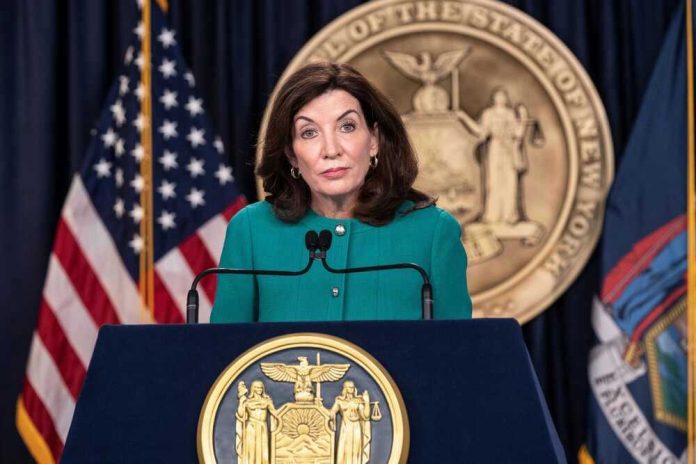
Hochul’s office describes the policy in blunt terms: local cops should “keep our communities safe instead of doing ICE’s job.” The law blocks state and local governments from using their facilities and staff for civil immigration enforcement, and it bars them from helping build or run immigration detention centers. It also says civilian state and local employees cannot give immigration agents access to private, non-public areas of government buildings without a judge’s warrant. That rule now reaches places like schools, hospitals, shelters, and housing.
Why The Rhetoric Sounds Like War, Not Policy Debate
At her press events, Hochul’s language has been fiery enough to light up conservative media. She said she will not let New Yorkers be “terrorized” by Immigration and Customs Enforcement and called it a “rogue federal agency” when it runs aggressive civil raids. She framed her push as a response to “tyranny” and “abuse of power” under the Trump administration’s mass deportation drive. That tone, mixed with real fear in immigrant communities, makes the policy feel like a battlefield instead of a legal tweak.
Conservative critics hear the same words and see something darker. RedState and others cast the law as “taxpayer-funded betrayal,” claiming Hochul is protecting “criminal illegals” and even “bribing” sheriffs to ignore ICE. Border hawks warn New York City will become a magnet for lawless migrants. A local Republican, Nassau County Executive Bruce Blakeman, calls Hochul “the most pro-criminal governor,” feeding the idea that she cares more about undocumented offenders than victims. These accusations track with a long pattern: when a Democrat limits ICE cooperation, the right cries “sanctuary for criminals,” regardless of the legal fine print.
The Bribery Charge Falls Apart Under Basic Scrutiny
Bribery is a serious word. It means money or favors paid to officials in exchange for breaking their duty. In the Hochul case, that charge has no documented backbone. There is no contract, no check, no budget line, no whistleblower naming a single sheriff who took cash to ignore ICE. The only concrete action on record is the public legislation itself: a statewide ban on specific civil enforcement agreements that passed through normal budget and legislative channels.
Not one sheriff has stepped forward to say, “Yes, we were paid to stand down.” There is no deposition, leaked email, or internal memo showing Hochul’s staff offering money for non-cooperation. The claim lives almost entirely in partisan commentary, not in sworn statements or audits. For readers who value rule of law and responsible spending, that matters. American conservative values prize evidence, not rumor. When someone says “taxpayer-funded betrayal,” they owe proof that any taxpayer dollar was secretly traded for corrupt favors. That proof does not appear in the available record.
Does The Law Really Shield Criminal Immigrants From Justice?
Critics insist Hochul is “shielding criminal illegals” from deportation, but her own description of the law points in a different direction. She stresses that local police will still help with criminal investigations and serious offenders, while refusing to act as civil immigration agents. The bill language distinguishes civil status issues from crimes. It bans jails and sheriffs from being used for civil enforcement sweeps but does not stop sharing information or working with Immigration and Customs Enforcement on criminal matters.
So far, no one has produced clear case examples where a violent or serious criminal walked free because of this policy. There are no court records, no denied deportation reports, and no named victims tied directly to Hochul’s law. Critics strongly believe shielding civil offenders will lead to more crime, but they have not offered data showing that crime has risen due to this policy shift. That gap matters. Common sense conservative thinking demands numbers and cases, not just anger, before claiming a law has blood on its hands.
Where This Fight Fits In The Bigger Immigration War
This clash in New York is part of a larger national pattern. For years, Republican-led states passed laws that force more local help for immigration enforcement, while Democrat-led states passed “sanctuary” style rules that limit it. These fights often create sharp claims about “shielding criminals” or “bribing officials,” but very rarely produce solid evidence of true corruption or intentional harboring of violent offenders. Most of the time, states are arguing about who pays for enforcement and who controls local police priorities.
Legal experts point out that there is no federal rule forcing states to spend their own resources on civil immigration enforcement. States can choose to focus their cops on local crimes while Immigration and Customs Enforcement handles federal civil status. The Justice Department has sometimes warned it will investigate state laws that obstruct immigration enforcement, but those cases hinge on specific legal details, not talk-show sound bites. For a reader skimming on a phone, the bottom line is simple: Hochul’s law is a hard-nosed political move in the sanctuary debate, but the “taxpayer-funded bribery” headline is not backed by the kind of facts that should convince a serious, skeptical adult.
Sources:
redstate.com, nytimes.com, youtube.com, cozen.com, nysfocus.com, cityandstateny.com, governor.ny.gov, facebook.com, columbialawreview.org, pmc.ncbi.nlm.nih.gov, themarshallproject.org