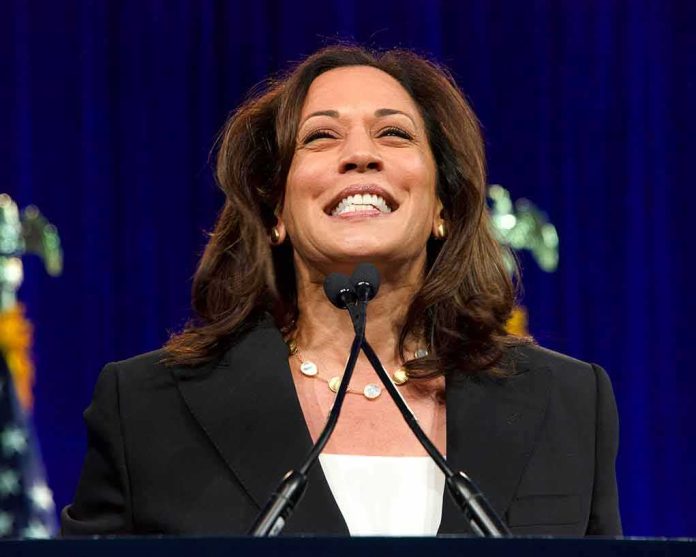
Kamala Harris tried to sell a sweeping 2028 reform agenda, but what stuck with voters was how awkwardly she delivered it.
Story Snapshot
- Harris is previewing a 2028 comeback with a “next generation” reform message built around changing Senate rules and other institutions.
- Her rollout has been mocked as cringe, with gaffes and viral clips overshadowing the substance of her ideas.
- The core reforms she hints at, especially changing the Senate filibuster, come from a serious, long-running mainstream policy debate.
- The clash shows a deeper fight between people who call these changes “democracy upgrades” and others who see them as raw power grabs.
Harris stumbles while trying to relaunch a 2028 reform brand
Kamala Harris has clearly started testing a 2028 comeback, but the way she is doing it has turned into a punchline. She relaunched her old campaign infrastructure as what she calls a Gen Z led progressive content hub, with a rebranded “headquarters” social media presence and slick videos that look more like influencer campaigns than presidential pitches. At rallies and online, she pairs this youth-focused style with hints of an aggressive institutional reform agenda aimed at undoing President Trump’s policies and reshaping the rules of power.
The problem is that almost every major moment has been overshadowed by awkward delivery. A botched teleprompter read in Michigan, where she tripped and repeated the phrase “32 days” over and over, went viral and fed a narrative that she struggles to speak cleanly under pressure. Her attempt to imitate Trump as a “mob boss” at a New York convention drew more eye-rolls than applause and was widely mocked as “cringe Kamala strikes again.” Online critics, including conservative outlets, have branded these clips as proof she cannot carry a tough reform message without becoming a meme.
The serious filibuster agenda hiding behind the cringe
Behind the gaffes, Harris is tracking with a real policy world that has spent years mapping out how to break the Senate’s gridlock. Reformers have developed detailed menus for changing the filibuster, including abolishing it, restoring a true talking filibuster that forces senators to hold the floor and argue, or flipping cloture rules so that 41 votes are needed to keep blocking debate instead of 60 to end it. Scholars at Northwestern and institutions like Brookings have cataloged these options as ways to let a governing majority actually act, instead of watching a small minority veto almost everything.
Advocacy groups go further and frame filibuster reform as a population fairness issue. One proposal would require that any blocking coalition represent less than a majority of the nation’s people, flipping the current reality in which sparsely populated states can freeze legislation that most Americans support. Some ideas would carve out voting rights and core democracy bills from filibuster rules entirely, letting those measures pass on a simple majority because they set the ground rules for everyone. When Harris hints that the rules themselves are rigged, this is the ecosystem she is pulling from, whether or not she explains it clearly in her videos.
Why conservatives see a “radical” package instead of neutral reforms
Many conservatives look at this bundle of ideas and see something very different than neutral rule tweaking. They remember how Democrats floated eliminating the filibuster outright when they saw a chance to lock in their agenda, and they hear talk of court expansion and election rule changes as the next phase of that same push. From a right-of-center, common sense view, changing the rules whenever you do not like the outcomes sounds less like “democracy repair” and more like stacking the deck for one side.
There is also a real worry about one-way escalation. If Harris and her allies break the filibuster to pass their preferred voting and Supreme Court reforms, nothing stops the next Republican majority from flipping the rules again or packing the courts in their direction. Even Brookings, which lays out reform options in detail, admits there is little hard evidence that these procedural changes will make the Senate more productive or more in line with public opinion over time. That uncertainty feeds a healthy conservative skepticism: you do not pull bricks out of the load-bearing wall just because it feels good in the moment.
Harris’s messaging gap: big stakes, sloppy execution
One of Harris’s biggest weaknesses in this fight is the gap between the seriousness of the ideas and the sloppiness of her communication. The research record does not show her issuing a clear platform document where she signs her name to specific plans like Supreme Court expansion or ending the Electoral College. Instead, voters get vibes and fragments: a youth content hub here, a clipped speech about “democracy” there, and then a flood of reaction videos calling the whole thing “radical” and “embarrassing.” That leaves critics free to mash every possible change—filibuster, court, elections—into one scary package.
On top of that, the online environment tilts the field against any nuanced explanation she might try to offer. Algorithms push short, emotional clips, and Harris has become a favorite target for deepfakes and edited audio that make her sound even more incoherent than she is. Fact-checkers have had to debunk multiple viral videos that altered her words to turn normal political boilerplate into nonsense, but the damage is done once millions see the fake clip. In practical terms, she is fighting for institutional reform in a media space that rewards mockery, not careful design.
Sources:
thegatewaypundit.com, polisci.northwestern.edu, filibusterreform.org, brookings.edu, effectivegov.uchicago.edu, fongsurvey.polisci.lsa.umich.edu, en.wikipedia.org, merkley.senate.gov, acslaw.org, pogo.org