
Experts told a coroner that a grandmother’s fatal internal bleeding likely did not come from the concrete fall everyone saw, but from a ruptured spleen that was already tearing inside her body.
Story Snapshot
- Christine Faunch fell from a stretcher while being moved by paramedics.
- She died hours later from a ruptured spleen and massive internal bleeding.
- Inquest experts said the fall most likely was not the direct medical cause.
- The ambulance service apologized to her family for the stretcher incident.
What Happened During The Transfer
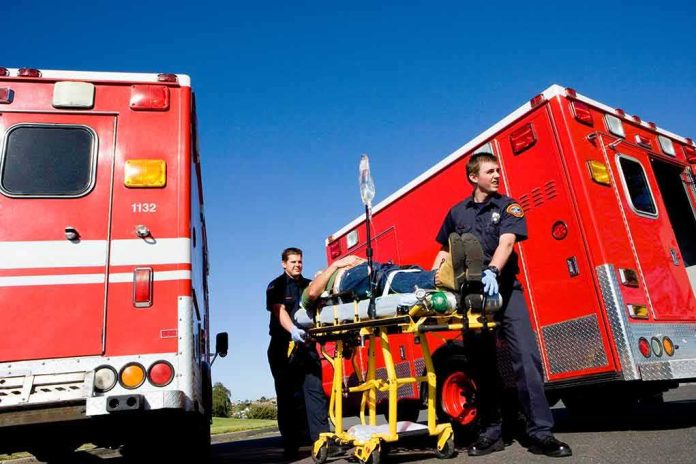
Paramedics moved Christine Faunch on a stretcher toward hospital care. During that transfer, the stretcher tipped and she fell, hitting her head on concrete. Witness accounts placed the slip in a tight handover moment, when small errors can turn major. The ambulance service apologized to the family for the incident and for the pain it caused. The apology recognized a failure in the transfer, even as medical experts drew a line between the fall and the actual cause of death.
Hospital staff scanned her soon after. The imaging showed a ruptured spleen. Doctors found catastrophic internal bleeding. They worked to stabilize her but her condition worsened. She died at William Harvey Hospital in Ashford hours after the fall. The timeline mattered to investigators: a visible head impact occurred, but the fatal process moved inside the abdomen. That contrast set up the key question for the coroner and the clinical experts.
How The Inquest Drew The Causal Line
The coroner heard from named medical experts on the likely pathway to death. They explained that a torn spleen can bleed fast and quietly. They said the internal injury, not the head strike on concrete, most likely caused the fatal bleed. That does not make the fall trivial. It does define mechanism versus cause. Inquests separate what happened, what medically killed a person, and whether the event contributed to the outcome. Here, experts placed the lethal mechanism on the ruptured spleen.
That distinction fits a pattern in coronial work. A dramatic event draws all eyes, but the body tells the final story. Coroners often weigh whether a fall is the sole cause, a trigger, or a serious but non-lethal event. Public headlines can skip that nuance. The written findings stage the facts in layers: identity, when and where, medical cause, and manner of death. That frame helps courts and families face hard truths without blurring medical reality.
Accountability Versus Medical Reality
The ambulance service accepted fault for the fall and apologized. That matters for trust and for safety fixes. The apology does not rewrite the medical chain. It signals that professionals see, and own, the visible error. Conservative common sense says both things can be true at once: human error deserves scrutiny and correction, and clear evidence must guide the cause of death. Policy should punish sloppy habits, not imagined causes. Facts, not feelings, keep patients safe.
NEWS: Ambulance service bosses have apologised to the grieving family of a gran who fell off a stretcher and hit her head hours before her death #kmfmnewshttps://t.co/nGsN8MRjTP
— kmfm news (@kmfmnews) August 9, 2026
Ambulance leaders can now do the simple, hard work: retrain crews on loading and unloading, enforce two-person checks, lower stretchers before movement, and mandate spoken confirmations at every curb, ramp, and threshold. Those steps cost little and prevent tip-overs. Hospitals can set shared handoff zones with flat surfaces and lighting. Families deserve that diligence. None of it changes what killed Christine. All of it can spare the next patient from a fall that never had to happen.