

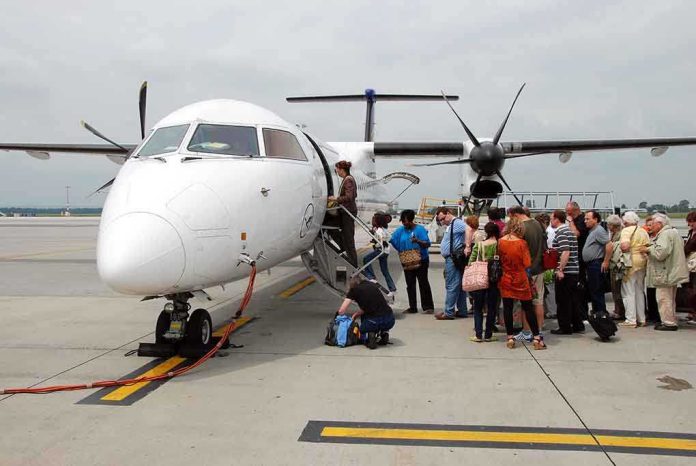
Six U.S. deportees refused to step off a plane in Liberia, so officials flew them to Equatorial Guinea instead.
Story Snapshot
- Six people resisted deplaning in Liberia and were redirected to Equatorial Guinea.
- Liberia agreed to receive up to 1,200 third-country deportees over 12 months.
- U.S. officials defend third-country removals as lawful under existing statutes.
- Equatorial Guinea now holds more than 30 U.S.-sent deportees, according to reports.
What Happened On The Flight And After
U.S. authorities flew a group of deportees to Liberia under a third-country deal. When the plane landed, six people refused to exit. Crew and officials did not force them off. The flight continued to Equatorial Guinea, which also has a deportation agreement with the United States. That country has been receiving noncitizens sent by the United States and is currently holding several dozen such arrivals, according to reporting from the region.
Liberian authorities had already announced a plan to receive up to 1,200 people over a year as part of a broader arrangement. They described the arrivals as guests and said they could move freely. The refusal by six people to deplane does not change that policy. Flights continue, and agencies on both sides keep coordinating arrivals and transfers under the agreements in place.
How Third-Country Removals Work
Federal law allows the Department of Homeland Security to remove a noncitizen to a country other than their own when certain conditions are met. The Trump administration has used this authority to scale third-country removals through bilateral deals. Nearly a dozen countries were first cited, then the list expanded as more governments signed on. Human rights groups say the reach now spans dozens of countries, including many in Africa.
These agreements vary in terms and transparency. Some include financial support, reception housing, or security provisions. Others rely on government-to-government assurances. Supporters argue they close loopholes, deter repeat border crossings, and ease diplomatic standoffs when home countries refuse to cooperate. Critics warn about downstream risks if receiving states lack due process, safety, or a path to permanent status for those transferred.
Why Liberia And Equatorial Guinea Are Involved
Liberia accepted a large quota of third-country deportees to support regional burden-sharing and ties with Washington. The first flights delivered twenty people, with more planned over the next year. Reports state Equatorial Guinea is also receiving people under a separate arrangement, with more than thirty held there following earlier transfers. The reroute of the six resisters from Liberia to Equatorial Guinea fits the current policy playbook for handling in-flight refusals.
Diplomats and immigration officials see these deals as practical tools. Flights cost money. Detention space is limited. When removal orders are final, the government must act. If one partner becomes a chokepoint, another may take the transfer. From a rule-of-law lens valued by many conservatives, executing final removals—calmly, safely, and without street chaos—protects borders and discourages abuse of the system. That test is met when transfers follow signed agreements and clear procedures.
The Larger Stakes Of Scaled Rerouting
The Liberia-to-Equatorial Guinea episode highlights how third-country removals now operate at scale. The Council on Foreign Relations explains that Washington relies on Immigration and Nationality Act authorities to deport to nations other than a person’s home country, and that the Trump administration pursued a network of partners to expand options. Amnesty International tracks at least thirty countries with such agreements by mid-2026, including twelve in Africa.
Deportees who refused to exit a U.S. flight in Liberia are sent to Equatorial Guinea https://t.co/oP79fVmhgt via @nbcnews
— Vet II (@8wdbf428wg) August 27, 2026
This system raises two durable questions. First, does the receiving country provide basic safety and a fair legal process? Second, does the policy deter unlawful entry, or does it only move the problem? Conservatives tend to judge by outcomes: fewer unlawful crossings, faster case closure, and less strain on American cities. On those measures, a lawful transfer that avoids street-side standoffs and keeps pressure on would-be repeat entrants aligns with common-sense enforcement goals.
Sources:
thegatewaypundit.com, nbcnews.com, reuters.com, youtube.com, cnn.com