

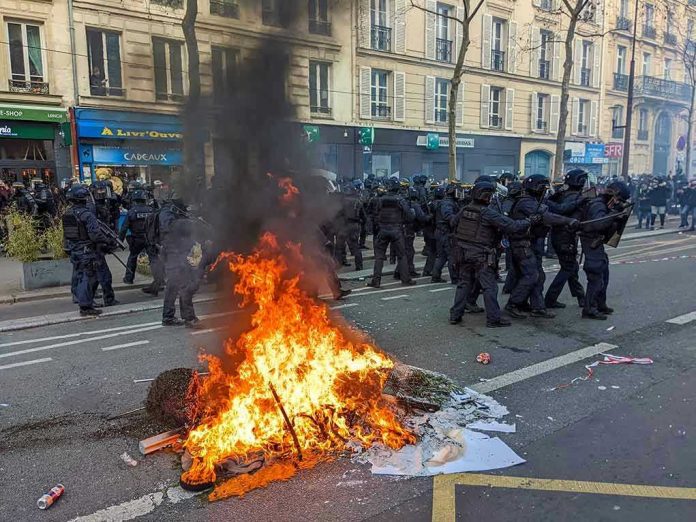
A 15-year-old in Lens lost his hand after picking up a police grenade during a school protest, authorities said.
Story Snapshot
- Officials say the teen’s hand was blown off after he picked up a police grenade near Béhal High School.
- Police-source accounts place the incident around late morning during a blockade outside the school.
- Prosecutors say his life is not in danger, and investigators opened a formal probe.
- France’s use of “less-lethal” grenades has a long record of severe injuries, fueling debate.
What Happened Outside Béhal High School
Local authorities reported that the injury occurred late Monday morning outside Béhal High School in Lens. The teen joined student protests over school conditions and stood near a blockade when the blast happened. The prefect said the student’s hand was torn off after he picked up a police stun or de-encirclement grenade used for crowd control. A police-source account described a similar sequence and timed it around 11 a.m., during clashes tied to the blockade.
Prosecutors confirmed the teen suffered a traumatic amputation but said his life was not at risk. They announced an investigation to determine which munition was used, who deployed it, and how the teen came into contact with it. Police often use different crowd-control grenades in France. Some make loud bangs and bright flashes. Others eject rubber pellets to push crowds back. Both can cause grave harm if handled or detonated at close range.
Why The Type Of Grenade Matters
French police have used several grenade models in recent decades. Explosive tear gas grenades that carried high explosive charges were suspended after earlier maimings and a death tied to a now-abandoned model. Stun grenades disorient with sound and flash but can still maim at close range. De-encirclement grenades explode and scatter rubber pellets in a ring. Rights groups and medical researchers have tied these devices to many severe injuries at protests. The exact model shapes the blast pattern and injury risk.
Officials and police unions often stress that these munitions are tools to break dangerous formations and protect officers. Critics counter that the blast radius, fuse timing, and the chaos of protests make these tools risky in mixed crowds. That risk grows when teenagers and bystanders gather near police lines. Common sense says two rules should be firm: police must deploy with tight discipline and training, and civilians must never pick up a live munition on the ground. Both reduce tragic outcomes.
The Pattern France Already Knows
France has wrestled with protest injuries for years. Human Rights Watch documented people blinded, burned, and maimed during the yellow vest era and student actions, often linked to explosive grenades and kinetic launchers. The government moved to end the use of one explosive tear gas grenade after a series of severe cases, including torn limbs. Research surveys still place French crowd control among Europe’s most forceful, due to routine use of blast and pellet devices in urban settings.
First victims in the 🇫🇷French school riots: a 15-year-old protester had his hand blown off in the northern town of Lens.
According to the police union source, the student appeared to have picked up a sting-ball grenade fired by riot police, hoping to fling it back, but the… pic.twitter.com/lGNTESjuvi
— Dovydas Vitkauskas (@Dovydas44444) October 5, 2026
That record sets the stakes in Lens. Authorities say the teen picked up the device, which aligns with past cases where handling caused injury. Critics will still question how and where police threw the munition in a school blockade. The strongest path forward is transparent forensics: map the throw, identify the model, confirm training compliance, and publish findings. That approach respects order, deters reckless handling, and honors the public’s right to know how a child lost his hand.
Sources:
usnews.com, bfmtv.com, lefigaro.fr, ground.news, x.com