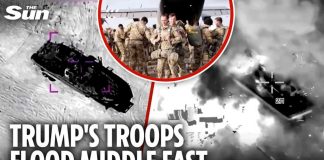
Hundreds of America’s most elite warriors just touched down in the Middle East with no publicly stated mission, and what they’re preparing for could reshape the entire region.
Story Snapshot
- Several hundred Special Operations forces including Army Rangers and Navy SEALs arrived in the Middle East over the past 48 hours, joining over 50,000 US troops now in the region.
- President Trump weighs options including reopening the Strait of Hormuz, seizing Iran’s Kharg Island oil hub that handles 90% of Iranian exports, or striking nuclear facilities.
- The buildup includes 2,500 Marines, 2,500 sailors, and over 2,000 82nd Airborne paratroopers as Iran keeps the Strait of Hormuz closed with sea mines and drones.
- The conflict began February 28 with US-Israeli strikes on 9,000 Iranian targets, resulting in 13 American deaths and 290 wounded while Iran retains asymmetric warfare capabilities.
- Military experts warn the current force is insufficient for a full ground invasion but adequate for high-risk surgical operations against strategic targets.
Elite Forces Deploy Into Uncertainty
Army Rangers and Navy SEALs landed in the Middle East theater without Pentagon confirmation of their specific objectives. The arrival of these Special Operations forces represents the tip of a much larger military buildup that has swelled to over 50,000 personnel, 10,000 above normal levels. Anonymous defense officials speaking to The New York Times acknowledged the deployment but declined to specify mission parameters or operating locations. This operational security blackout suggests potential high-value targets requiring precision capabilities that only America’s tier-one units possess. The timing coincides with President Trump’s deliberations on three distinct military options, each carrying significant strategic weight.
The Strait That Holds Global Energy Hostage
Iran’s closure of the Strait of Hormuz after US-Israeli strikes beginning February 28 threatens 20 percent of the world’s oil supply. The narrow waterway, now seeded with Iranian sea mines and patrolled by drone swarms, represents both an economic chokepoint and a military challenge. Clearing these mines demands time and resources that could stretch for months, according to military analysts. Trump postponed planned strikes on Iranian power plants after what he termed “productive” talks, yet the Strait remains blocked. The standoff demonstrates Iran’s asymmetric warfare advantage: cheap drones costing $25,000 can threaten American assets worth $500 million, fundamentally altering traditional cost-exchange ratios in modern conflict.
Kharg Island Emerges as Critical Target
Ninety percent of Iran’s oil exports flow through Kharg Island’s terminal facilities, making it a strategic pressure point Trump reportedly considers seizing. Such an operation would require amphibious assault capabilities now positioned in theater aboard the USS Tripoli and USS Boxer, carrying the 31st Marine Expeditionary Unit. The 2,500 Marines and accompanying sailors possess the training for forced-entry operations against defended coastlines. Seizing Kharg would devastate Iran’s economy while avoiding the civilian casualties associated with striking power infrastructure or population centers. Yet military experts caution that holding territory against Iranian counterattacks would demand sustained commitment from ground forces currently stretched across multiple Middle Eastern bases in Saudi Arabia, Bahrain, Iraq, Syria, Jordan, Qatar, UAE, and Kuwait.
Paratroopers Position for Rapid Assault Options
Over 2,000 paratroopers from the 82nd Airborne Division have established presence in the region, with potential for 3,000 to 4,000 additional soldiers deploying. These Fort Bragg-based troops specialize in rapid insertion behind enemy lines, capabilities essential for operations against Iran’s Isfahan nuclear facilities or other hardened targets. The 82nd Airborne’s deployment signals preparation for time-sensitive missions where speed determines success. The Washington Post reported Pentagon preparations for potential ground operations extending weeks into the future, though no decision on entering Iranian territory has been finalized. This buildup provides Trump with flexible response options while maintaining diplomatic pathways that could prevent escalation into full-scale invasion requiring far more than 50,000 troops to occupy a nation of 88 million people.
Asymmetric Warfare Reshapes Battlefield Mathematics
The loss of a US E-3 Sentry reconnaissance aircraft to an Iranian drone exposed critical vulnerabilities in American counter-unmanned aircraft systems. Iran retains substantial missile, drone, and mining capabilities despite four weeks of sustained US-Israeli bombardment targeting 9,000 locations across Iranian territory. Houthi forces in Yemen have launched missiles toward Israel while threatening the Bab el-Mandeb strait, opening a second maritime chokepoint. These distributed threats demonstrate how technologically inferior adversaries can impose disproportionate costs on conventional military superiority. American public opinion reflects growing concern, with approval for the strikes dropping to 35 percent while disapproval climbed to 61 percent. The arithmetic of modern conflict has shifted: defending against swarms of inexpensive drones strains both resources and strategic patience in ways traditional warfare doctrines never anticipated.
Strategic Calculations at a Crossroads
Trump faces decisions that will define American Middle East policy for years. Reopening Hormuz addresses immediate global energy security but requires mine-clearing operations lasting months. Seizing Kharg Island applies economic pressure without regime-change commitments yet demands indefinite occupation of hostile territory. Striking Isfahan’s nuclear facilities eliminates long-term proliferation threats but risks cementing Iranian resolve and international condemnation. Military experts unanimously assess current troop levels as inadequate for regime change or sustained occupation, positioning this buildup as coercive leverage rather than invasion preparation. The presence of Special Operations forces suggests planning for surgical strikes against high-value targets, missions where small teams of elite operators achieve strategic effects without large-scale ground combat. Whether Trump chooses force, diplomacy, or continued containment, the concentration of America’s finest warriors in theater ensures he holds credible options.
Sources:
US Special Operations forces touchdown in Middle East as Trump weighs next move in war with Iran
US expected to send thousands of soldiers to Middle East, sources say
Special Operations Forces News Update