

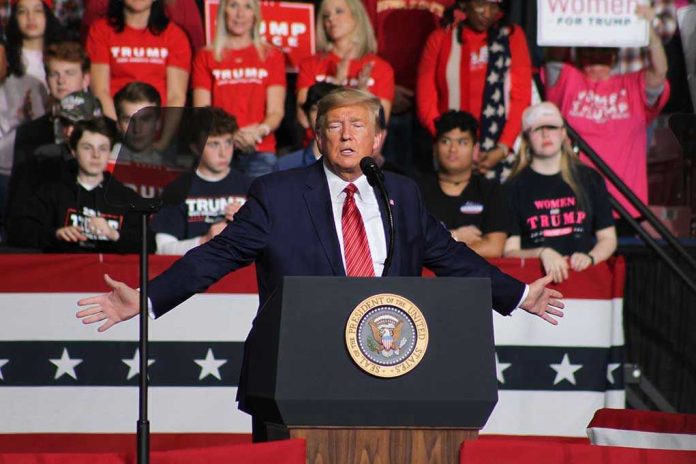
The uproar was not about what President Donald Trump said on stage, but about who said his name first—and why that brief handoff lit up the outrage machine.
Story Snapshot
- A controversial introducer set off rapid backlash after bringing Trump on stage at a rally [1][2].
- The rally context was fraught: recent violence and heightened scrutiny of security shaped perceptions [1].
- Critics amplified the optics; supporters framed the moment as energy and relevance [2][3].
- The specific record remains thin: few direct quotes from critics and no official transcript [1][2].
Why an Introduction Became the Story
Commentary centered on the introducer rather than Trump’s remarks because rally-stage optics function as political signals that audiences decode instantly. The headline framing—“Look who introduced President Trump… and some libs were furious”—documented real backlash tied to the identity of the person at the microphone, not merely rumor [1]. The coverage described a familiar cycle: a visible figure touches Trump’s orbit, then pundits and activists mobilize to condemn or celebrate the symbolism, allowing the reaction to eclipse the event itself [2][3].
Reports positioned the introduction as more than stagecraft. Within partisan ecosystems, the handoff conveys endorsement or legitimacy, especially when the introducer carries cultural cachet or baggage [2]. Supporters frame this as coalition building and proof of sustained media gravity; detractors read it as moral signaling that normalizes what they oppose. The absence of a complete, primary-source transcript keeps the factual aperture narrow, but the existence of immediate backlash is sufficiently documented in the available coverage [1][2].
The Heavier Shadow Over the Stage
Security and tone shaped the stakes. The broader rally context included an assassination attempt that left Trump injured on his right ear, one spectator dead, and two critically wounded, placing event optics under extraordinary scrutiny [1]. Against that backdrop, the choice of introducer inevitably carried more weight. Critics claim the selection was inappropriate, but the record provided lacks direct quotations specifying their objections, which constrains precision about motives or standards they believe were breached [1]. In a tense environment, even a routine introduction can be read as provocation rather than protocol.
Supporters counter that controversy demonstrates continued reach. They argue that the attention spike itself shows Trump’s enduring dominance of the news cycle, making the introduction a net positive within an attention economy that rewards salient moments [2]. That argument has intuitive appeal in campaign terms, yet the source set offers no measurable indicators—no fundraising lift, volunteer surge, or polling movement—linking the introducer to enthusiasm beyond anecdote [2]. Without data, the energizing effect remains a claim, not a demonstrable outcome.
What Is Known, What Is Missing, and Why It Matters
The trigger is confirmed: a figure introduced Trump and drew public backlash, documented in contemporaneous reporting and social-media commentary patterns [1][2]. The surrounding sensitivity of the rally environment is also confirmed, explaining why stagecraft became a flashpoint [1]. What is missing is the most basic verification material—full video segment, verbatim transcript, and named, on-the-record critic statements. That gap matters because, without the introducer’s identity and exact words, the proportionality of the outrage cannot be assessed on the merits [1][2].
Being invited to the White House vs speaking and doing the introduction at a Trump rally
— 5$pooky (@spookywashere_) May 23, 2026
The coverage fits a known media dynamic: personal optics as proxy for moral legitimacy. Outrage language travels faster than nuance; it converts introductions into referendum moments divorced from policy or outcomes [3][4]. From a common-sense, conservative vantage, standards should be consistent. If celebrity introductions are routine across parties, selective condemnation looks like theater more than principle. The remedy is sunlight: release the run-of-show, publish the clip and transcript, and let voters judge the content instead of the caricature. Until then, the debate is mostly about vibes, not facts.
Sources:
[1] YouTube – Assassination Attempt at Trump Rally: Security Under Scrutiny
[2] YouTube – Lawmakers, community groups react after Trump rally …
[3] Web – Donald Trump: Domestic affairs – Miller Center