

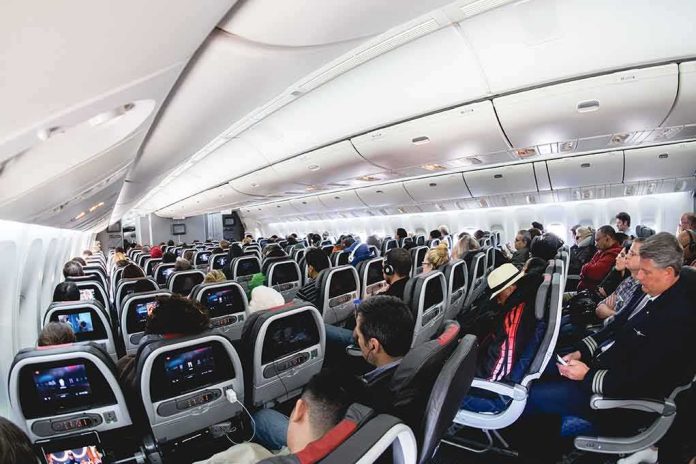
A man on a packed flight claimed Sharia law forbade him from sitting next to a woman—then allegedly hit the female flight attendant who tried to fix it, forcing German police to decide where religious freedom ends and basic rule of law begins.
Story Snapshot
- A 29-year-old Turkish-background passenger refused his assigned seat next to a woman, citing Sharia law.
- The dispute escalated when he allegedly slapped or punched a female flight attendant in the face.
- Officials stress Sharia law has no legal standing in Germany, so his “religious” excuse carries zero legal weight.
A routine flight turns into a test of law and culture
Police and media say the incident began like countless flights across Europe, with passengers boarding a Turkey-to-Germany route in the early hours of June 1. Somewhere in that shuffle, a male passenger saw his assigned seat placed next to a woman. Instead of shrugging it off, he reportedly announced that, under Sharia law, he could not sit next to her. That single claim lit the fuse on what became a criminal case, not a simple customer service headache.
Witnesses told German outlet Bild that the man refused to remain in his seat because it was beside a woman and framed his refusal as obedience to Islam’s moral code. A police spokesman echoed this, saying “according to initial witness statements, the man invoked Sharia law and refused to sit next to a woman.” Flight crew now faced an impossible choice in a metal tube at 30,000 feet: respect his claimed religious limits or enforce basic seating rules that keep order and safety.
From seating dispute to alleged assault in seconds
When a female flight attendant approached to calm the situation or arrange a solution, the conflict jumped from argument to violence. Reports from Bild and several outlets say the passenger slapped or punched her in the face after she tried to talk with him. On a modern airliner, hitting crew is not a “misunderstanding.” It is treated as a direct attack on safety, because crew must be able to give orders and move freely during emergencies.
Once the plane landed in Düsseldorf, federal police boarded and took the man into custody. During questioning, he confessed to assaulting the flight attendant, according to German authorities cited by Gateway Pundit. That matters under any conservative, common-sense lens: when a suspect admits he hit a woman over a seating dispute, the focus shifts from “was he offended?” to “what consequences follow?” He was also charged for insulting officers in Turkish during the interview, after learning one of them understood the language.
Sharia law claim meets German criminal law
The man’s defense was not “I did not do it.” It was “I was following Sharia law.” Media reporting is clear on one point: Sharia law has no legal standing in Germany. German law, like other Western systems, allows religious belief and practice, but it does not allow private religious codes to override public safety rules or criminal statutes. You can believe your faith forbids something; you cannot hit someone when they insist you follow the law instead.
So far, no respected Islamic scholar or jurisprudence text has been cited that says a Muslim must refuse to sit next to a woman on public transport. That gap is striking. If a command is strong enough to justify disrupting a flight, you would expect a clear verse, ruling, or scholarly statement, not just one man’s personal claim. From a conservative viewpoint, this looks less like devotion and more like using religion as a shield for bad behavior, which poisons public trust in faith communities that follow the law.
Why this case hits a nerve in Europe’s wider culture wars
This event taps into larger tension in Germany and across Europe about migration, religious identity, and public safety. The suspect is described as a German national with Turkish roots or as a Turkish migrant living in Germany, depending on the outlet. Many citizens already worry about parallel moral systems replacing national law. When someone literally invokes a foreign religious code mid-flight, then allegedly strikes a woman and insults police, it feels to them like their fears given concrete form.
A plane passenger "invoked Sharia law" to avoid sitting next to a woman, then hit a flight attendant, according to German police.https://t.co/vFEd7uy7Ck
— ABC 13 News – WSET (@ABC13News) July 19, 2026
German authorities are framing the case as “bodily injury” and insulting officers, not as a religious-accommodation debate. That signals a bright line: your beliefs may shape your private life, but violence on a plane is a crime, full stop. Experts note that airlines sometimes honor respectful requests for seat changes, including for religious reasons, as long as safety rules and crew authority stay intact. The key word is respectful. Once a demand becomes defiance and then a slap, the law must speak louder than any personal doctrine.
Sources:
thegatewaypundit.com, abcnews4.com, newsbreak.com, en.wikipedia.org