
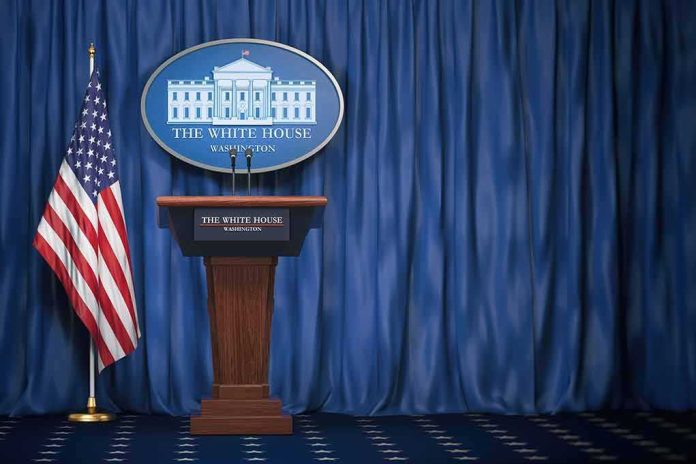
The White House launched “Trump TV,” a 24/7 official stream, two days after barring CNN, MS NOW, and Politico from its grounds.
Story Snapshot
- The White House promoted a nonstop “Trump TV: The Essentials Station” on its site.
- Trump announced bans on CNN, MS NOW, and Politico from White House access.
- Major TV networks suspended pooled coverage in response to the bans.
- The move follows a yearslong push to tighten control over press access.
The Launch: A Round-the-Clock White House Stream
The White House Live page listed a new channel, “TRUMP TV: The Essentials Station,” with a start time and clear promise: top videos, major remarks, and highlights, streaming 24/7 and updated in real time. The official videos hub featured recent presidential clips, signaling an organized stream, not a one-off. This is a direct-to-audience pipeline that cuts around traditional networks and their editors. It packages presidential messaging as a steady feed, shaped inside the building and delivered on government platforms.
White House staff framed the project as service journalism: one place to watch the administration’s biggest moments. Supporters often say this keeps the message clean and avoids media spin. Critics saw something else: a state-branded TV feed rolled out days after naming and shunning unfriendly outlets. That timing raised the stakes. The stream’s promise of nonstop highlights suggested a standing channel that competes with cable and social clips, while holding official status and reach.
The Spark: Bans On CNN, MS NOW, And Politico
President Trump said he was banning CNN, MS NOW, and Politico from the White House, calling out their coverage. The next day, security turned away those outlets’ journalists and pulled their access badges, showing the ban was active on the ground. This jumped from rhetoric to policy in hours. The step went further than normal press fights. It singled out named organizations and blocked their physical access to a seat of government power and daily news.
Major television networks responded as a group. They suspended their pooled coverage of the president, a rare act of solidarity in a competitive business. Pool coverage solves a practical problem: only a few cameras can fit near a president. One crew shoots and shares the feed. Turning off that pool means fewer shared shots and less common footage. That choice underlined how central the bans had become to daily newsgathering and how the fight moved from complaints to consequences.
The Pattern: Centralizing Access And Message
Reporters have clashed with this White House over access since early 2025. The administration took control of press pool selection, ending the decades-old role of the White House Correspondents’ Association in that task. Wire services lost their traditional pool rotation after litigation over viewpoint discrimination against the Associated Press. Each change tightened the gate. Each one made it easier for officials to decide who gets in, and harder for disfavored outlets to maintain presence and context.
Launching a 24/7 official stream fits that arc. When the government offers a complete video record, it can claim transparency, while still deciding what enters the frame and when. That power matters when independent cameras are barred or pooled crews walk away. Conservatives value open government and neutral rules. A curated government feed is fine as a supplement. It is less fine if it fills a vacuum created by viewpoint-based bans. Courts have warned against arbitrary press denials at public facilities for decades.
The Stakes: What Viewers Lose And What Officials Gain
Viewers get convenience from “Trump TV.” They can see speeches and clips without waiting on a nightly newscast. They miss something too. Independent cameras catch the gaps, the off-script moments, and the questions that power would rather skip. That tension is not new. The White House has always tried to frame itself in the best light. What is new is speed, scale, and the formal seal on a constant feed that looks like television while it functions as official messaging.
An event on Day 610 (https://t.co/0AeWvwjSiF) saw an escalation of the Trump administration's undermining of press freedom:
"President Trump banned CNN, MS NOW, and Politico from the White House on Friday, citing 'fake news.' All three outlets filed a First Amendment lawsuit on… pic.twitter.com/WgAI5u31lc
— thatnoisytrump.com (@thatnoisytrump) September 22, 2026
Officials often argue the press is hostile and that direct channels speak to the people. Direct channels are not a problem by themselves. The First Amendment protects both the government’s speech and the press’s watchdog role. The red line shows up when the government blocks access because of viewpoint and then elevates its own channel as the default lens. That mix risks turning the people’s house into the only camera in the room. The public deserves both streams at once.
Sources:
youtube.com, whitehouse.gov, newswav.com, variety.com, washingtonpost.com, mediaite.com, foxnews.com, reuters.com, yahoo.com, frontiersin.org