President Trump handed Democrats a ready-made attack line when he told reporters he doesn’t think about Americans’ financial situation “even a little bit” during Iran negotiations — a candid but politically costly statement that ignores real economic pain millions of voters are feeling right now.
Quick Take
- Trump stated his singular focus during Iran talks is preventing nuclear weapons development, explicitly saying he does not consider Americans’ financial hardship in those decisions.
- Department of Labor data shows inflation has risen sharply, with energy costs identified as a primary driver linked to the ongoing Iran conflict.
- Polling indicates 75% of Americans say the war with Iran has negatively affected their personal finances, with estimates of roughly $300 in additional fuel costs per household.
- Vice President Vance publicly defended Trump’s remarks, arguing the nuclear threat justifies the singular focus — but the political damage from the soundbite was already done.
What Trump Actually Said — and Why It Matters
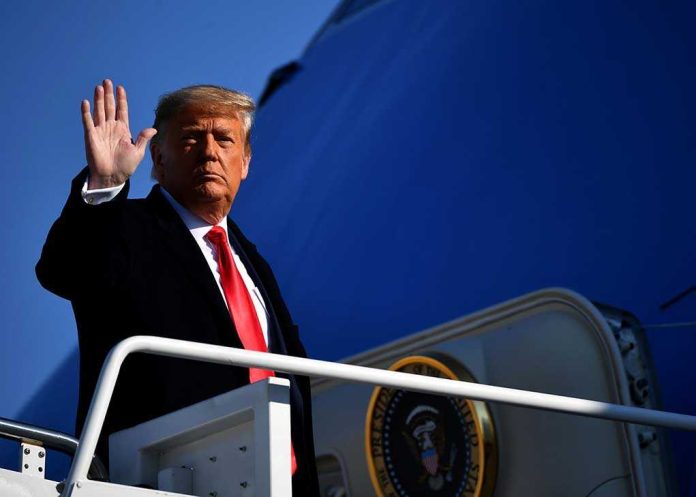
Before departing for his trip to China, President Trump was asked whether Americans’ financial concerns were motivating him to reach a deal with Iran. His answer was unambiguous: “The only thing that matters when I’m talking about Iran, they can’t have a nuclear weapon. I don’t think about Americans’ financial situation, I don’t think about anybody. I think about one thing — we cannot let Iran have a nuclear weapon, that’s all.” The statement was captured on video and spread rapidly across news and social media platforms.
The intent behind the comment is defensible — stopping Iran from acquiring nuclear weapons is a legitimate and serious national security priority that transcends everyday politics. But the delivery was a gift to every Democrat looking for evidence that the administration is disconnected from working Americans. In politics, how you say something matters as much as what you mean, and “I don’t think about Americans’ financial situation” is a brutal clip in a thirty-second attack ad.
The Economic Reality Behind the Soundbite
The frustration many Americans feel is grounded in real numbers. Department of Labor data confirms inflation has climbed significantly, with energy costs cited as a leading driver tied directly to the Iran conflict. Estimates place additional gas and diesel costs at roughly $38 billion nationally — approximately $300 per household — while energy analysts project Brent crude prices near $106 per barrel if the Strait of Hormuz disruption continues. These are not abstract statistics; they show up at the gas pump and the grocery store every week.
Polling data reinforces the political danger. Roughly three in four Americans report the war with Iran has hurt their finances. For a president whose original coalition was built heavily on economic populism — the promise to put American workers first — a statement that sounds dismissive of household budgets cuts against the brand. Conservatives who rallied behind Trump in 2024 did so in large part because they were exhausted by years of inflation and energy mismanagement under the previous administration. They expect this White House to keep those concerns front and center.
Vance Steps In, But the Framing Problem Remains
Vice President JD Vance moved quickly to defend the president’s remarks, framing the nuclear threat as an overriding national security imperative that justifies keeping negotiations focused on a single objective. That argument has historical and strategic merit — presidents from both parties have treated nuclear nonproliferation as a category-one priority that supersedes other considerations. The logic is sound: a nuclear-armed Iran would destabilize the entire Middle East and threaten American allies and interests for decades.
‘I don’t think about Americans’ financial situation’ says Trump, as Iran war drags on – and economic worries persist with it#PersonalFinance #Inflation #IranWarhttps://t.co/xzWLWHuksY
— Moneywise (@moneywisecom) May 15, 2026
The problem is not the policy — it is the framing. Trump could have said, “Stopping Iran from getting a nuclear weapon is the best thing I can do for Americans’ financial future,” and the message would have been both accurate and politically effective. Instead, the phrasing suggested indifference rather than prioritization. Democrats will run that clip on a loop through the midterm cycle, and the White House will spend weeks explaining what the president meant rather than driving its own message. A single poorly worded answer in a press gaggle should not define a serious foreign policy, but in today’s media environment, it often does.
Sources:
[1] Web – Despite Affordability Concerns due to War with Iran, Trump says “I …
[2] Web – Trump says “I don’t think about Americans’ financial …
[3] YouTube – Trump says he doesn’t consider Americans’ financial …
[4] YouTube – ‘I don’t think about Americans’ financial situation’ during Iran talks
[5] YouTube – Trump on Iran talks:’I don’t think about ‘Americans’ finances
[6] YouTube – Trump says he does not consider American financial …