

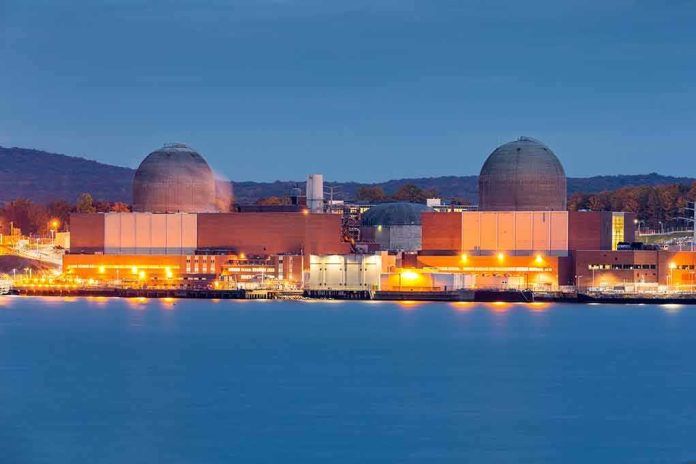
Three tiny bursts of radiation inside Africa’s only nuclear plant rattled the whole country more than the science says they should.
Story Snapshot
- Three brief contamination events stayed inside Koeberg’s walls with no environmental leak
- Worker exposure was below a dental X-ray and rated “no safety significance” on global scales
- Device glitches and a burnt power cord raise maintenance questions, not meltdown fears
- Public panic is now colliding with government plans to expand nuclear power in South Africa
What Really Happened Inside Koeberg’s Unit 2
South Africa’s National Nuclear Regulator says three separate “contamination” events hit Koeberg Nuclear Power Station between June 30 and July 7, all inside Unit 2 during planned maintenance work. A temporary loss of power to ventilation units in maintenance tents allowed airborne radioactive particles to drift within a controlled area of the containment building. Regulators and Eskom, the state power company, stress that steel-reinforced containment did its job and no radioactive material escaped into the environment or nearby Cape Town communities.
The regulator states there was “no danger to the public,” and the events never met the threshold for a nuclear or radiological emergency under international rules. Eskom classed the incidents as Level 0 on the International Nuclear and Radiological Event Scale, the lowest rating that means “no safety significance.” That is a long way from Chernobyl or Fukushima. Those disasters involved core damage and large off-site releases. Koeberg’s events involved a maintenance tent, not a failing reactor, and the plant continued operating safely.
How Much Radiation Did Workers Actually Get?
Radiation detectors inside the work area triggered alarms and workers were pulled, screened, and measured. The National Nuclear Regulator reported contamination levels below what a person receives from a dental X-ray. Energy expert Matthew Cruise told a CapeTalk audience that measured doses around one microsievert are common low-level exposures; a dental X-ray is about five microsieverts, and eating a few bananas exposes you to similar natural radiation. Eskom later said the highest recorded dose was about 20 microsieverts, just 0.1% of the annual limit of 20,000 microsieverts for workers.
To put that into plain numbers: 20 microsieverts is a fraction of what many people receive each year from background radiation in everyday life. Eskom screened 31 workers initially and then another 245 who had been in containment, giving whole-body counts to check for internal contamination. That kind of broad screening is less a sign of danger than a sign of transparency. The tests confirmed very low uptake, and no iodine tablets or emergency medical steps were needed.
Minor Event, Major Panic: Why The Story Blew Up
Despite the “no leak” verdict, headlines screamed “radiation leaks scare” and social media lit up with comparisons to Chernobyl and Fukushima. Some outlets framed the story as a near-disaster, even though the regulator’s own statement says no radioactive material left the plant and the public dose was effectively zero. This is the classic pattern in nuclear reporting: contained technical events turn into fear stories, and once panic starts, facts struggle to catch up.
NEW: Airborne radioactive contamination” was detected during scheduled maintenance work at the Koeberg nuclear plant in South Africa
— Insider Paper (@TheInsiderPaper) July 19, 2026
From a common-sense conservative view, this kind of fear-mongering is reckless. Citizens deserve hard facts, not clickbait. When regulators say “no off-site radiological consequences” and back it with dose numbers far below everyday medical exposure, it aligns with established nuclear safety practices. That does not mean Koeberg should get a free pass. It does mean critics should argue from evidence, not from worst-case images borrowed from foreign disasters with very different causes and scales.
Legitimate Concerns: Maintenance, Aging Hardware, And Trust
Side B of the debate focuses less on radiation risk to the public and more on what these incidents say about maintenance culture at Koeberg. Engineer and energy expert Lutuli notes that two incidents were linked to malfunctioning radiation measuring devices, pointing to possible calibration or upkeep gaps. A third involved a burnt electrical cord, which she finds more troubling because it hints at basic electrical maintenance problems inside a nuclear facility. Those details raise questions worth serious attention.
Koeberg is about 42 years old, with plans to stretch operation toward 60 years, pushing aging technology to its limit. The plant has seen past internal contamination episodes and a crane malfunction in April, adding to public skepticism that Eskom and regulators are always on top of safety. When the same institutions also push a national nuclear expansion agenda of more reactors and 5.2 gigawatts of new capacity, many South Africans suspect conflicts of interest. They worry officials will minimize problems to keep that expansion on track, rather than level with the public when things go wrong.
Where Responsible Scrutiny Should Focus Next
The strongest case for tough oversight is not that Koeberg almost poisoned Cape Town; the evidence shows it did not. The real issue is whether maintenance, monitoring devices, and outage procedures are as robust as they should be in a nuclear setting. Independent audits of radiation monitor calibration, ventilation systems, and root-cause reports on the power loss and burnt cord would help rebuild trust. Transparent publication of worker dose records, plus environmental sampling around the plant, would give skeptics hard data instead of rumors.
For readers who value limited, reliable government and sober risk management, this story cuts both ways. On one side, nuclear power still looks far safer than many assume, especially compared with daily risks we ignore. On the other, a state utility with a history of failures must earn trust with proof, not press releases. Minor radiation events at Koeberg were scientifically small. The bigger test now is whether South Africa’s leaders handle them with the honesty and discipline that real nuclear stewardship demands.
Sources:
insiderpaper.com, apnews.com, facebook.com, youtube.com, abcnews.com, gov.za, world-nuclear-news.org, reddit.com