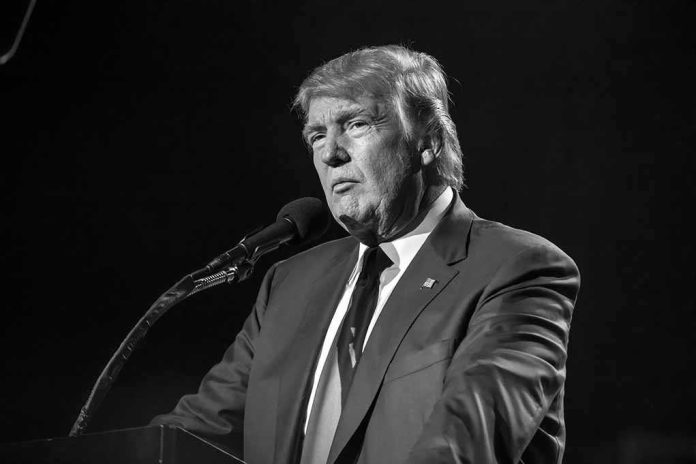
President Trump just turned the screws on the International Criminal Court, tying America’s wallet and welcome mat to national sovereignty.
At a Glance
- Executive action frames the Court’s reach as a threat to U.S. security and policy.
- Sanctions target officials linked to probes of U.S. and allied personnel.
- The Court and many governments denounce the move as an attack on judicial independence.
- Future, broader sanctions could hit the Court’s access to dollars and travel.
What Washington Did, And Why It Matters
President Trump used emergency economic powers to treat the Court’s claims over Americans as a direct security threat. Executive Order 13928 in 2020 declared the Court’s “illegitimate assertion of jurisdiction” an unusual and extraordinary danger to U.S. national security and foreign policy. That set the legal base to freeze assets, cut access to the U.S. financial system, and block visas for targeted individuals. The policy message is simple: U.S. citizens do not answer to a court America never joined.
The administration later acted on that framework. Officials designated International Criminal Court figures involved in investigations touching U.S. or allied personnel. The Brennan Center summary notes the order covers foreign persons who directly support such efforts, once the Secretary of State makes the finding with key cabinet input. The State Department has since named senior Court leaders, triggering asset freezes in U.S. reach and travel limits that bite in daily life.
The Trigger: Afghanistan And Allied Cases
Congressional research ties the original move to the Court’s Afghanistan probe that could have pulled in U.S. service members and intelligence personnel. That clash sits at the core of the sovereignty debate. The United States never ratified the Rome Statute, so it rejects a prosecutor pulling Americans into a foreign dock over actions in a war zone. The order answered by shifting pressure from legal briefs to bank ledgers and border control, where America holds clear leverage.
The logic extends to allies under Court scrutiny. The 2025 presidential action and later designations mirrored the same lines: protect U.S. and partner officials from a tribunal the administration views as unaccountable to voters in democratic states. That view fits a long U.S. pattern. Washington backs justice for mass atrocities but resists any outside court claiming power over Americans without consent. Sanctions are the sharp end of that stance, not a surprise detour.
Global Pushback And The Legitimacy Fight
The Court blasted the sanctions as a “flagrant attack” on its independence and said they undermine the rule of law. Policy voices piled on. Brookings highlighted that eighty-eight countries, including major allies, publicly defended the Court and condemned sanctions and intimidation. This response frames the issue as bigger than one case. To them, punishing judges and lawyers for doing their jobs weakens the global promise that even the powerful face scrutiny.
Trump Urges ICC Member States To Quit Court
US President Donald Trump has called on all countries that are members of the International Criminal Court (ICC) to withdraw from the tribunal.
Trump made the call on Tuesday during his address to the United Nations General Assembly,… pic.twitter.com/ckhWHyFu2f
— Blueprint Newspapers (@Blueprint_ng) September 23, 2026
Consequences could grow if entity-wide sanctions land. Reuters reported the Court could lose access to much of the dollar-based financial system and face broader travel limits for staff. That would raise the cost of every case, not just those touching the United States or Israel. Supporters argue that is exactly the point: force the Court to respect state consent and narrow its reach. Critics argue it is collective punishment that chills war-crimes work and emboldens abusers.
How To Judge The Move By Conservative Common Sense
The sovereignty case is strong. Americans should not be hauled before judges they never empowered, especially when our courts and Congress can police our own. National elections, not foreign prosecutors, set U.S. policy. The Executive Order relies on clear statutes and targets individuals tied to claims against our people. That aligns with a core duty of government: protect citizens, allies, and the constitutional order from outside control.
The counter-case raises real costs. Sanctions risk alienating partners who see the Court as a check on tyrants. If eighty-eight governments line up against Washington on process, coalition-building gets harder. Overreach could also hit victims who rely on the Court when local courts fail. Common sense draws a line: defend sovereignty without swinging so wide that honest investigations elsewhere stall. Precision matters. Sanction actors who target Americans; avoid blunt tools that wreck unrelated cases.
What To Watch Next
First, watch for any move from targeted designations to institution-wide sanctions. That is the breakpoint where dollar access and broad services get cut, and the diplomatic bill rises fast. Second, track whether Congress codifies parts of this policy, locking in leverage across administrations. Third, assess whether the Court adjusts case strategy on non-consenting states. If the docket shifts, sanctions changed incentives. If not, expect more financial and travel pressure to follow.
Sources:
youtube.com, time.com, brennancenter.org, theguardian.com, apnews.com, bbc.com, hls.harvard.edu, cnn.com