
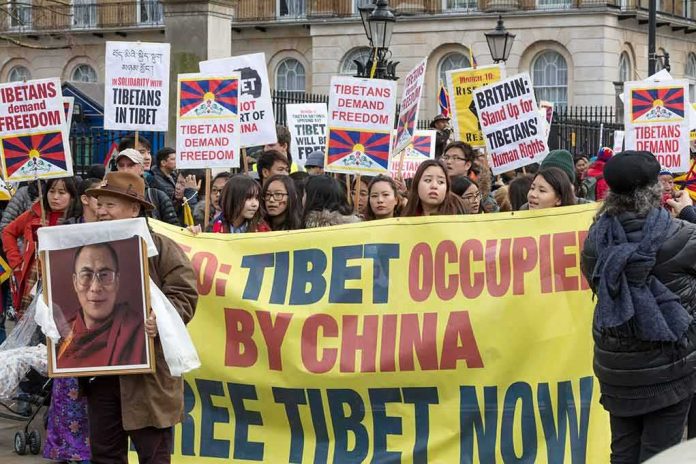
As President Trump welcomed China’s Xi Jinping to Washington, protesters filled nearby streets with banners, drums, and a message that would not be ignored.
Story Snapshot
- Protesters and pro-Xi supporters gathered near hotels and security zones in downtown D.C.
- One protester climbed a Pennsylvania Avenue light pole and hung an anti-Xi banner.
- Police and the Secret Service tightened security and warned of road closures.
- Rights groups used the summit to spotlight Tibet, Uyghurs, Hong Kong, and dissidents.
Protests Erupt As State Visit Begins
President Trump greeted Xi at Joint Base Andrews to start a three-day state visit, while demonstrations formed downtown. Crowds gathered near Xi’s hotel route and around the security perimeter. Some waved Chinese flags and cheered. Others chanted for freedom and held rights group placards. Reports described a face-off between welcoming groups and protesters near key checkpoints and staging areas, a common scene when Xi travels in the United States.
Police in Washington, D.C., and the United States Secret Service increased staffing and barriers ahead of the arrival. Officials flagged likely street closures and warned commuters to expect slowdowns. Agencies prepared for both protests and welcome events linked to diaspora organizations. The heavier security posture matched the schedule pace and the size of planned gatherings across the downtown grid and near the White House complex.
A Banner From A Lamppost Draws Focus
Hours before the formal welcome, a protester scaled a light pole on Pennsylvania Avenue Northwest and hung a banner aimed at Xi. The message referenced Tibet and denounced dictatorship. Crews briefly closed the street in both directions as responders worked the scene and removed the banner. The climb became a visual shorthand for the broader unrest and the mix of high emotion and clever staging that often defines protests around major summits.
Rights groups pressed their causes into the spotlight across several blocks. Advocates for Tibet, Uyghurs, Hong Kong democracy, Falun Gong, and Chinese dissidents organized chants and flyered passersby. Their stated goal was simple: put human rights on the table while the two leaders discussed trade, security, and technology. That tactic has precedent. During earlier Xi visits, protests cropped up near hotels and official venues, even when cameras kept some of the scenes out of the frame.
Security, Speech, And The Optics Of Power
Law enforcement faced a tough balancing act. Officers had to maintain a hardened perimeter fit for a state visit while protecting the right to peaceful assembly for both sides. Freedom House and other civic voices stressed that the best answer to any pressure from foreign dignitaries is to show America’s strength lies in open debate and lawful protest. That standard fits mainstream conservative values: protect order, uphold rights, and do both without apology.
The crowd mix told its own story about influence and identity. Pro-Xi groups rallied to present unity and national pride as the Chinese leader met Trump. Protesters countered with stories of relatives jailed, faiths persecuted, and regions under tight control. Both images traveled fast on social media feeds. The contrast did not weaken the summit; it framed it. Negotiations in Washington always happen in public view, with the street reminding leaders who is watching.
What Matters Next
The White House agenda runs long, from trade friction to military risk control. Yet the street will keep pulling one issue back into the lens: how Beijing treats people who speak, pray, or organize outside party lines. That pressure is not theater; it is leverage. If Xi wants a calmer relationship, human dignity cannot be a side note. A summit can set terms on tariffs and tech, but trust grows only when promises line up with what people see on the ground.
Sources:
youtube.com, chinatimes.com, wionews.com, foxnews.com, scmp.com, x.com, nbcwashington.com, bbc.com