
The Federal Aviation Administration froze most takeoffs across America after key air traffic centers lost communications, and safety—not panic—drove the call.
Story Snapshot
- The Federal Aviation Administration ordered a nationwide ground stop tied to communications failures.
- Officials later cited a temporary telecommunications outage as the specific trigger.
- Departures paused nationwide while inbound international flights were managed case by case.
- About 3,100 aircraft were already en route to the United States when the stop began.
What triggered the nationwide halt
The Federal Aviation Administration said communications problems struck multiple regional control centers that handle aircraft between airports. The agency told facilities to hold departures nationwide “for reasons of safety,” and it framed the action as a direct response to the loss of a core link in the traffic system. Later the agency pointed to a “temporary telecommunications outage” as the root operational cause. That explanation aligns with the type of failure that can force a broad pause while controllers verify backups and routes.
The Air Traffic Control System Command Center message set the tone: all airports ground stopped, departures held, inbound international flights handled case by case. That is the checklist you reach for when voice or data bridges between centers are in doubt. You do not add more planes into a grid you cannot fully see; you stabilize the picture you have, then restore order piece by piece.
How the stop unfolded across a busy sky
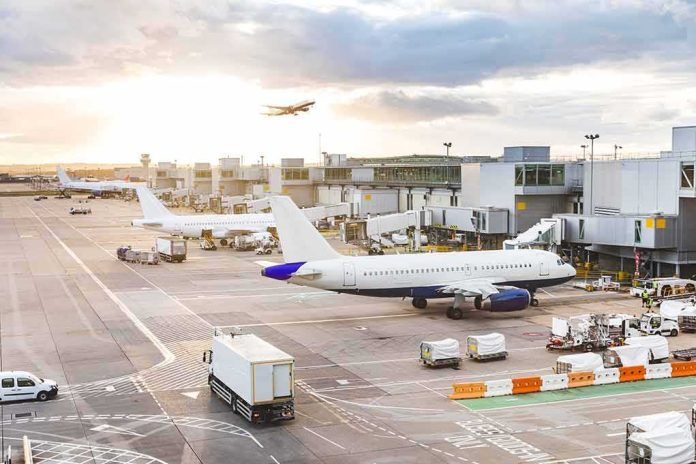
Airlines froze boarding and pushed updates to passengers as delays grew by the hour. Flight-tracking data showed roughly 3,100 aircraft already headed to United States airports as the order hit, which controllers worked one by one. That approach kept airborne flights moving under positive control while preventing new departures from compounding risk and clogging arrival fixes and holding stacks around hubs.
Regional centers manage the high-altitude highways between cities. When their lines to each other degrade, handoffs get risky. Controllers must confirm routes, altitudes, and conflicts in real time. The scale of these centers explains why even a short outage can ripple across the map. You cannot run modern airspace with guesswork; the system demands clear circuits and verified status before the next wave of takeoffs leaves the ground.
Why this response fits the rulebook
The Federal Aviation Administration rarely stops departures nationwide, but when uncertainty touches a safety-critical layer, it acts fast. The last comparable pause came in 2023, when a Federal Aviation Administration pilot advisory system failure halted takeoffs until integrity was restored. Before that, the only modern benchmark was the shutdown after the September 11 attacks. That history shows a clear pattern: halt, diagnose, restore, then deconflict the backlog.
Homeland Security Secretary Markwayne Mullin said officials saw no sign of a “nefarious attack” at the time and framed the stop as a safety-first decision. That matters for public confidence and for operations, because it signals controllers and airlines should focus on clearing queues rather than locking down infrastructure. The statement also fits conservative common sense: protect lives first, then fix the pipe and explain the fix when verified.
What the outage exposed about the system we rely on
Modern air travel depends on a web of voice lines, data circuits, and automation. A communications outage can hit any of those layers. When several centers lose clean ties at once, the fast and responsible choice is to stop feeding the machine until links stabilize. That choice stranded travelers in terminals, but it also kept pilots and passengers safe while ground teams confirmed what worked, what failed, and how to bring traffic back in sequence.
Mullin says no lives or flights were ever at risk, and the ground stop was called out of an abundance of caution after a telecom outage. Good news, but a single comms failure stopping every flight in America still needs a full public explanation. #Groundstop #FAA
— Azwan (@Azwan213) November 14, 2026
Government auditors have warned for years that many air traffic control systems are aging and hard to sustain. They urged faster upgrades to communications networks, cybersecurity defenses, and automation backbones. Those findings support a simple lesson from this event: redundancy must be real, and switchover must be quick, or small breaks become national headaches. Safety was served here; resilience still needs to catch up.
Sources:
faa.gov, fox5atlanta.com, cbsnews.com, thedailybeast.com, en.philenews.com, nbcchicago.com, gao.gov