

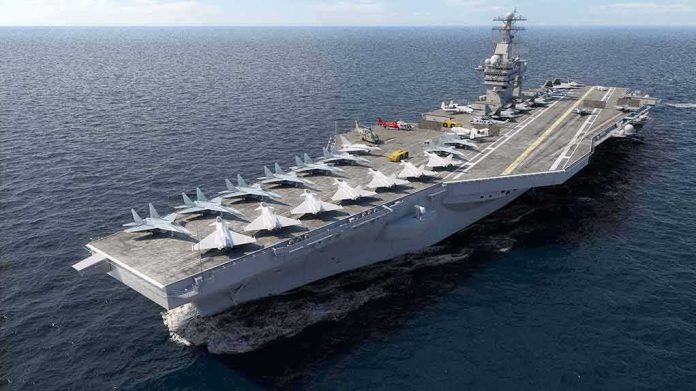
The Navy’s own letter says eight service members in the USS Abraham Lincoln strike group tried to kill themselves during the deployment, and that single sentence now defines the fight over truth, blame, and duty.
Story Snapshot
- The Navy confirmed eight suicide attempts across the Lincoln strike group during deployment.
- Senator Kirsten Gillibrand pressed Acting Navy Secretary Hung Cao over the wording and accountability.
- Cao later framed the cases as “mitigations,” highlighting onboard chaplains and counselors.
- Earlier Navy messaging claimed no observed increase on the carrier, creating a rift over transparency.
What the Navy Put in Writing, and Why It Matters
Acting Secretary of the Navy Hung Cao told Senator Kirsten Gillibrand in writing that eight service members across the USS Abraham Lincoln carrier strike group attempted suicide during the deployment. The phrase “suicide attempts” appeared in the letter, not a press leak or a rumor. That official count covers the carrier, the embarked air wing, strike-group and destroyer-squadron staffs, destroyers, and aviation squadrons. The scope matters. It confirms real events but does not prove they all happened on the carrier or share one cause.
The dispute ignited because words carry weight. Gillibrand cited the Navy’s own term to argue for hearings and a full accounting. Cao then spoke of “eight suicide mitigations,” crediting chaplains, counselors, and mental-health staff for lifesaving interventions. Both things can be true at once: attempts occurred, and teams stepped in. The public wants straight talk on both counts. Euphemisms soothe headlines but do not answer families who want timelines, locations, and follow-up care.
The Clash Between Confirmation and Confidence
CNN reported the Navy had said it “had not observed an increase” in suicidal ideation or attempts aboard the carrier. That line now sits next to the letter confirming eight attempts across the strike group, and the contrast has consequences. The phrase “aboard the ship” narrows the lens and risks sounding like legalese to readers who hear “Lincoln” and think of the entire deployed team. Clear baselines, definitions, and denominators should have accompanied the message on day one.
The American Legion highlighted the grueling length and intensity of the deployment, noting more than 200 days of combat operations in the region. Long, punishing deployments stress people and systems. That does not prove causation. It does frame reasonable questions about crew endurance, counseling access, and leadership tempo. Common sense says you measure this stuff with hard numbers, not wishful thinking, then fix what the numbers reveal.
Events on the Water, People on the Line
Reports described at least two concrete events: a sailor went overboard in August and was rescued, and shipmates stopped another person from jumping in March. Cao also said one overboard sailor wore a life preserver and told the commanding officer he was not trying to die. These details show why classification gets tricky. Investigators need statements, medical reviews, and timelines. Leaders need to speak plainly, avoid spin, and own the duty to follow the facts wherever they lead.
The Navy points to a support stack on Lincoln: five chaplains, an embedded prevention counselor, a psychologist, a clinical social worker, and behavioral-health technicians. That is real capability, but it is also finite. A sailor told Navy Times that non-urgent mental-health waits could take weeks aboard a ship with about five thousand personnel. Leaders cannot preach resilience without resourcing it. Adding counselors and chaplains service-wide helps only if the help is where sailors stand watch when the pressure peaks.
Accountability Without Politics, Action Without Delay
Gillibrand wants hearings and full disclosure: dates, places, units, methods, rescues, and aftercare outcomes. That is the right ask. Conservative values demand clarity, honesty, and stewardship of people as seriously as stewardship of ships. The Department of Defense Suicide Event Report system exists to track attempts and risks across the force. Use it here to map patterns, test whether the rate was abnormal, and identify which fixes work fastest in the real world, not just on a slide deck.
Congress should force clean definitions across the chain of command and require quarterly public briefings specific to deployed strike groups. The Navy should release anonymized timelines and resource logs and explain any messaging gaps between the “no increase aboard ship” line and the eight-attempt confirmation. Sailors deserve straight answers. Families deserve confidence that help arrives on time. The country deserves a Navy that fights hard wars and fights just as hard for its people.
Sources:
youtube.com, bbc.com, gillibrand.senate.gov, washingtonsun.com, washingtonexaminer.com, militarytimes.com, navy.mil, ms.now