A Marine Corps fighter jet slammed into a Washington State hillside during a training run, ignited a wildfire, and left behind more questions than answers — and the pilot barely got out alive.
Story Snapshot
- A U.S. Marine Corps F/A-18D Hornet from the “Death Rattlers” squadron crashed near Rimrock Lake, Washington, on June 13, 2026, during a low-level training flight.
- The pilot ejected safely and was hospitalized with minor injuries — the ejection seat did its job.
- The crash sparked a wildfire called the Pine Tree Fire, forcing campers to evacuate the area near the Okanogan-Wenatchee National Forest.
- Video captured before impact appears to show the jet smoking, raising early questions about a possible mechanical failure.
A Marine Jet Goes Down in the Cascade Mountains
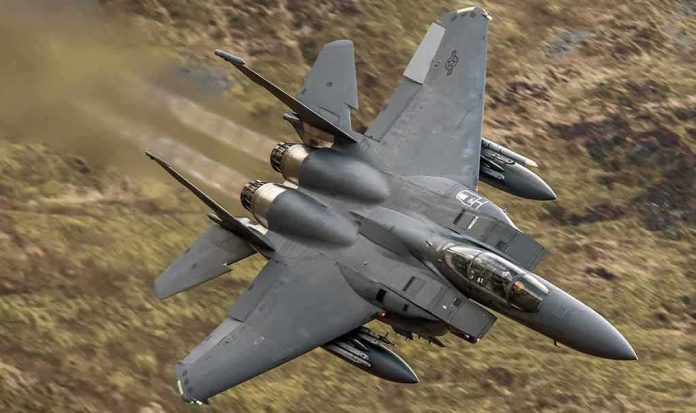
Around noon on Saturday, June 13, 2026, a McDonnell Douglas F/A-18D Hornet assigned to Marine Fighter Attack Squadron 323, known as the “Death Rattlers,” out of Marine Corps Air Station Miramar in San Diego, crashed into a hillside near Rimrock Lake in Yakima County, Washington. The aircraft was flying the VR-1355 low-level training route at the time. The jet was destroyed on impact. The pilot ejected and survived with minor injuries. [4]
Low-level routes like VR-1355 push pilots and aircraft hard. These routes hug terrain at high speeds to train crews for real-world combat scenarios. They are legal, planned, and practiced. But flying fast and low through mountain terrain leaves almost no room for error when something goes wrong. That context matters when you start asking why this jet went down.
Wildfire Erupts as Crews Race to the Scene
The crash did not just destroy a $30 million aircraft. It started a wildfire. The blaze, named the Pine Tree Fire, broke out immediately after impact and spread into the surrounding forest. The U.S. Forest Service and local firefighting crews responded. The Naches Fire Department coordinated evacuations of campers in the area. The Okanogan-Wenatchee National Forest sits in that region, and dry summer conditions made the fire a serious secondary threat on top of the crash itself. [1]
The Marine Corps confirmed the aircraft belonged to Marine Aircraft Group 11, 3rd Marine Aircraft Wing. Beyond that, the official statement was brief. The 3rd Marine Aircraft Wing said the cause of the crash is under investigation and that no additional details would be released to protect the integrity of that process. Investigations of this type can take several months to finish. [9]
Pre-Impact Smoke Raises the Stakes for Investigators
Here is where the story gets more complicated. Aviation safety records show the aircraft, Bureau Number 165412, appeared to be smoking before it hit the ground. [4] Eyewitness video circulating online captured the jet in its final seconds, and multiple clips appear to confirm something was wrong before impact. Smoke before a crash points toward a possible mechanical or systems failure — not necessarily pilot error. That distinction matters enormously for how the investigation unfolds and who or what bears responsibility.
🚨 U.S. Marine F/A-18D Hornet from VMFA-323 “Death Rattlers” crashed near Rimrock Lake, Washington during low-level training. Pilot ejected safely with minor injuries rescued quickly. Impact sparked the Pine Tree Fire (now contained). No other injuries. Grateful the aviator is… pic.twitter.com/ncJWFW4Ff1
— LouieHaHa (@LouieHa_ha) June 15, 2026
To be clear, nobody has officially ruled out any cause. The Marine Corps is right to hold its conclusions until investigators finish their work. That is standard practice, and it is the correct approach. Rushing to blame a pilot or a maintenance crew before the data is in serves no one. But the pre-impact smoke detail is the kind of specific, observable fact that investigators will focus on closely, and the public deserves to know it exists.
What the Investigation Will Need to Answer
Military aviation mishap investigations are thorough but slow. A formal safety board will examine flight data, maintenance logs, the pilot’s account, and physical evidence from the crash site. The smoking-prior-to-impact detail will be central. Investigators will want to know whether the aircraft had any recent maintenance flags, whether the engine or systems showed warning signs in the cockpit before ejection, and whether the VR-1355 route itself played any role in the sequence of events.
The pilot’s survival is the one unambiguous good news in this story. Ejection seats on F/A-18s are among the most reliable pieces of equipment in military aviation, and this one worked exactly as designed. The pilot walked away from a catastrophic, high-speed terrain impact. That outcome reflects decades of investment in crew survival systems — a reminder that even when hardware fails, other systems can still save a life. The full story of what brought this jet down will take months to tell. But the questions worth asking are already on the table.
Sources:
[1] Web – U.S. Marine Corps F/A-18D Crashes Near Rimrock Lake, Washington
[4] Web – Fighter Jet Crash Reported Near Rimrock Lake – Pilot Contact Made …
[9] YouTube – U.S F/A-18 Hornet Crash BREAKING: Trump’s Jet Went …