

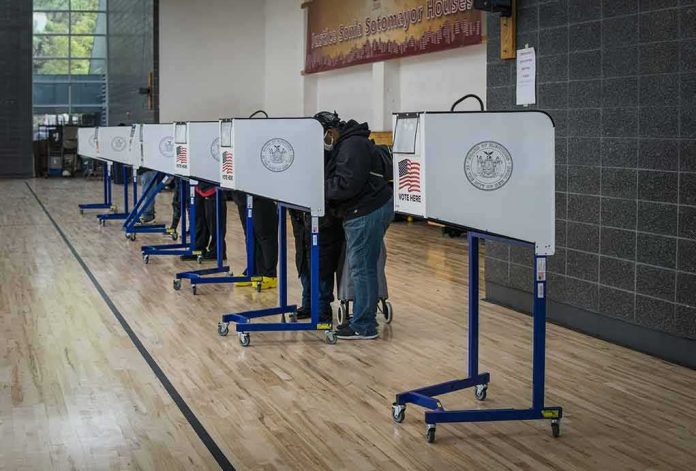
Election Day will not be quiet; it will be a ground fight with clipboards, cameras, and court filings ready to launch.
Story Snapshot
- Justice Department asked a court to pause Alaska’s Senate certification under a similar-name confusion theory.
- The request hinged on Alaska’s ranked-choice process and would trigger only if the incumbent lost.
- Opponents moved to intervene and warned the bid was an extraordinary step.
- States brace for many federal and party-aligned monitors; critics warn of intimidation risks.
What Actually Happened In Alaska
The Department of Justice filed United States of America v. Alaska on October 22, 2026, asking a federal judge to delay certification in the Senate race if the incumbent Dan S. Sullivan lost. The theory pointed to two candidates with nearly the same name—Republican Senator Dan S. Sullivan and independent Daniel J. Sullivan—on the same ballot. The complaint said the step would protect the integrity of the election and allow the court to examine potential voter confusion before Alaska locked in results.
The filing tied the request to Alaska’s ranked-choice system. The government sought a narrow trigger: act only if two conditions held—first, the incumbent lost; second, reassigning votes cast for Daniel J. Sullivan would change the outcome under ranked-choice tabulation. That design framed the intervention as conditional and evidence-led rather than a blanket attempt to stop certification. The case landed before Judge Sharon Gleason, which moved the dispute into an arena with rules and cross-examination.
Why The Theory Sounds Plausible—And Why Proof Still Matters
Ballots with two near-identical names create a real risk vector, especially in ranked-choice contests that ask voters to sort several choices. Research on ranked-choice ballots shows measurable rates of mismarks, though scholars debate how much reflects confusion versus choice strategy. Those base rates explain why officials might flag a similar-name pairing as a hazard zone. Yet the public record, so far, does not show voter interviews, error tallies, or survey evidence that confusion changed the count in Alaska.
The dispute also leans on a hypothetical fix. Critics of the government’s motion argued the court would have to assume most votes for Daniel J. Sullivan belonged, in truth, to Senator Sullivan. That leap is a big one. Voters sometimes pick a namesake on purpose, or they protest-vote. The opposing filings labeled the remedy as a stretch and said the National Voter Registration Act did not authorize a federal block on certification in these conditions. A judge’s ruling would decide the legal reach; that answer was not yet on the record.
The Ground Game Beyond Alaska: Monitors Everywhere
States expect a surge of observers this cycle, including federal personnel and party-aligned watchers. Supporters say many eyes deter mistakes and document real problems fast. Critics warn the crowd itself can chill turnout, strain poll workers, and turn minor hiccups into headline fodder. Reporting describes state officials and rights groups who fear a federal overreach that could erode trust if deployments look ad hoc or partisan rather than by clear rules and public notice.
The concerns are not limited to Democrats. A Republican county clerk in Wyoming and the state’s Republican governor described prior federal monitors as aggressive and irregular. They said the teams questioned staff, pressed on machines, and sought voter contacts without enough coordination. That feedback matters to conservatives who value local control. Election integrity means guarding both the count and the calm at the precinct level; heavy boots can rattle both if they ignore state lines and roles.
How To Judge A Serious Oversight Effort
Any large monitoring push should publish a clear plan: where people go, what they can do, and how referrals move from rumor to evidence. Alaska shows the right channel—court filings, sworn claims, and a narrow, testable ask. But the standard of proof cannot be “it might have mattered.” It should be specific, reproducible, and tied to law. Ranked-choice ballots complicate the task, yet complexity is not chaos. The remedy must match the record, not replace it.
A conservative approach draws two bright lines. First, protect voters from pressure, whether from federal suits, party watchers, or loud activists. Second, protect the rules of counting by using courts to weigh focused claims with data, not vibes. The Alaska case pressed that balance in public view, with adversaries ready to argue. That is how elections earn trust—by testing hard questions in daylight and by refusing to change outcomes on speculation alone.
Sources:
redstate.com, cnbc.com, democracydocket.com, detroitnews.com, usatoday.com, nbcnews.com, mercurynews.com, spectrumlocalnews.com