
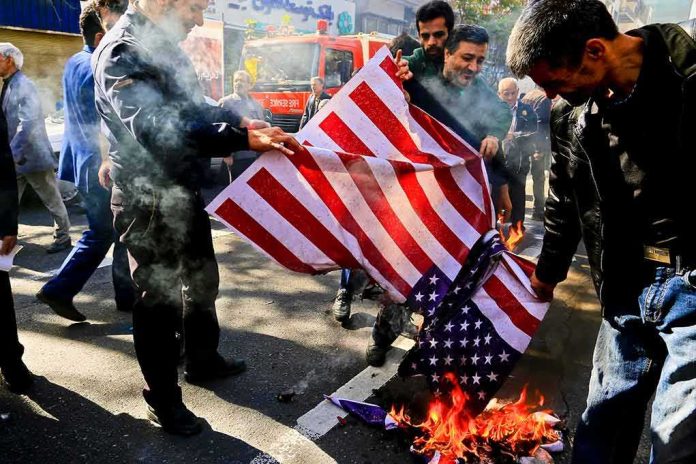
Tehran’s state-organized crowd lit a giant banner of President Trump, Vice President JD Vance, and Israel’s Benjamin Netanyahu on fire the day after Republicans lost the midterms.
Story Snapshot
- A giant banner of Trump, Vance, and Netanyahu burned in Tehran’s Enghelab Square.
- The burning took place during the annual November 4 rally marking the 1979 embassy takeover.
- Chants of “Death to America” and “Death to Israel” and flag burnings filled the square.
- Iranian officials tied the timing to Republican midterm losses in the United States.
A staged blaze in the capital’s political theater
Footage from Tehran shows a massive banner with Trump, Vance, and Netanyahu going up in flames at Enghelab Square on November 4, 2026. Al Jazeera’s video report situates the burn during a large rally in the city center, with the banner featured as the visual focus before it was set alight. A separate outlet described the same square, the date, and the scene as part of the day’s planned events, confirming the where and when across reports.
News accounts linked the act to the United States midterm results reported the previous day, noting Republican losses and Iran’s eagerness to show it. The display did not single out only Trump. The banner grouped him with Vice President JD Vance and Israel’s Benjamin Netanyahu, which signals Tehran’s message aimed at a broader camp of U.S. and Israeli leaders rather than one man alone. Another report also mentioned developer and envoy Steve Witkoff as part of the image set.
Why November 4 always draws a crowd in Iran
Iranian authorities have long used November 4 to rally supporters around the memory of the 1979 U.S. Embassy seizure. This rally followed the same script: speeches, anti-U.S. slogans, and a large visual meant for cameras and headlines. Reports described thousands in attendance and the burning of American and Israeli flags alongside the banner, with chants of “Death to America” and “Death to Israel” echoing through the square. The date and staging match a pattern that repeats every year across Iran’s major cities.
Analysts of Iran’s domestic politics have shown how state institutions, mosques, and loyal groups mobilize turnout for such events. That machine can fill streets and shape the emotional tone of the day. Research on state-led mobilization in Iran explains how authorities “own the streets” during set-piece anniversaries, using ritual to project unity and resolve toward foreign foes. That helps explain the mix of large crowds, polished visuals, and coordinated messaging on display in Tehran.
Election setback abroad, message discipline at home
Iranian officials framed the midterm outcome as a popular U.S. rebuke of Trump’s approach to Iran and the region. Coverage quoted officials saying the results showed that American voters rejected Trump’s war posture, a line they then tied to the spectacle in Enghelab Square the next day. The claim serves a familiar purpose: convert a foreign news beat into proof of the regime’s narrative, then stamp it onto a bold image that travels fast.
People have gathered in Tehran to burn a banner depicting Donald Trump, JD Vance, Israeli Prime Minister Benjamin Netanyahu and US special envoy Steve Witkoff. pic.twitter.com/nQ5SqxJFdi
— Prime Time (@primetime_ge) November 5, 2026
The banner’s composite faces matter for that narrative. Trump, Vance, and Netanyahu have been cast by Tehran as a single front. Grouping them on one sheet and burning it treats U.S. and Israeli policy as one target. That choice also focuses attention away from domestic strains. State-organized rallies emphasize defiance abroad to unify supporters at home, a common tactic in Iran’s political playbook.
How to read the flames without missing the point
The act happened as reported: a giant banner with Trump, Vance, and Netanyahu burned at a government-organized rally in Tehran the day after the U.S. midterms. The crowd also burned U.S. and Israeli flags and chanted well-known slogans. The setting matters for how to interpret it. The event looks less like a spontaneous poll of Tehran’s public and more like a ritual of state signaling aimed at both foreign and domestic audiences.
The bottom line for American readers is simple. Iran used a global news hook—the Republican midterm loss—to stage a message of strength at home and contempt toward U.S. and Israeli leaders. That message will not change U.S. interests or erase the threats those leaders represent to Tehran. But it shows how quickly a regime that plans its symbolism can turn an election across an ocean into a torch on a banner in the city square.
Sources:
youtube.com, news.com.au, economictimes.indiatimes.com, theaustralian.com.au, sfchronicle.com