

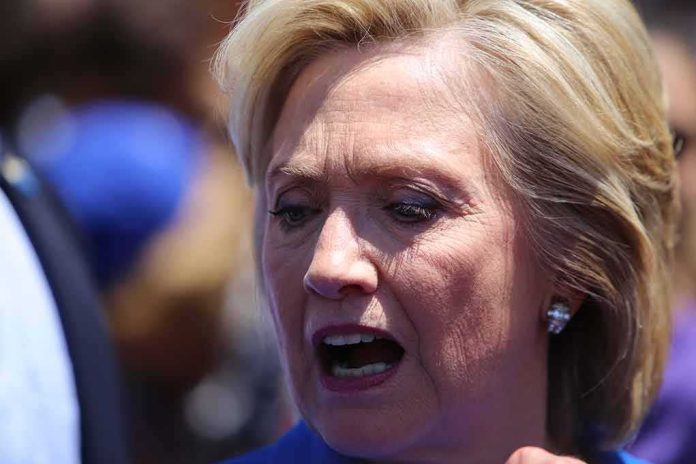
Hillary Clinton says Trump’s deportation push targets people based on how they look, not whether they broke the law.
Quick Take
- Clinton said in October 2026 that the administration’s removals are “a systematic effort to try to rid the country of people that don’t look like them,” distinguishing it from deporting criminals.
- A UC Berkeley Human Rights Center report found over 21,644 people deported to 28 countries by late August 2026, many with no criminal record.
- The Supreme Court let third-country removals resume temporarily while the underlying legal fight continues, with arguments set for December 9, 2026.
- Critics point to Clinton’s 2008 remarks backing criminal deportations and tougher rules for others as proof her current criticism is hypocritical.
What Clinton Actually Said About Trump’s Removal Policy
Clinton drew a sharp line in her October 13, 2026 comments. She said she backed deporting criminals when she served in the Senate. But she argued the current policy goes much further, calling it an effort to remove people simply because of their appearance rather than their record. That claim turns a policy debate into an accusation about motive, which raises the stakes for anyone trying to sort fact from spin.
Her remarks landed through a secondhand report, reproducing a social post rather than a full transcript. There’s no video of the complete event, the audience, or what she said right before that line. That gap matters. Readers deserve the full context before deciding whether her words describe a real pattern or just a punchy soundbite built for clips.
The Third-Country Removal Numbers Behind the Debate
Separate from Clinton’s statement, researchers have been digging into the actual removal data. The Berkeley Human Rights Center Investigations Lab tracked more than 21,644 people deported to 28 different countries through the end of August 2026, some sent “half a world away from where they were born”. The report says many of those people were in the country legally and had no criminal history at all, undercutting the idea that removals were limited to lawbreakers.
Human Rights Watch backed up part of that picture, reporting the program swept in people caught at the border, people with past criminal charges, and undocumented residents already living here, all without a clear public standard for who got picked. That lack of a defined methodology is a legitimate concern for conservatives who favor strong borders but also expect government power to follow clear, consistent rules rather than guesswork.
Courts Are Still Fighting Over Whether the Policy Is Legal
The legal fight over third-country removals isn’t settled. A late September 2026 court filing argued the policy lets the government send people to newly chosen countries without real notice or a fair chance to argue they’d face persecution or torture there. That’s not a small technicality. Due process protections exist precisely to stop government agencies from moving too fast and making irreversible mistakes.
The Supreme Court allowed the removals to resume while the case plays out, with oral arguments scheduled for December 9, 2026. That interim order is not a final ruling on whether the policy is lawful. Treating it as a green light, the way some coverage has, skips over the fact that the justices still have to weigh the merits.
Clinton’s 2008 Record Creates a Credibility Problem
Clinton’s own history complicates her current framing. Back in 2008, she said plainly that people who committed crimes should be deported “no questions asked” and that other undocumented immigrants should pay fines, repay back taxes, learn English, and wait in line for legal status. In 2015, she also said San Francisco made a mistake by not deporting someone federal authorities wanted removed. Those are not the words of someone who rejected enforcement outright.
That record gives critics a fair opening. If removing people who broke immigration law was acceptable enforcement in 2008, it’s reasonable to ask what specifically changed her view now, beyond the method and scale of who gets removed. Voters can hold two things true at once: her due-process concerns may have merit, while her past statements still raise real questions about consistency.
Separating the Racism Claim From the Policy Debate
Nothing in the available record shows internal directives, enforcement criteria, or data proving removals were driven by race rather than immigration status or nationality. Clinton’s assertion rests on her own characterization, not a documented dataset. A separate detention policy, letting authorities hold immigrants without individual bond hearings, adds another layer of concern, but it’s a distinct issue from the removals Clinton was addressing.
The honest takeaway sits in the middle. Americans broadly support removing people who commit crimes and oppose illegal immigration. Whether the current program’s scope, notice procedures, and safeguards meet that standard is still being argued in court. That’s where this debate belongs, not in dueling accusations about who truly cares about fairness.
Sources:
twitchy.com, clintonfoundationtimeline.com, pettersen.house.gov, news.berkeley.edu, jurist.org, millermayer.com, abc17news.com, aa.com.tr