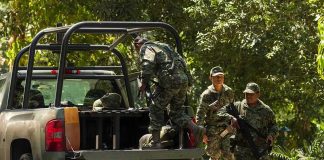

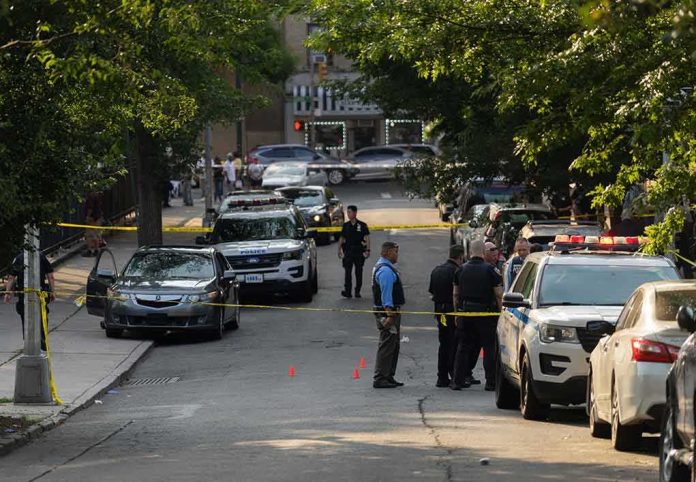
Seven shots cracked across a Bronx block because federal agents say a driver turned his car into a weapon.
Story Snapshot
- Immigration and Customs Enforcement agents moved on a targeted arrest in Marble Hill.
- Officials say Oscar Belgal drove into officers’ vehicles, and agents fired in fear for their safety.
- Surveillance reporting shows the vehicle moving as agents approached the driver’s side.
- New York Police Department leaders say at least seven rounds were fired, striking Belgal.
Targeted arrest turns into gunfire on a residential street
Federal agents with Immigration and Customs Enforcement converged on Marble Hill Avenue in the Bronx during a planned arrest operation. Officials identified the target as Oscar Belgal, an undocumented immigrant with a criminal record. As agents surrounded a Honda CR-V, the vehicle moved forward while an agent approached, and gunfire followed. New York Police Department leaders said at least one agent fired seven rounds and that a bullet struck Belgal in the neck during the exchange.
Senior leadership at Immigration and Customs Enforcement defended the use of force. Marcos Charles, who leads Enforcement and Removal Operations, said Belgal drove into officers’ vehicles and that agents believed their lives were in danger. He said officers opened fire because they faced an imminent threat from the moving vehicle. That rationale aligns with long-standing training that treats a rapidly advancing car as deadly force when officers stand in its path.
What the cameras and early accounts show
Local surveillance reporting captured agents advancing on the driver’s side before shots rang out. The car appears to move forward as an agent nears, then a burst of gunfire follows. The sequence supports the claim that the vehicle’s motion triggered a split-second decision to shoot. New York Police Department Commissioner Jessica Tisch later briefed reporters that the driver pulled into a space, moved forward, and took fire from at least one agent, who discharged seven rounds.
The Department of Homeland Security and several outlets described the operation as a targeted enforcement action to apprehend Belgal, not a chance encounter. That context matters. Planned arrests place plainclothes and marked units around a vehicle in tight quarters. When a driver accelerates in that box, agents have little room to move. A single wrong angle can turn a compact crossover into a two-ton battering ram within a few feet.
Why vehicle movement changes the rules of force
Federal policy limits when officers may fire at moving vehicles, but it allows deadly force when a driver poses an immediate threat of serious injury or death. Officers learn to avoid standing in front of a car and to sidestep danger, but training also states that a car aimed at people can be a lethal weapon. The question on the street is simpler than a policy manual: did the car’s movement leave agents with no safe out in that instant?
On Friday nearly 1k people gathered in NYC to protest the ICE shooting of Oscar Belgal and the violent repression of protesters and Bronx residents by the NYPD Thursday night.
Abolish ICE. Disband SRG. Full rights for all immigrants. pic.twitter.com/ZrkBf89kpw
— Left Voice (@left_voice) October 10, 2026
The Bronx incident also fits a wider pattern. Federal accounts in recent years often describe cars as weapons in fast-moving arrests and traffic stops. Reviews by national outlets have tracked many shootings that began around vehicles, with officials citing imminent vehicular threats in most cases. That record does not decide this case, but it shows why agencies stress tactics that keep officers out of a car’s path and why split-second calls carry high stakes.
What officials say comes next
Officials said Belgal was hospitalized and later taken into federal custody. Local coverage reported that New York Police Department units arrived after 911 calls about shots, since the city was not part of the operation. The department’s account remains a preliminary reconstruction based on what officers learned after they reached the scene and what they reviewed in early video and statements. More detailed agency reports typically follow in the weeks after a shooting.
How to read the facts through public safety and common sense
Common sense says two truths can stand at once. First, agents have a duty to stop dangerous drivers who can crush people in seconds. Second, deadly force must stay a last resort tied to a real and present threat. The reporting here supports the core claim that the vehicle moved as agents closed in and that officers fired because they feared for their safety. The cleanest path forward is routine for serious force cases: release fuller video and finalize the official reviews.
Sources:
bronx.news12.com, nytimes.com, fox5ny.com, democracynow.org, newsbreak.com