

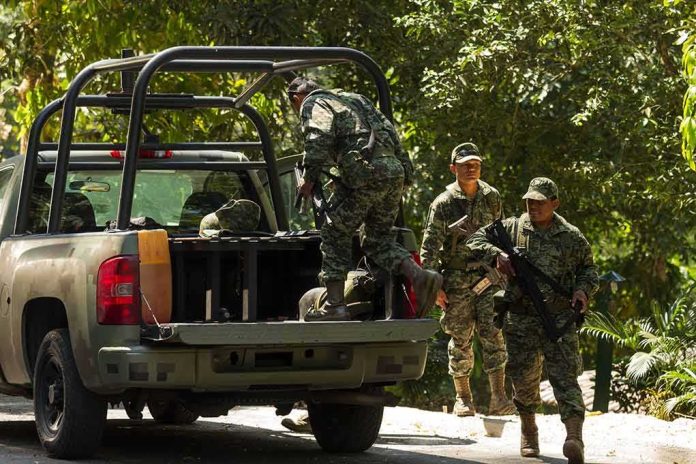
Two sources linked the deadly Congo ambush on Erik Prince’s Vectus Global team to Rwandan military forces, and the details read like a textbook military takedown.
Story Snapshot
- Sources tied the attack to Rwandan forces, citing how the ambush was run.
- The strike hit while the team moved between sites, a prime moment for a trap.
- About 20 were killed or wounded, including Congolese troops and foreign contractors.
- Former UFC fighter and Green Beret Tim Kennedy was shot three times in the leg.
An organized ambush with military fingerprints
Two people with direct knowledge told Reuters that Rwandan military forces carried out the ambush on a Vectus Global team supporting Congolese operations in South Kivu. Their account pointed to how the attack unfolded as proof: the team was hit during a move between locations, where a well-trained force can exploit weak spacing and short reaction times. The sources described a planned kill zone, heavy initial fire, and rapid withdrawal. That matches how professionals disrupt higher-value targets.
A Congolese government source said Rwandan forces tied to the March 23 Movement may have tracked a surveillance drone to find the team’s position. That tactic would fit the theater. Drone control links can leak clues. A patient enemy can follow the operator back to base or a staging point. The reported method also lines up with repeated findings by United Nations experts and Western governments that Rwanda backs or embeds with the March 23 Movement, claims Rwanda has rejected.
Casualties that signal a heavy hit
Reuters reported about 20 casualties in the ambush. The dead and wounded included at least seven Congolese personnel, a former New Zealand special forces member, and foreign contractors. Former Ultimate Fighting Championship fighter and U.S. Army Green Beret Tim Kennedy survived with three gunshot wounds to the leg. The toll reflects a coordinated strike on a mixed team that blended Congolese troops and foreign specialists. Attacks that land this hard usually combine terrain control, surprise, and fire discipline.
Vectus Global has been working with Congo on border security and advice for the national army, according to reporting that cited United Nations Group of Experts material. The package reportedly included aircraft and the hiring of former foreign military personnel. That profile would make the team a valuable target. Knocking out aviation enablers and planners can slow operations across a wide front. A strike like this has ripple effects beyond the bodies on the ground. It forces route changes, tighter signals rules, and delays that can cost the host nation.
The battlefield and the motives in plain view
Eastern Congo hosts a layered war. The Congolese army fights the March 23 Movement while international reports accuse Rwanda of backing it. Rwanda disputes those charges. United Nations reporting over several years has pointed to Rwandan support and even direct intervention at times. In that frame, a hit on a contractor team that supplies aircraft, advice, and foreign talent makes tactical sense for any force aligned with the March 23 Movement. Remove the edge, and you level the fight.
The ambush also shows the risk curve for private security outfits in hot zones. When firms advise, fly, and scout, they become high-payoff targets. They travel in small numbers. They move often. They carry key tech, like drones and radios, that can betray them. A disciplined enemy needs only one window when the convoy strings out, vehicles stall, or the drone team halts in a predictable spot. That is when a trained force strikes, then fades before help arrives.
What the facts say, and why they matter
The best-supported claims so far hang on three pegs. First, two sources with direct knowledge linked the attackers to Rwandan forces and cited the ambush design as evidence. Second, a Congolese government source said the team may have been found by tracking a drone, a method that matches the region’s evolving tactics. Third, the casualty count and the presence of foreign contractors, including Kennedy, confirm the scale and stakes of the hit. One sentence of caution: Vectus Global declined public comment in the cited reporting.
🚨 DEADLY CONGO AMBUSH
Former NZSAS operator Justin Conaglen was killed and former UFC fighter and U.S. Green Beret Tim Kennedy was shot three times in the leg during a September 17 ambush in South Kivu.
The attack on Erik Prince-linked Vectus Global forces left at least 20… pic.twitter.com/V586izNEXh
— Decode Conflict (@DecodeConflict) October 10, 2026
For policymakers who value clear lines and firm rules, this case underlines a hard truth. Proxy-infused wars blur accountability, but they do not blur the bullets. When a team that supports a sovereign government gets hit this hard, deterrence suffers if no one pays a price. American conservative instincts favor clarity: defend borders, back allies who fight extremists, and call out state actors who hide behind proxies when credible reporting points their way. Strength rises when consequences are real and quick.
Sources:
mediaite.com, yahoo.com, athlonsports.com, thebrief.news, nypost.com, x.com